Twilight Struggle Board Game Review

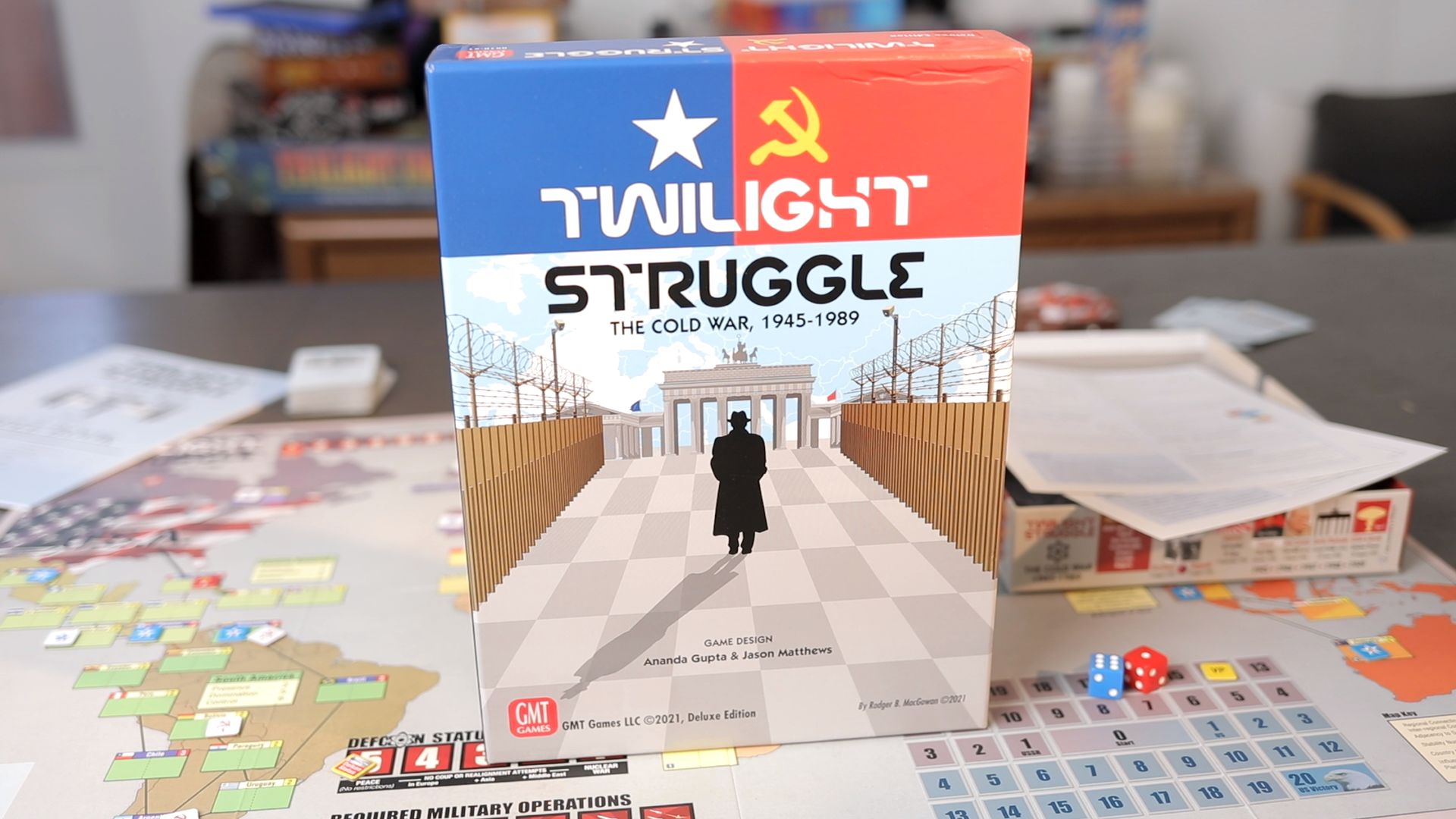
Twilight Struggle, designed by Ananda Gupta and Jason Matthews and published by GMT Games in 2005, is a card-driven war game that puts two players on opposite sides of the Cold War. One plays the USA, the other the USSR, and they spend 40+ years of history fighting for global influence without ever firing a shot at each other directly. Built for 2 players, ages 13+, with a playing time of 120 to 180 minutes, this review covers how the game plays, what comes in the box, and whether it deserves a spot on your shelf.
Twilight Struggle Overview
The theme covers the period from 1945 to 1989. Each player tries to win the Cold War by gaining influence across regions of the world, racing to space, and scoring more victory points than the opponent. The game ends in 1989 or earlier if one side triggers nuclear war or hits a 20-point lead.
Action runs through a deck of 110+ event cards drawn from real history: Marshall Plan, Vietnam, Solidarity, Cuban Missile Crisis. Each card forces a choice: use it for operations (influence, coups, realignments) or trigger the event itself.
| Specification | Detail |
|---|---|
| Designer | Ananda Gupta, Jason Matthews |
| Publisher | GMT Games |
| Year Released | 2005 |
| Players | 2 (strictly 2-player) |
| Age Range | 13+ |
| Playing Time | 120–180 minutes |
| Game Type | Strategy, Wargame, Card-Driven |
| Complexity Rating | 3.62 / 5 (BGG Weight) |
What’s in the Box: Twilight Struggle Components
The Deluxe Edition includes a mounted 22″x34″ world map showing major countries grouped into six regions. The map quality holds up well after dozens of plays and lays flat.
You get 110 event cards (Early War, Mid War, Late War sets), 67 wooden influence cubes in red and blue, two scoring markers, a DEFCON track marker, Space Race markers, two six-sided dice, and a paper score track. The cards are linen-finished and durable. The wooden cubes feel solid in hand.
Twilight Struggle Pros and Cons
Pros
- Asymmetric play: the USA and USSR have different strengths, openings, and pressure points, so each side teaches you something new.
- Every card creates a real dilemma. Holding a card that helps your opponent and having to play it anyway is one of the best tension mechanics in board gaming.
- The history feels earned. Events from JFK to Reaganomics land at unpredictable times, but always in context.
- High replay value. Card draw variance and player choice mean no two games follow the same script.
- The 20-point auto-win and DEFCON loss conditions force aggressive play instead of turtling.
Cons
- A full game can stretch past three hours, especially with two new players reading every card.
- Steep learning curve. The rules are not long, but the strategy depth takes 5–10 games to start grasping.
- Card draw can swing badly. A bad Mid War deck for the Soviet player feels rough.
- Only plays 2. No solo mode or multiplayer variant in the base box.
How to Play Twilight Struggle
Setup
Place initial influence in Eastern Europe (USSR) and Western Europe and parts of Asia (USA) per the setup chart. Shuffle the Early War deck. Set DEFCON to 5. Setup takes about 10 minutes once you know the routine.
Turn Structure
Each turn has a Headline Phase, where both players secretly play one event card simultaneously. Then come 6 or 7 Action Rounds. On each round, a player plays a card for one of four purposes: trigger an event, place influence, attempt a coup, or realign a country. The Space Race gives a fifth option for discarding tough cards.
Win Conditions
Win by hitting 20 victory points at any time, controlling Europe at the end of any turn (Europe Scoring instant win), or holding the lead after Turn 10. You lose immediately if you cause DEFCON to drop to 1 during your action.
Where to Buy Twilight Struggle
| Platform | Edition | Approximate Price |
|---|---|---|
| Satyam Stationers | Deluxe Edition (Physical) | ₹2,290 |
| Board Games India | Deluxe Edition (Physical) | ~₹5,400 |
| DLCompare (Steam Key) | Digital PC/Mac | ₹350–₹657 |
| eBay | Various Editions | Varies (Secondary Market) |
| BoardGameGeek Marketplace | Various Editions | Varies |
Twilight Struggle Game Mechanics
The core engine is card-driven gameplay. The same card that lets you place influence in South America might also trigger a bad event for you if you play it, since cards from your opponent’s “side” still fire their event when you use the operations value. That single rule generates most of the game’s hard decisions.
Area influence controls regions. To “control” a country, you need more influence than the opponent and enough total to meet the country’s stability number. Coups use dice to remove enemy influence in unstable countries. Realignment is a softer dice-based tool for contested regions.
The Space Race acts as a release valve. If a card in your hand would be disastrous to play, you can burn it on space advancement instead, picking up small bonuses and victory points along the way.
Who Should Play Twilight Struggle
This game suits two-player households or regular gaming partners who want a long, thinky game with real historical weight. Fans of chess-like depth will find more than enough planning room here. History buffs will recognize every card. If you mostly game with one other person, our two-player rankings cover lighter alternatives for the weeknights when 180 minutes feels like too much.
Skip it if your group has more than two players, if you want short evening games, or if losing to a bad card draw will ruin your night. It compares well to 1960: The Making of the President (same designers, lighter) and to Watergate (shorter, more focused). Twilight Struggle still tops our roundup of the best military board games two decades after release, so the staying power is real.
FAQ
Is Twilight Struggle good for beginners?
Not really. The rules are moderate, but understanding which cards to play, hold, or space-race takes several games. New players often lose their first 3–4 matches badly. Pair up with a patient opponent or watch a playthrough video before your first game.
How long does Twilight Struggle take to play?
A first game runs 4 hours easily. Once both players know the cards, expect 2 to 3 hours. Games can end early through a 20-point auto-win, Europe control, or DEFCON loss, which sometimes cuts a session to 90 minutes.
What’s the best player count for Twilight Struggle?
It only plays 2. There is no official solo mode or multiplayer variant in the base game. The two-player design is the whole point: one USA, one USSR. Fan-made solo rules exist online, but the official experience is strictly head-to-head.
Is Twilight Struggle worth buying?
If you have a regular two-player partner and like long strategy games with a strong theme, yes. It held the #1 spot on BoardGameGeek for years and still rates 8.2. If your gaming nights run 60–90 minutes or involve 3+ players, look elsewhere.
What games are similar to Twilight Struggle?
Try 1960: The Making of the President by the same designers, Watergate for a shorter card-driven duel, Imperial Struggle for a meatier follow-up, or 13 Days: The Cuban Missile Crisis for a 45-minute taste of the same system. If you can field seven players, Diplomacy scratches the same area-control and negotiation itch on a wider scale.
