
Diplomacy Board Game Review

Diplomacy, designed by Allan B. Calhamer and published by Avalon Hill, is a pure strategy game set in pre-World War I Europe. First released commercially in 1959, it plays 2 to 7 players (7 is the recommended count) and suits ages 12 and up. Sessions typically run 4 to 6 hours. This review covers what the game does well, how it plays, and whether it belongs on your shelf.
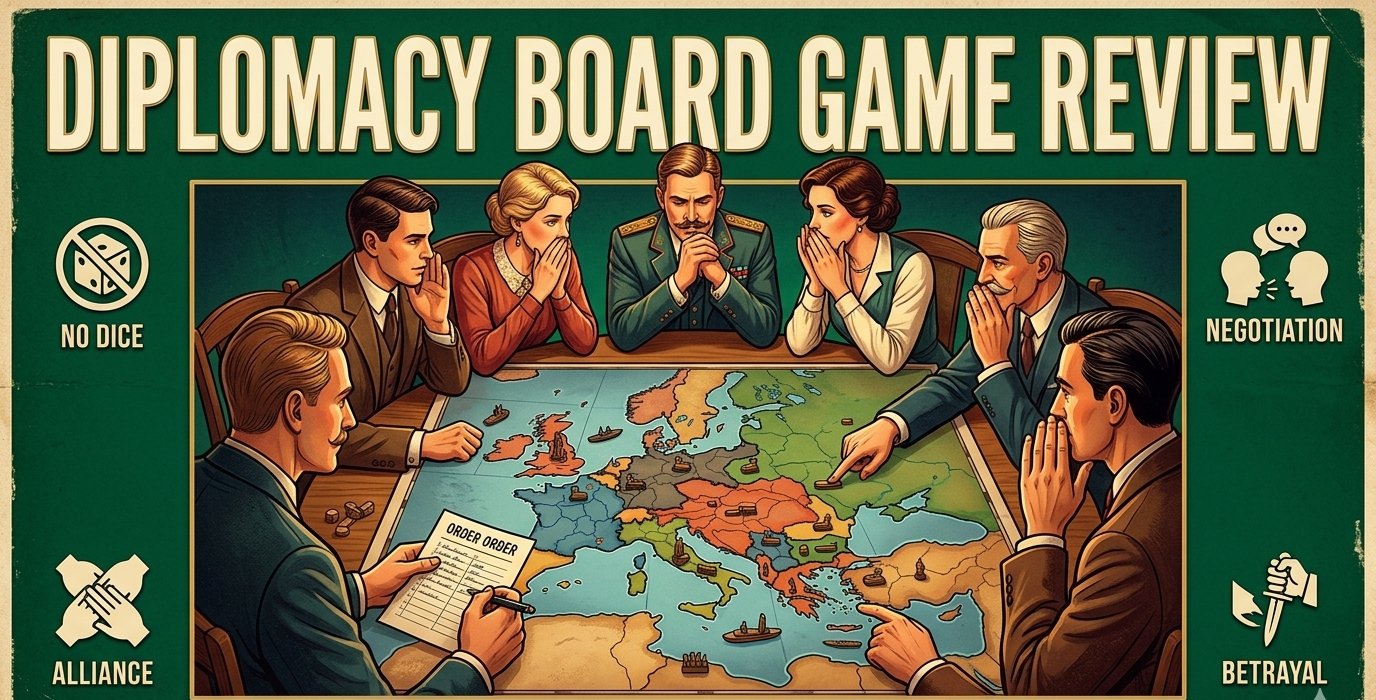
Diplomacy Board Game Overview
Each player controls one of seven European powers — England, France, Germany, Italy, Austria-Hungary, Russia, or Turkey — and attempts to capture a majority of supply centers across the map. No dice. No cards. No random elements at all. The outcome comes entirely from player negotiation and unit movement.
That absence of luck separates Diplomacy from most wargames. Winning depends on making and breaking alliances at the right time.
| Designer | Allan B. Calhamer |
|---|---|
| Publisher | Avalon Hill |
| Year Released | 1959 |
| Players | 2 – 7 (7 recommended) |
| Age Range | 12+ |
| Playing Time | 4+ hours (typically 4–6) |
| Game Type | Wargame / Negotiation / Area Movement |
| Complexity | Medium–Heavy (4–5 out of 5) |
| MSRP | $29.99 |
What’s in the Diplomacy Board Game Box
The current Avalon Hill edition includes all the components needed to run a full game. Quality is generally solid for the price point, with the board being the standout piece.
| Component | Details |
|---|---|
| Game Board | Large map of Europe divided into land and sea provinces |
| Army Units | Wooden or plastic pieces representing armies for each power |
| Fleet Units | Wooden or plastic pieces representing naval fleets |
| Supply Center Markers | Markers indicating home and neutral supply centers |
| Order Sheets | Paper sheets for players to write simultaneous orders |
| Rules Booklet | Full rulebook with adjudication guidelines |
The Avalon Hill edition has a more colorful board than the Gibsons version, though both use the same core components. The order-writing sheets are consumable, so long-term players typically substitute scratch paper or print extras.
Diplomacy Board Game Pros and Cons
Pros
- No luck — outcomes are determined entirely by player decisions and negotiation
- Deep strategic and social depth; alliances and betrayal drive every session
- Games can be paused and resumed across multiple sessions
- Low component cost relative to the gameplay depth on offer
- Each of the seven powers plays differently, giving high replayability
- Teaches real negotiation and strategic thinking, not just rulebook mechanics
Cons
- Requires exactly 7 players for the best experience — harder to fill than most games
- Sessions run 4–6 hours, which rules it out for casual game nights
- Heavy social conflict; player elimination and betrayal can cause real friction
- The learning curve is steep for newcomers without wargame experience
- Eliminated players sit out for potentially hours with nothing to do
How to Play Diplomacy Board Game
Setup begins by assigning each player one of the seven great powers. New players are generally pointed toward France or Turkey, since both have geographically compact starting positions that are more forgiving of early mistakes. Each power starts with three home supply centers and a matching number of units — a mix of armies and fleets depending on the nation.
Turn Structure
The game starts in Spring 1901 and progresses through Spring and Autumn turns each year. Every turn follows the same three phases.
In the negotiation phase, players talk privately and in groups. There is no enforced time limit in the standard rules, though many groups set 15–30 minutes. Promises mean nothing — agreements are not binding.
In the order-writing phase, all players simultaneously write orders for each of their units in secret. Units can be ordered to Move, Support another unit’s move, Support a unit holding position, or Hold.
In the resolution phase, all orders are revealed at once. The rules then adjudicate conflicts. A unit moving into an occupied province needs more support than the defending unit to succeed. Tied support results in a bounce — both units stay put.
Supply Centers and Build Phase
After the Autumn turn each year, players count how many supply centers they occupy. If a player controls more centers than they have units, they build new units in their home centers. If they control fewer, they must disband units. A player who loses all supply centers is eliminated.
Winning
The winner is the first player to control 18 of the 34 supply centers on the board. If no player reaches 18 by a predetermined end date, the game can end in a draw among surviving players.
Diplomacy Board Game Mechanics
The simultaneous order-writing system is what makes Diplomacy work. Every player commits orders before anyone else reveals theirs, which means every move involves a read of what other players are planning. Miscommunicate, and an allied support order falls apart.
The support mechanic is the core tactical element. A unit that moves alone can be bounced; a unit with one support behind it can dislodge a lone defender. Two supports beat one. Chaining support lines across multiple turns is how players break through entrenched positions.
Because units can only move one province per turn and the map is deliberately crowded, most territories require cooperation to hold or capture. That interdependence is what forces negotiation. You cannot win without allies, and you cannot win without eventually betraying them.
There is no combat roll, no resource track, no technology tree. The entire mechanical structure pushes players toward the table rather than toward their own board state. This is closer to a negotiation game than a traditional wargame despite its military theme.
Who Should Play Diplomacy Board Game
Diplomacy is a good fit for players who enjoy games where reading people matters as much as reading the board. If you like the social manipulation in games like Cosmic Encounter or the hidden loyalty tension in traitor games, Diplomacy scratches that itch at a deeper level.
It works best in a group that can commit to a long session — or agrees upfront to continue across multiple evenings. Players who want to start and finish in two hours will be frustrated.
It is not a beginner game. Players without some strategy game experience will struggle to keep up with players who understand the support system and map geometry. France and Turkey are more accessible starting positions, but understanding why requires knowing the map.
Skip it if your group dislikes direct conflict, cannot reliably field seven players, or has members who take betrayal personally. The game’s social friction is intentional — it is the point — but it can end friendships if the group isn’t on board with that dynamic.
Where to Buy Diplomacy Board Game
| Retailer | Format | Notes |
|---|---|---|
| Amazon | New & Used | Usually the lowest price; Prime shipping available |
| eBay | New & Used | Good for older or out-of-print editions |
| Miniature Market | New | Specialist board game retailer; frequent sales |
| CoolStuffInc | New | Competitive pricing, large board game selection |
| Local Game Store | New | Supports local retail; staff can advise on editions |
FAQ
Is Diplomacy board game good for beginners?
Not as a first strategy game. The rules themselves are relatively straightforward, but the negotiation and tactical support system take time to understand. Players new to wargames should start with something shorter and more forgiving, then work up to Diplomacy once they’re comfortable with area-movement strategy games.
How long does Diplomacy board game take to play?
Expect 4 to 6 hours for a full game with experienced players. First-time groups often run longer. Many players split sessions across two evenings. There is no hard rule against pausing — the board state holds fine between sessions, which makes multi-day play a practical option.
What’s the best player count for Diplomacy board game?
Seven players. The game was designed around seven powers, and every power has a strategic purpose in that configuration. With fewer players, some nations are simply removed, which changes the map balance. The game technically supports 2 to 7, but anything under 5 feels significantly different from what the designer intended.
Is Diplomacy board game worth buying?
At around $30, yes — if you have the right group. The game offers strategic depth that most titles at ten times the price don’t match. If you can reliably get 6 or 7 committed players together for a long session, it is one of the most rewarding games available. For casual groups, the commitment required makes it a harder sell.
What games are similar to Diplomacy board game?
Twilight Imperium offers comparable negotiation and political maneuvering in a space setting with more mechanical complexity. Risk has a similar area-control structure but adds dice, making it more luck-driven. Cosmic Encounter captures the alliance and betrayal dynamic in a shorter format. For a closer match to Diplomacy’s pure negotiation, Machiavelli is the most direct equivalent.
