Rumble Rummy Board Game Review

Rumble Rummy is a 1985 board-and-card hybrid from International Games, the same company behind UNO. It seats 2 to 4 players aged 10 and up, with games running around 30 minutes. The pitch on the box sums it up: “The strategy of a board game with the pace of a card game.” In practice, Rumble Rummy blends roll-and-move with set collection, asking you to pick up face-up cards from the board and assemble a seven-card rummy hand. This review covers how it plays, what you get in the box, and whether it holds up four decades later.
Rumble Rummy Overview
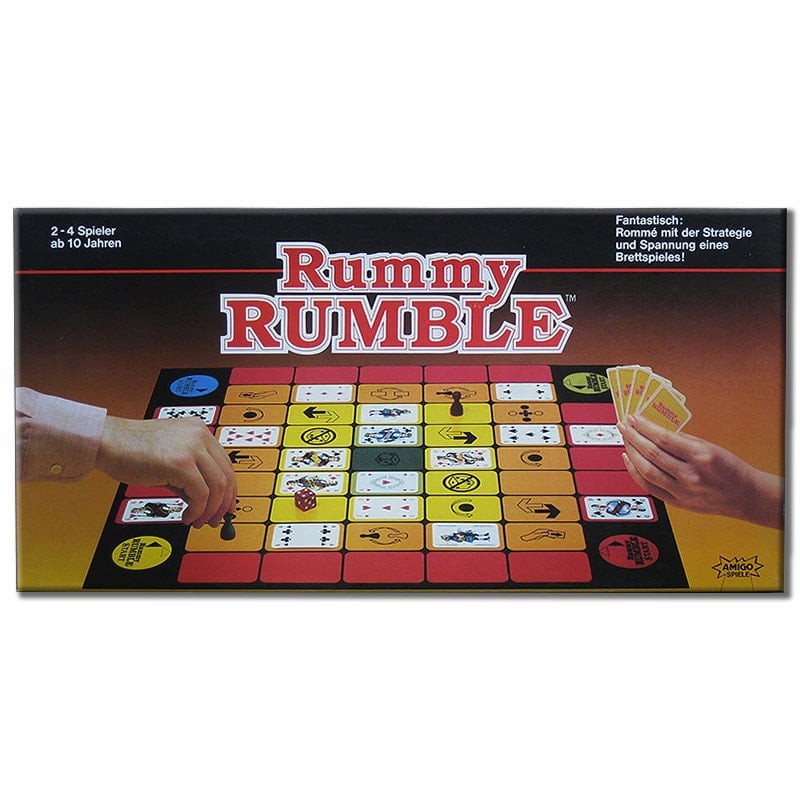
Rumble Rummy drops a standard deck of playing cards face-up onto a game board. On your turn, you roll a die, move your pawn, and take the card sitting on the space you land on. Your goal is to collect seven consecutive cards of the same suit, forming a rummy hand. The first player to do so wins the game outright.
The UNO connection isn’t just branding. Some board spaces carry special effects borrowed from UNO’s action cards, adding a layer of disruption that can rearrange your plans mid-game.
| Detail | Info |
|---|---|
| Designer | Uncredited |
| Publisher | International Games, AMIGO, Gibsons |
| Year Released | 1985 |
| Players | 2–4 |
| Age Range | 10+ |
| Playing Time | 30 minutes |
| Game Type | Card Game / Dice / Set Collection |
| Complexity Rating | 1.50 / 5 (BGG) |
What’s in the Rumble Rummy Box
Rumble Rummy was produced in several editions across Europe and the US, so exact component quality varies by version. The Finnish/Swedish edition, for example, had cards manufactured in Belgium and the rest of the game produced in West Germany.
| Component | Details |
|---|---|
| Game Board | Fold-out board with card placement spaces and special action spaces |
| Card Deck | Standard playing cards in a small tuck box, placed face-up on board spaces |
| Die | Single six-sided die for movement |
| Player Pawns | Colored markers (one per player, up to four) |
| Rulebook | Short instruction sheet |
The components are typical of mid-1980s family games. The board is functional, the cards are standard weight, and the pawns are basic plastic pieces. Nothing here feels premium, but everything does the job it needs to do. Copies still turn up at thrift stores and online resellers in decent condition.
Rumble Rummy Pros and Cons
Pros
- Easy to learn — the rules fit on a single page and most people grasp them in under two minutes.
- Quick play sessions at around 30 minutes keep the game from overstaying its welcome.
- The open information of face-up cards lets you plan ahead and choose which cards to target.
- Good entry point for younger players who are learning about sequences and suits.
- The UNO-style disruption cards add a bit of surprise to an otherwise predictable structure.
Cons
- Roll-and-move means the die controls most of your decisions. You often can’t reach the card you actually need.
- Limited player interaction — you’re mostly building your own hand without much direct competition until someone grabs a card you wanted.
- The 4.9 rating on BoardGameGeek reflects a general consensus that the game feels dated and thin by modern standards.
- Only available secondhand, so component condition varies wildly from copy to copy.
- Two-player games can feel slow since fewer cards get claimed each round.
How to Play Rumble Rummy
Setup
Shuffle all the cards and place one card face-up on each space of the game board. Each player picks a colored pawn and places it on the starting space. Choose a first player by any method you prefer.
Turn Structure
On your turn, roll the die and move your pawn that many spaces in any direction around the board. Pick up the card from the space you land on and add it to your hand. If you land on a special action space, follow its instructions — these can force you to skip a turn, swap cards, reverse play order, or trigger other UNO-style effects.
Building Your Hand
You’re collecting cards to form a seven-card rummy hand. A valid rummy hand in this game is a sequence of seven consecutive cards in the same suit (for example, 3 through 9 of hearts). Since all cards on the board are face-up, you can see exactly what’s available and plan your route accordingly.
Winning Rumble Rummy
The first player to assemble a complete seven-card sequence in one suit declares their hand and wins. There’s no scoring system — it’s a single-round, first-to-finish race.
Where to Buy Rumble Rummy
Rumble Rummy has been out of print for decades. Your best bet is secondhand marketplaces. Expect to pay anywhere from $10 to $25 depending on condition.
| Platform | Notes |
|---|---|
| eBay | Most common source — both sealed and used copies appear regularly |
| BoardGameGeek Market | Occasionally listed by collectors in the BGG marketplace |
| Thrift Stores | Frequently spotted at Goodwill and similar shops in the US |
| Etsy | Vintage game sellers sometimes stock copies |
| Facebook Marketplace | Local sellers sometimes list copies at low prices |
Rumble Rummy Game Mechanics
Rumble Rummy runs on two core mechanisms: dice rolling and set collection. The die determines movement, and the card pickup is the collection layer. What makes the game slightly different from a pure rummy card game is the spatial element — you’re navigating a physical board to get specific cards rather than drawing from a shuffled deck.
Because every card sits face-up on the board, the game has zero hidden information at setup. You can map out which cards you need and roughly how many turns it might take to reach them. The catch is that the die rarely cooperates, and other players might grab a card before you get there.
The special action spaces borrow from UNO’s playbook. Skip, reverse, and card-swap effects break up what would otherwise be a very straightforward collection exercise. These moments of disruption are where most of the table talk happens.
Who Should Play Rumble Rummy?
Rumble Rummy works best as a casual family game for people who enjoy traditional card games and don’t mind a heavy dose of luck. If your household already plays UNO or standard rummy, this game sits right in that territory. Kids who are learning number sequences and suit recognition can get some value out of the open-information board.
This is not a game for hobby gamers looking for depth. The BGG complexity rating of 1.50 out of 5 reflects the reality — there isn’t much to think about beyond “which card do I want” and “can the die get me there.” If you’re after a family board game with more decisions, modern options like Ticket to Ride or Splendor give you similar accessibility with far more strategy.
Collectors of vintage board games from the 1980s may find Rumble Rummy worth tracking down for the shelf. The UNO connection gives it some historical curiosity, and complete copies aren’t hard to find at reasonable prices.
FAQ
Is Rumble Rummy good for beginners?
Yes. The rules take about two minutes to explain and the gameplay is straightforward. Roll the die, move your pawn, pick up a card. Anyone who can count to thirteen and recognize card suits can play without trouble. It works well as a first board game for kids aged 8 and up.
How long does Rumble Rummy take to play?
Most games wrap up in about 30 minutes. Setup adds another 5 minutes since you need to place all cards face-up on the board spaces. Shorter games are possible if someone gets lucky with their die rolls and card availability early on.
What is the best player count for Rumble Rummy?
Three or four players is the sweet spot. With two players, the board stays crowded with unclaimed cards for too long and turns feel slow. At four players, cards disappear faster and there’s more competition for the sequences you need, which adds some tension to each roll.
Is Rumble Rummy worth buying?
At $10 to $15 secondhand, it can be a decent pickup for families with younger kids or collectors of 1980s games. It won’t replace modern family games in terms of replayability or decision-making, but it fills 30 minutes pleasantly enough. Don’t expect deep strategy.
What games are similar to Rumble Rummy?
Rummikub uses similar set-building mechanics with tiles instead of cards. For the roll-and-move plus card collection angle, games like Sorry and Trouble share the luck-driven movement, though they lack the rummy hand-building goal. Modern set collection games like Splendor or Jaipur offer more strategic depth.
