
Forest Shuffle Board Game Review

Forest Shuffle, designed by Kosch and published by Lookout Games in 2023, is a card game about building a forest full of trees, animals, plants, and mushrooms. It plays 2–5 players, takes around 40–60 minutes, and is suitable for ages 10 and up. With a complexity rating of 2.21 out of 5 on BoardGameGeek, it sits in a sweet spot between casual and mid-weight strategy. This review covers the gameplay, components, and who this game works best for.
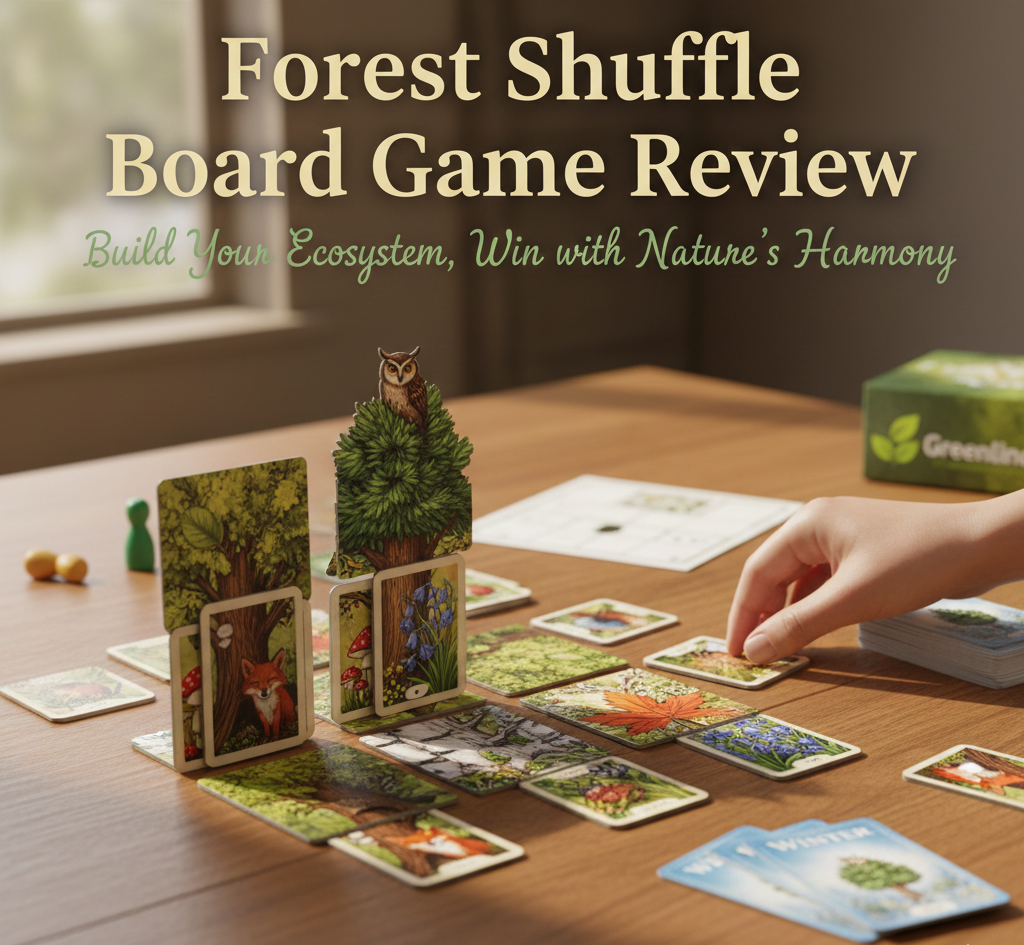
Forest Shuffle Overview
Players compete to build the most valuable woodland by planting trees and attracting species to them. Each card shows either a tree or a pair of forest dwellers — animals, plants, or mushrooms — split across halves of the card. You tuck dweller cards under your trees to score points based on how your species interact with each other.
Three winter cards are buried in the bottom third of the deck. When the third one appears, the game ends immediately. No warning, no final round. The player with the highest score wins.
| Designer | Kosch |
|---|---|
| Artist | Toni Llobet, Judit Piella |
| Publisher | Lookout Games |
| Year Released | 2023 |
| Players | 2–5 |
| Age Range | 10+ |
| Playing Time | 40–60 minutes |
| Game Type | Card Game, Family/Strategy |
| Complexity Rating | 2.21 / 5 |
What’s in the Forest Shuffle Box
The game comes with 180 cards: 66 tree cards across eight species, 48 top/bottom split cards, 44 left/right split cards, 3 winter cards, 5 cave cards, 14 reference cards, a small clearing game board, and a scorepad.
Card stock is solid, and the artwork by Toni Llobet and Judit Piella is a genuine highlight. The illustrations are detailed and naturalistic — these look like wildlife field guide drawings rather than generic fantasy art. Lookout Games also produces this under their “Greenline” label, meaning FSC-certified paper and zero plastic in the packaging.
Forest Shuffle Pros and Cons
Pros
- Beautiful, naturalistic artwork that makes the table look great
- Simple turn structure — draw two cards or play one — keeps the pace brisk
- The multi-use card system creates tough, interesting decisions every turn
- Eco-friendly production with no plastic at all
- Scales well from 2 to 5 players without major downtime
- Easy to teach to new or casual players in under 10 minutes
Cons
- The abrupt winter ending can feel punishing if you’re caught mid-plan
- At higher player counts, the clearing flushes often, reducing card availability
- Some card text requires a reference sheet, which slows early plays
- Luck of the draw can swing outcomes, especially in two-player games
- Scoring at the end takes a while and can be fiddly
How to Play Forest Shuffle
Setup
Place the clearing board centrally. Remove cards based on player count — 30 cards for 2 players, 20 for 3, 10 for 4, all cards for 5. Separate the three winter cards. Divide the remaining deck into three roughly equal stacks. Shuffle two winter cards into one stack, place the third winter card on top of that stack, then pile the other two stacks on top. Deal six cards to each player. If you get no trees at all, you may discard and redraw once.
Turn Structure
On your turn, pick one of two actions. You can draw two cards, taking each from either the top of the deck or the face-up clearing. Or you can play a single card from your hand by discarding other cards equal to its cost into the clearing.
Trees go directly in front of you. Split cards tuck under a tree on the matching open side — top, bottom, left, or right. Each tree has room for one card on each of its four sides. You can also play any card face-down as a tree sapling, which costs nothing but has no species and scores no points by itself.
When you play a tree, flip the top deck card into the clearing. If the clearing reaches 10 or more cards at the end of your turn, all those cards get removed from the game entirely.
Effects and Bonuses
Many cards have effects that trigger when played. Some are instant — draw extra cards, play another card, take an extra turn. Mushroom cards often grant permanent effects that last for the rest of the game. There’s also a color-matching bonus: if every card you used to pay for a card shares the same tree symbol as the played card, you get an additional bonus.
Game End and Scoring
The third winter card ends the game on the spot. You don’t finish your turn. Each visible card in your forest scores based on its own condition — some reward collecting specific tree species, others count pairs of animals, and some score based on what’s adjacent. Tally everything, add cave bonuses, and the highest score wins. Ties are shared.
Forest Shuffle Game Mechanics
The core mechanic here is hand management. Every card in your hand is both a potential play and potential fuel to pay for other cards. That tension — do I keep this nice squirrel or burn it to afford the oak tree? — runs through every turn.
The layering system, where dwellers tuck under trees on specific sides, adds a spatial puzzle. You need to plan which trees to plant early so you have open slots for the right orientation of dweller cards later. The clearing acts as a shared market, and timing when to draw from it versus the blind deck is a constant consideration.
Set collection ties everything together at scoring. Birds might reward variety, while certain plants want you to go deep on one tree species. Reading these scoring conditions early and building toward them is what separates a good Forest Shuffle player from a scattered one.
Who Should Play Forest Shuffle
Forest Shuffle works well as a family game for groups with older kids (10+) and as a weeknight game for regular board gamers who want something lighter than Ark Nova but meatier than Sushi Go. If you enjoy games like Wingspan or other card-driven tableau builders, you’ll feel at home here.
It’s a good fit for 2–4 players. At five, the clearing resets more often and turns feel a bit less controlled. Two-player games are tighter and more strategic since the card pool is smaller. Groups that dislike luck-heavy card draws or abrupt game endings may find the winter mechanism frustrating.
Three expansions are already available — Alpine, Woodland Edge, and Exploration — plus a growing list of promo cards tied to specific events and regions. There are also two standalone reimplementations: Dartmoor and Smoky Mountains.
Where to Buy Forest Shuffle
| Retailer | Notes |
|---|---|
| Amazon | Wide availability, often with Prime shipping |
| BoardGameBliss | Canadian retailer with competitive pricing |
| Cardhaus Games | US-based board game retailer |
| Game Nerdz | Frequent sales and deals |
| Noble Knight Games | New and used copies available |
| Philibert | European retailer |
| Zatu Games | UK-based with fast shipping |
| Meeples Corner | UK retailer, good for expansions too |
FAQ
Is Forest Shuffle good for beginners?
Yes. The turn structure is simple — draw two cards or play one — and the rulebook is short. New players may need the reference cards for scoring conditions during their first game, but most people grasp the flow within a few rounds. It’s a solid pick for anyone new to modern card games.
How long does Forest Shuffle take to play?
Most games run 40–60 minutes, including scoring. Setup takes about 5 minutes. At two players, games tend to run closer to 40 minutes. With four or five, expect the full hour, partly because scoring at the end requires checking each card’s condition individually.
What is the best player count for Forest Shuffle?
Three or four players is the sweet spot. Two works well for a tighter, more strategic experience. At five, the clearing flushes frequently and the deck runs out faster, which reduces your ability to plan ahead. The game adjusts card counts per player to balance this.
Is Forest Shuffle worth buying?
If you like card games with a nature theme and light-to-medium strategy, yes. It won the 2024 Deutscher Spiele Preis and picked up a Kennerspiel des Jahres recommendation. The artwork alone is worth the purchase for many players. The three available expansions add replay value without bloating the base game.
What games are similar to Forest Shuffle?
Wingspan shares the nature theme and tableau-building feel, though it’s heavier. Everdell has a similar woodland aesthetic with worker placement added. For something lighter and faster, Sushi Go uses a comparable pick-and-pass card drafting style. Ark Nova is the big step up if Forest Shuffle leaves you wanting more complexity.
