
Earth Board Game Review

Earth, designed by Maxime Tardif and published by Inside Up Games in 2023, is a tableau-building engine game themed around the natural world. It won the 2023 Dice Tower Game of the Year and has earned a strong following among fans of card-based strategy games. The game supports 1–5 players, is aimed at ages 13 and up, and wraps up in about 45–90 minutes. This review covers what you get in the box, how the game plays, and who will get the most out of it.
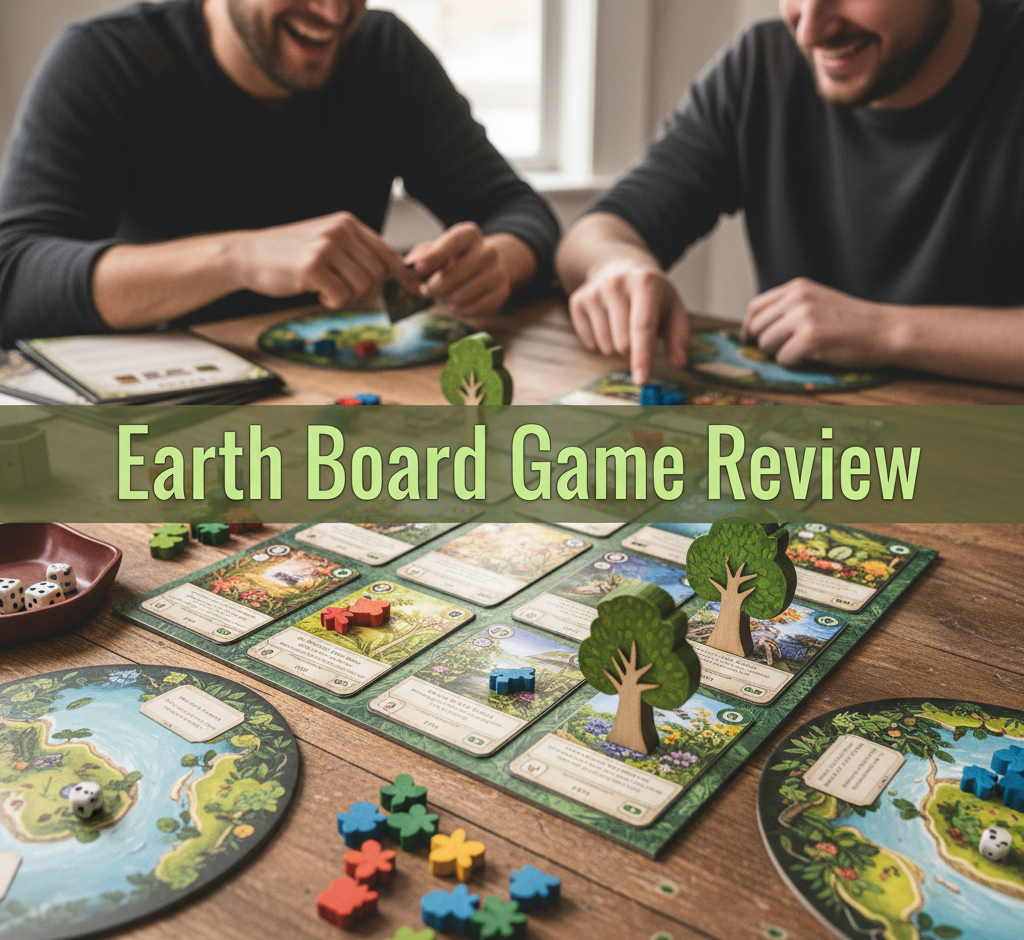
Earth Board Game Overview
In Earth, players build a 4×4 grid of cards representing flora, terrain, and natural events. Each card you place feeds into an engine that grows more powerful as the game goes on. Your goal is to score the most points through a mix of card combos, resource management, and completing public and private objectives.
The game uses a shared-action system. On your turn, you pick one of four color-coded actions. You get the full benefit, while everyone else at the table gets a smaller version of the same action. After that, all players activate every card in their tableau that matches the action’s color. This keeps everybody involved on every single turn — there’s almost no downtime.
| Specification | Details |
|---|---|
| Designer | Maxime Tardif |
| Publisher | Inside Up Games |
| Year Released | 2023 |
| Players | 1–5 |
| Age Range | 13+ |
| Playing Time | 45–90 minutes |
| Game Type | Tableau Building, Engine Building, Card Game |
| Complexity Rating | 2.91 / 5 (Medium) |
What’s in the Earth Board Game Box
Earth comes packed with a lot of components. The card pool alone is massive, with over 280 unique Earth cards in the base game. Material quality is solid throughout — the cardboard tokens are thick, and the wooden pieces are well-finished.
| Component | Quantity |
|---|---|
| Earth Cards (Flora, Terrain, Event) | 283 |
| Ecosystem Cards (double-sided) | 32 |
| Fauna Cards (double-sided) | 23 |
| Island Cards (double-sided) | 10 |
| Climate Cards (double-sided) | 10 |
| Sprout Cubes (wood) | 145 |
| Soil Tokens (cardboard) | 105 |
| Trunk Pieces (wood) | 88 |
| Canopy Pieces (wood) | 74 |
| Leaf Tokens | 25 |
| Player Boards (double-sided) | 5 |
| Solo Mode Cards | 6 |
| Fauna Board, Score Pad, Rulebook | 1 each |
The double-sided island, climate, ecosystem, and fauna cards are a nice touch. They effectively double the setup variety without adding extra bulk to the box. Art across the cards depicts real plants and animals with clean, naturalistic illustrations by M81 Studio, Conor McGoey, Yulia Sozonik, and Kenneth Spond.
Earth Board Game Pros and Cons
Pros
- The shared-action system keeps all players engaged on every turn, which cuts downtime almost entirely.
- Over 25,000 possible starting setups give the game very high replay value.
- Card combos are satisfying to build and trigger, especially in later rounds when your tableau is running at full speed.
- Solo, team, and competitive modes included in the box.
- Games move faster than you’d expect for this level of depth — most sessions finish inside 75 minutes.
- The nature theme and card art are well done without being overbearing.
Cons
- Card draw luck can leave you without the tags or synergies you need, especially early on.
- With 280+ unique cards, first-time players face a steep learning curve just reading and understanding cards.
- Player interaction is mostly indirect — if you want head-to-head conflict, this isn’t the game for that.
- The simultaneous card activation step can slow down with newer players who need time to process their tableau.
- Moderate in-game text means the language dependency is higher than some other strategy games.
How to Play Earth Board Game
Setup
Each player receives a player board, then draws an island card, a climate card, and an ecosystem card. All three are double-sided, so you pick which side to use. This combination gives you starting resources, a special ability, and a private scoring goal. You also receive a starting hand of cards and a personal fauna card that sets another scoring target.
Place the fauna board in the center of the table with its shared objectives visible to all players. Shuffle the Earth card deck and set out the draw area. That’s it — setup takes roughly 10 minutes once everyone knows what they’re doing.
Turn Structure
On your turn, you choose one of four actions, each tied to a color:
- Green (Planting) — Place cards into your 4×4 tableau and draw cards.
- Red (Composting) — Gain soil and compost cards from your hand for future points.
- Blue (Watering) — Add sprout tokens to your plant cards and collect soil.
- Yellow (Growing) — Draw cards and add growth (trunk/canopy) to plant cards.
You take the full action. Every other player takes a weaker version of it. Then, all players simultaneously activate any cards in their tableau matching that action’s color. Early in the game, this activation step resolves quickly. By mid-game, chains of effects start firing in sequence and the engine really starts producing.
End Game and Scoring
The game ends when any player fills their 4×4 tableau (16 cards). That player earns a completion bonus, and everyone finishes out the round. Points come from card abilities, sprouts, growth tokens, compost, completed fauna objectives, ecosystem bonuses, and public goals on the fauna board. The player with the highest total wins.
Earth Board Game Mechanics
Earth blends several mechanisms that work well together. The core is tableau building — you’re constructing a personal 4×4 grid of cards that forms your engine. Each card you add can trigger effects when its color is activated, and many cards have conditional bonuses based on what’s already in your tableau or what resources you’ve collected.
The action selection system borrows from games like Race for the Galaxy and Terraforming Mars: Ares Expedition. Picking an action helps everyone, but helps you more. This creates an interesting tension: do you take the action you need most, or do you avoid giving opponents something they clearly want?
Hand management matters quite a bit. You’ll draw a lot of cards over the course of a game, but you can only play so many. Unused cards can go to compost (your discard pile, which scores points), so nothing is truly wasted. The follow mechanism ensures that even on other players’ turns, you’re making decisions about which cards to activate and how to spend the resources they generate.
Pattern building also comes into play. Some cards score based on adjacency or on having specific card types in certain rows or columns of your tableau. This adds a spatial puzzle element on top of the engine-building layer.
Who Should Play Earth Board Game
Earth fits a wide range of players, but it works best for people who enjoy building card engines and watching combos develop over time. If you like Wingspan, Terraforming Mars, or Ark Nova, you’ll find a lot to enjoy here. Earth is lighter than Ark Nova but heavier than Wingspan, sitting comfortably in the medium-weight category.
The game works well at all player counts from 1 to 5. Solo mode uses a simple AI opponent, and the simultaneous action system means adding more players doesn’t drastically increase game length. It’s a strong pick for groups of three or four.
You might want to skip Earth if you prefer direct confrontation between players, or if large card pools with lots of text feel overwhelming. The first game or two can feel information-heavy as you learn what the icons and abilities mean. After that initial hump, turns flow quickly.
Where to Buy Earth Board Game
Earth is widely available through major retailers and game stores.
| Retailer | Link |
|---|---|
| Amazon | Buy on Amazon |
| Walmart | Buy on Walmart |
| Noble Knight Games | Buy on Noble Knight |
| Inside Up Games (Publisher) | Buy Direct |
| BoardGameGeek Market | Browse on BGG |
| eBay | Browse on eBay |
The Earth: Abundance expansion adds a sixth player board, new “seed” resource, and 70+ new cards. It’s worth looking into once you’ve gotten several plays of the base game under your belt.
FAQ
Is Earth Board Game good for beginners?
Earth is medium-weight with a complexity rating of 2.91 out of 5. The core rules are straightforward — pick an action, activate matching cards — but the large card pool means first-time players need a game or two to learn the icons and common combos. It’s approachable for anyone with some board game experience.
How long does Earth Board Game take to play?
Most games finish in 60–75 minutes, though your first session might run closer to 90 minutes as players read cards more carefully. The simultaneous action system keeps things moving even at higher player counts. Setup takes about 10 minutes once you know the process.
What is the best player count for Earth?
Earth plays well at all counts from 1 to 5. Three and four players hit a sweet spot where you get enough variety in action choices without the game running too long. Solo mode is solid and uses a simple automated opponent. Two-player games work fine but can feel slightly less dynamic.
Is the Earth Board Game worth buying?
If you enjoy engine-building card games, Earth delivers a lot of value. Over 280 unique cards, 25,000+ starting setups, and three play modes (solo, competitive, team) give it strong legs. It won multiple 2023 Game of the Year awards for good reason. The price is reasonable for what you get in the box.
What games are similar to Earth?
Earth shares DNA with Wingspan (nature theme, engine building), Terraforming Mars: Ares Expedition (action selection, tableau building), and Ark Nova (card-driven strategy with animal themes). It’s lighter than Ark Nova, slightly heavier than Wingspan, and faster than all three. Race for the Galaxy fans will also see familiar patterns in the follow mechanism.
