
Codenames Board Game Review

Codenames is a team word game by Vlaada Chvátil, published by Czech Games Edition in 2015. Two spymasters give one-word clues to point their teams at the right agents in a 5×5 grid of words. It plays 2 to 8 players, ages 10 and up, in about 15 minutes, and it won the Spiel des Jahres in 2016. This review covers the components, rules, mechanics and the groups it suits.
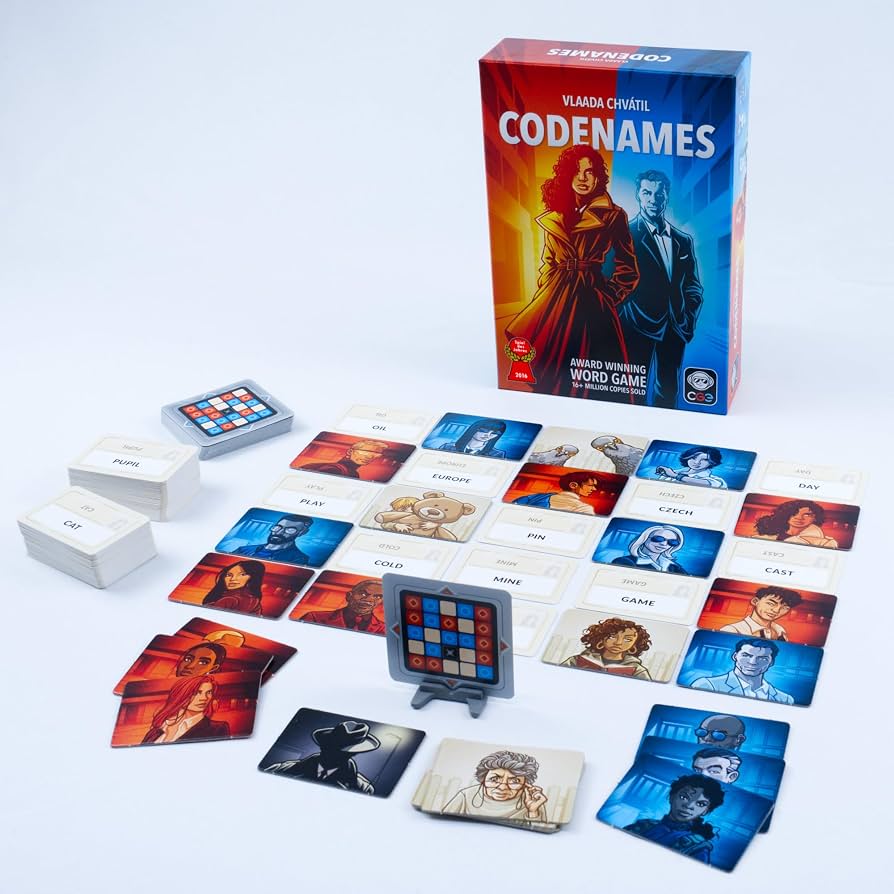
Codenames Overview
Twenty-five word cards sit face up on the table. One team’s agents hide among them, along with the other team’s agents, seven bystanders and a single assassin.
Only the two spymasters know which is which. They take turns giving a clue word and a number, and their teammates touch cards to make contact.
| Designer | Vlaada Chvátil |
|---|---|
| Artists | Vlaada Chvátil, Stéphane Gantiez, Dávid Jablonovský, Tomáš Kučerovský |
| Publisher | Czech Games Edition |
| Year Released | 2015 |
| Players | 2 to 8, best with 4 or more |
| Age Range | 10+ |
| Playing Time | 15 minutes |
| Game Type | Party, word game, deduction, team-based |
| Complexity Rating | 1.25 / 5 (BoardGameGeek weight) |
What’s in the Codenames Box
The box is small and the card stock is sturdy. Word cards take a beating over hundreds of plays and hold up well.
| Component | Count | Notes |
|---|---|---|
| Word cards | 200 | Double-sided, 400 codenames in total |
| Key cards | 40 | Double-sided grids showing the secret layout |
| Agent cards | 16 | 8 red, 8 blue |
| Double agent card | 1 | Red on one side, blue on the other, for the starting team |
| Innocent bystander cards | 7 | Beige, they end your turn |
| Assassin card | 1 | Black, touch it and your team loses |
| Card stand | 1 | Props the key card up between the spymasters |
| Sand timer | 1 | Optional, for teams that stall |
The art keeps a faded spy-file look, and the tiny illustrations on each word card give clue-givers a visual hook.
Codenames Pros and Cons
What works:
- Rules teach in three minutes, which makes it one of the easiest party board games to drop on a table of strangers.
- 400 words and 40 double-sided key cards mean the grid almost never repeats.
- Player count stretches from 2 to 8 without changing the rules.
- Games run 15 minutes, so a loss stings for about 30 seconds before the rematch.
- The assassin creates real tension on every ambiguous clue.
What does not:
- One-word clues punish players who think in phrases, and the restriction frustrates some new spymasters.
- Operatives with nothing to say can coast while a loud teammate guesses for everyone.
- Clue quality depends on shared vocabulary, so mixed-language groups struggle.
- The base box has no solo mode. That takes Codenames: Duet.
How to Play Codenames
Codenames Setup
Deal 25 word cards into a 5×5 grid. Split into two teams, red and blue, and pick one spymaster per side.
The spymasters sit together, slide a key card into the stand and look at it. The key shows which squares belong to red, blue, the bystanders and the assassin. Setup takes about two minutes.
Codenames Turn Structure
The starting team has nine agents to find, the other team eight. The spymaster says one word and one number, nothing else.
Say the grid holds PIRATE, BANK and TOOTH. A spymaster wanting all three might say “gold, three” and hope nobody reaches for RING instead.
Teammates touch a card. A correct agent card goes on top and they may keep guessing, up to the stated number plus one bonus guess. A bystander ends the turn, an enemy agent ends the turn and helps the other side, and the assassin ends the game.
Codenames Clue Rules
Clues must relate to meaning. No rhymes, no letter counts, no pointing at the board. A clue cannot use a word visible in the grid, and compound words are ruled out while they stay visible.
How to Win Codenames
The first team to cover all of its agents wins. A team that touches the assassin loses at once. Most games end in four to six rounds.
Where to Buy Codenames
| Platform | Edition | Typical Price |
|---|---|---|
| Local game stores | Physical, MSRP | Around $20 |
| Amazon | Physical | $15 to $22 |
| Target and Walmart | Physical | Around $20, frequent discounts |
| Czech Games Edition webstore | Physical, including XXL | Varies by region |
| Codenames app (iOS, Android) | Digital key generator | Free |
Codenames Game Mechanics
The core mechanism is clue-giving under a hard communication limit. One word and one number carry everything the spymaster knows.
That limit does the design work. A clue for four words is efficient and risky, while a safe clue for one wastes a turn your opponent will not waste.
Past clues stay on the table as evidence. When “gold, three” produced two hits last turn, the third card is still sitting there waiting.
Negative association matters just as much. Good spymasters pick clues that avoid the assassin square, which often means rejecting the obvious word and settling for two agents instead of four. Among word board games, few punish a sloppy association this hard.
Who Should Play Codenames
Codenames fits mixed groups: gamers, relatives who never play anything, coworkers at a lunch table. The 10+ rating holds if an adult takes the spymaster seat.
Four to six players is the sweet spot. Two operatives per team keeps discussion useful without turning the table into a debate club.
Two-player and three-player games use a cooperative variant with a countdown, though Codenames: Duet handles small counts far better.
Skip it if your group wants longer clues or deeper competition. Decrypto covers that ground, and The Chameleon suits players who prefer bluffing over deduction.
FAQ
Is Codenames good for beginners?
Yes. New players learn the rules in about three minutes and can play as operatives right away. The spymaster role is harder and worth handing to someone experienced for the first game. Reading the clue rules aloud once prevents most disputes later.
What is the best player count for Codenames?
Four to six players works best. Two operatives per team gives real discussion without long delays. At seven or eight the table gets loud and quieter players stop contributing. Two and three players need the cooperative variant or Codenames: Duet.
How long does Codenames take to play?
Around 15 minutes per game, plus two minutes of setup. A game ends when one team covers all its agents or somebody touches the assassin. Groups rarely stop at one, so plan for three or four games in an hour.
Does Codenames have expansions?
Codenames: Deep Undercover, Duet, Disney Family Edition, Harry Potter and Marvel all exist as standalone versions rather than expansions. Codenames: Duet cards mix with the base game. Codenames XXL is the same game in oversized format for large rooms.
What games are similar to Codenames?
Decrypto uses the same clue-giving core with longer clues and more competition. Just One and Letter Jam run cooperative. Wavelength trades words for a dial. For image-led alternatives, look at a cooperative deduction board game instead.
