
Chameleon Board Game Review

The Chameleon is a social deduction word game from designer Rikki Tahta, published by Big Potato Games in 2017. One player has no idea what the secret word is and must fake their way through a round of one-word answers. It plays 3 to 8 players, ages 14 and up, in about 15 minutes. This review covers the components, rules, mechanics and the groups it fits.
The Chameleon Overview
Every round hides one player among the group. The Chameleon does not know the secret word, and everyone else does.
The group wants to catch the Chameleon. The Chameleon wants to blend in and work out the word from the clues.
| Designer | Rikki Tahta |
|---|---|
| Publisher | Big Potato Games (also Angry Lion Games, Magellan, Trefl, Randolph and others by region) |
| Year Released | 2017 |
| Players | 3–8 |
| Age Range | 14+ |
| Playing Time | 15 minutes |
| Game Type | Party, bluffing, deduction, word game |
| Complexity Rating | 1.05 / 5 (BoardGameGeek weight) |
What’s in the Box: The Chameleon Components
The box holds very little. Setup takes about a minute.
- Two code card decks, blue and green. Each has 8 cards: one Chameleon card and 7 coordinate cards.
- A thick stack of topic cards, each with a 4×4 grid of 16 related words such as countries, films or food.
- Two oversized dice, including an eight-sided die. Together they point to one square on the grid.
- A scoring pad and the rules sheet.
Card stock is sturdy and the print holds up to repeat shuffling. The dice draw the first comment, since a chunky d8 rarely turns up in a party box.
The two code decks use different grid layouts, so swapping decks stops anyone memorising which coordinate sits where.
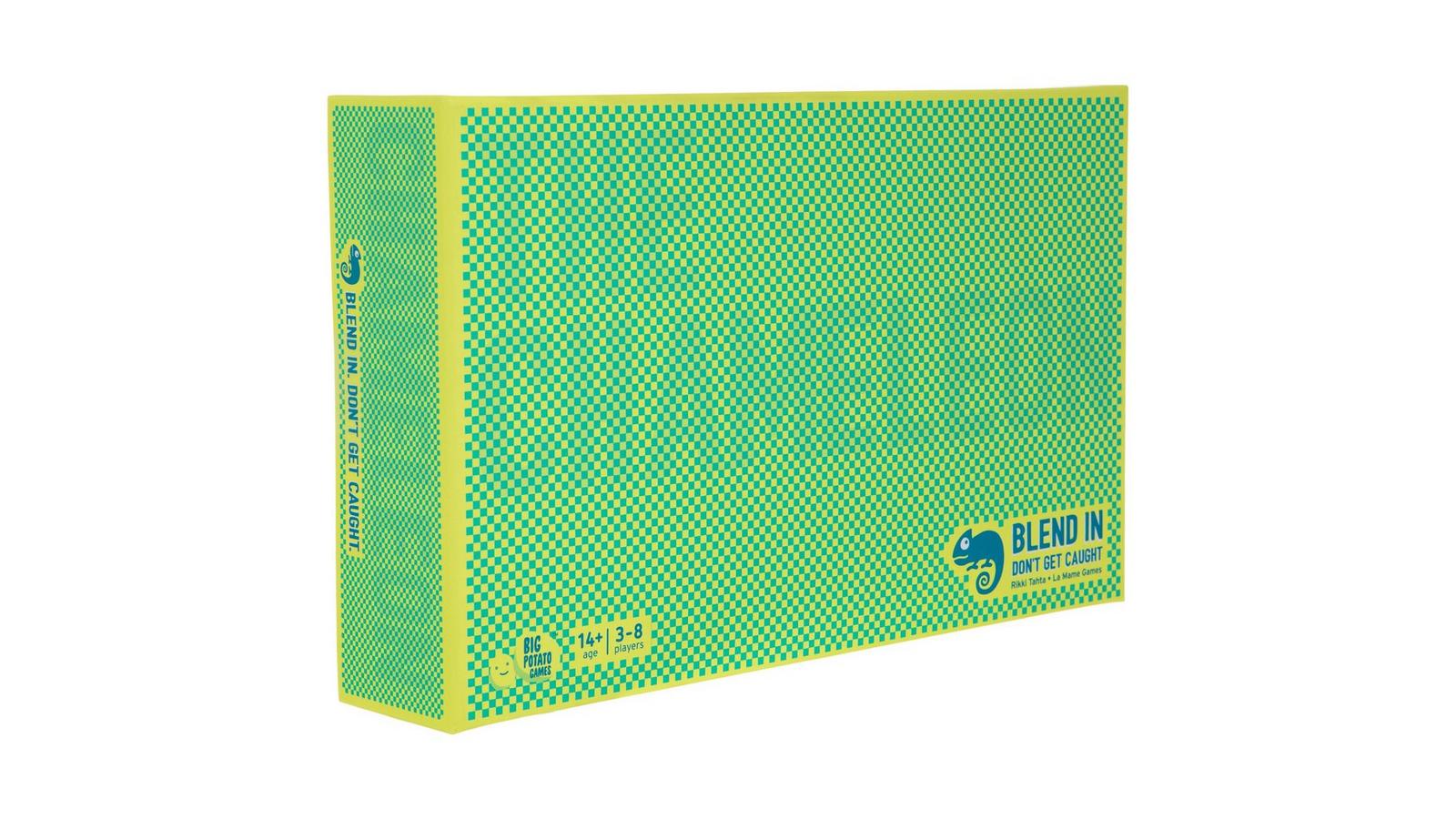
One gripe: the title on the box lid only reads clearly at an angle. Straight on, the lettering disappears into the art.
The Chameleon Pros and Cons
What works:
- Rounds finish in two or three minutes, so ten of them pass without anyone checking the clock.
- The teach takes under two minutes. Say a word, point at someone, done.
- It handles 3 to 8 players with no rule changes.
- The topic grid plus the coordinate matrix gives a large pool of secret words before repeats show up.
- Two code decks stop the player who tries to memorise positions.
What does not:
- The core idea sits close to Spyfall and other hidden-role guessing games.
- Scoring feels beside the point. Most groups drop the pad and keep playing.
- It leans on shared language and cultural reference. Mixed-language tables struggle with topics like sitcom characters.
- A quiet group kills it. The fun comes from arguing over who gave the weak clue.
- The box lid legibility issue above.
How to Play The Chameleon
The Chameleon Setup
Pick one code deck. Count out cards equal to the player count and make sure the Chameleon card is among them.
Shuffle well, deal one card to each player face down, then choose a starting player.
The Chameleon Round Structure
Place a topic card face up so everyone can read all 16 words, then roll both dice.
Players holding a coordinate card cross-reference the dice result to find the secret word. The Chameleon sees no coordinates and has to guess from the grid alone.
Each person then says one word connected to the secret word. Play goes around the table once, and the Chameleon speaks in turn like everyone else.
The Chameleon Voting and Win Conditions
After the clues, players discuss and then point at their suspect at the same time.
Whoever gets the most votes reveals their card. If they are not the Chameleon, the Chameleon wins.
If they are the Chameleon, they get one guess at the secret word. Right, they win. Wrong, everyone else does.
Where to Buy The Chameleon
| Retailer | Notes |
|---|---|
| Amazon | Listed around $24.99 for the standard English edition |
| Big Potato Games | Publisher’s own store, bigpotato.com |
| Zatu Games | UK stock, often discounted |
| Noble Knight Games | US hobby retailer, new and used copies |
| Eureka Puzzles and Games | US independent store |
| eBay | Used and older printings, hundreds of listings |
The Chameleon Game Mechanics
Three systems carry the game: hidden roles, targeted clues and a group vote. The dice and grid pick the word with no app or timer involved.
The targeted clue is where the tension lives. Your one word has to prove you know the secret word without handing it to the Chameleon.
Say the word is “Rome” on a cities topic card. Answer “pizza” and the Chameleon gets a free ride. Answer “aqueduct” and the table turns on you.
The vote closes the loop. Groups that overthink a vague clue convict the wrong player, which is how the Chameleon wins without guessing anything.
Who Should Play The Chameleon
It suits mixed groups where some people play party board games and some do not. Owning fewer games is no disadvantage here.
Compared to Spyfall, this runs shorter and needs less table talk. Compared to Codenames, the clue pressure sits on every player rather than one spymaster.
Skip it if your group prefers quiet tactical games, or if English fluency varies a lot around the table. The Chameleon won Best Party Game at UK Games Expo in 2017, and it earns that with talkative groups.
FAQ
Is The Chameleon good for beginners?
Yes. The rules take under two minutes to teach and the BoardGameGeek complexity weight is 1.05 out of 5. New players need to know one thing: say a single word tied to the secret word. The box lists ages 14 and up, mostly because some topic cards assume adult general knowledge.
How long does The Chameleon take to play?
The box says 15 minutes. A single round runs two or three minutes, including the vote and the reveal. Most groups play several rounds back to back and stop when they feel like it rather than at a set score.
What is the best player count for The Chameleon?
Five to seven works best. That gives enough clues to reason from while keeping the round short. Three players is playable but thin, since one bad read decides the round. Eight is the ceiling and the discussion starts to sprawl.
Is The Chameleon worth buying?
If you host groups of five or more and want a filler that needs no explaining, yes. Around $24.99 buys a lot of rounds. Skip it if you already own Spyfall or a similar hidden-role guessing game, because the play experience overlaps.
What games are similar to The Chameleon?
Spyfall is the closest comparison, with longer rounds and open questioning. Codenames shares the one-word clue pressure but splits players into teams. Insider and Wavelength scratch a similar itch. The Chameleon: Picture Edition swaps the word grids for images.
