Unconscious Mind Board Game Review

Unconscious Mind, designed by Laskas, Jonny Pac, Yoma, and Antonio Zax and published by Fantasia Games in 2024, places players in the role of early psychoanalysts working alongside Sigmund Freud in 1900s Vienna. Players treat clients, interpret dreams, and publish theories across a session lasting 60 to 120 minutes. The game supports 1 to 4 players aged 12 and up and carries a BGG weight rating of 4.02 out of 5. This review covers components, mechanics, and gameplay flow.
Unconscious Mind Overview
Players take on the role of Wednesday Psychological Society members competing to become Freud’s most distinguished contemporary. The theme runs through every action, from drafting client contracts to advancing inkpot rondels.
The game blends worker placement with engine building. Players move through Vienna, attend meetings, and treat clients whose dreams lift away in transparent card layers as therapy progresses.
| Specification | Details |
|---|---|
| Designers | Laskas, Jonny Pac, Yoma, Antonio Zax |
| Publisher | Fantasia Games |
| Year Released | 2024 |
| Players | 1 to 4 |
| Age Range | 12+ |
| Playing Time | 60 to 120 minutes |
| Game Type | Heavy Euro Strategy |
| Complexity Rating | 4.02 / 5 |
What’s in the Box of Unconscious Mind
The component count is high and material quality across the retail edition is solid. The deluxe edition adds upgraded bits and metal coins.
- Individual player boards with rondel tracks and tile slots
- Client cards with transparent overlay layers for dream interpretation
- Idea workers in four player colors
- Tile sets for player board placement
- Card decks for drafting and publishing theories
- Insight resource tokens managed on a multi-level dial
- Central Vienna board acting as the Meeting Table
- Inkpot tokens for rondel advancement
- Scoring track, first player marker, and rulebook
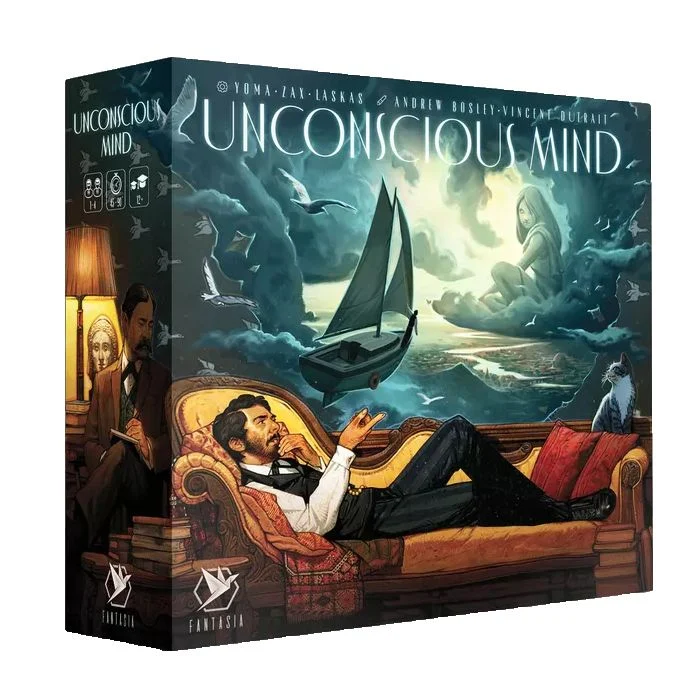
Artwork by Andrew Bosley and Vincent Dutrait gives the game a clear period look without leaning into kitsch.
Pros and Cons of Unconscious Mind
Pros
- Transparent client card layers create a tactile reveal as therapy progresses
- Cascading effects allow long, satisfying combo turns when systems align
- Included solo mode plays smoothly and earns a place alongside top solo board games released in recent years
- Theme links tightly to actions rather than sitting on top as a coat of paint
- Multiple paths to points keep replay value high across sessions
Cons
- The 4.02 weight pushes most casual gamers out of the audience
- First plays often run past the 2-hour mark while players learn the iconography
- Setup takes 15 to 20 minutes once you account for the dial and client cards
- Player interaction is light, limited mostly to action and card availability
How to Play Unconscious Mind
Setup
Each player takes a board, an inkpot rondel, and starting Ideas. Set up the central Vienna board, shuffle client decks, and prepare the Insight dial. Players draw starting cards and place initial tiles.
Turn Structure
On your turn, place one or two Ideas onto the Meeting Table. The placement location grants an action and tells you how far to advance your inkpot rondel. The rondel then triggers a row or column of tile effects on your board, often chaining into further results.
Common actions include adding tiles to your board, drafting cards, moving in Vienna, and treating clients. Insight resources move up and down the dial as you work through Manifest dreams toward deeper Latent dreams.
Winning
The game ends after the group’s reputation reaches a set threshold. Players score from completed clients, published theories, tile combinations, and end-game card bonuses. Highest total wins.
Where to Buy Unconscious Mind
| Platform | Edition / Notes | Price Range |
|---|---|---|
| Fantasia Games Store | Direct publisher, all editions | €59 to €80 |
| Gamefound | Original crowdfunding platform, late pledges | €59 to €70 |
| Tabletopfinder.eu | EU retailer comparison | €60 to €75 |
| Local Game Stores | Retail edition availability varies | €65 to €75 |
| Nightmares Expansion | Adds new clients and modules | €22 to €30 |
Unconscious Mind Game Mechanics
The worker placement layer uses just two workers per turn, but each placement triggers a second engine through the personal rondel. A single action can unlock a chain of tile effects, resource gains, and client progress.
Engine building happens on the player board. As you add tiles and activate rows through the rondel, your output per turn grows. The card-driven decision feel is close to Concordia, though the engine here builds out further and rewards more elaborate combos.
Open drafting controls card flow. Cards available to all players sit on the central board, and timing your draft against opponents matters. Players who set up strong tile combinations earn more from each placement late in the game.
The layering mechanism is unusual. Each client card has physical transparent layers you peel back as therapy advances. This turns dream interpretation into a tangible reveal rather than an abstract token swap.
Who Should Play Unconscious Mind
This game suits players who already enjoy heavy euros like Anachrony, Lisboa, or Brass: Birmingham. Anyone looking for a quick gateway experience should skip it. It already shows up across most lists of the most popular board games from the last few years, which gives a sense of how the community has received it.
Three or four players gives the best meeting table tension since action spaces fill up faster. The solo mode works well for players who want a long puzzle session without coordinating a group.
If you want strong player interaction or quick turns, look elsewhere. If you want a long, satisfying engine to build with a theme that informs play, this fits the brief. For something low-pressure at the opposite end of the weight scale, cozy titles like Mythwind offer a calmer alternative.
FAQ
Is Unconscious Mind good for beginners?
No. The 4.02 complexity weight and overlapping systems make it a poor first heavy game. Players new to engine builders or rondel mechanics should try Wingspan or Everdell first, then return to this one after a few sessions with mid-weight euros.
How long does Unconscious Mind take to play?
First sessions run 2 to 3 hours including teaching. Experienced groups finish in 90 to 120 minutes at three players. Four-player games stretch longer due to action selection downtime. Solo games finish in about 75 minutes once you know the rules.
What’s the best player count for Unconscious Mind?
Three players offers the best mix of competition for action spaces and reasonable game length. Two-player games feel a bit open with low pressure on the Meeting Table, so couples may want to check dedicated two-player board games as an alternative. Four-player games maximize tension but add 30 to 45 minutes.
Is Unconscious Mind worth buying?
Yes, if heavy euros are your preferred weight class and the theme appeals to you. The transparent client cards and tight theme-mechanism link give it staying power. Skip it if you prefer shorter games, lighter rules, or higher direct player conflict.
What games are similar to Unconscious Mind?
Anachrony shares the worker placement and engine building feel at similar weight. Lisboa matches the cascading effect style. Brass: Birmingham hits the same complexity tier with stronger interaction. For lighter recent options, check the new board game releases roundup for similar-weight euros.
