
Wondrous Creatures Board Game Review

Wondrous Creatures, designed by Yeom C.W. and published by Bad Comet in 2024, is a worker placement and tableau-building game for one to four players, rated for ages 14 and up. A typical session runs between 40 and 80 minutes. The premise is simple: build the best creature reserve by collecting fantastical animals, completing achievements, and outscoring your rivals. This review covers the rules, mechanics, components, and who this game is likely to suit.
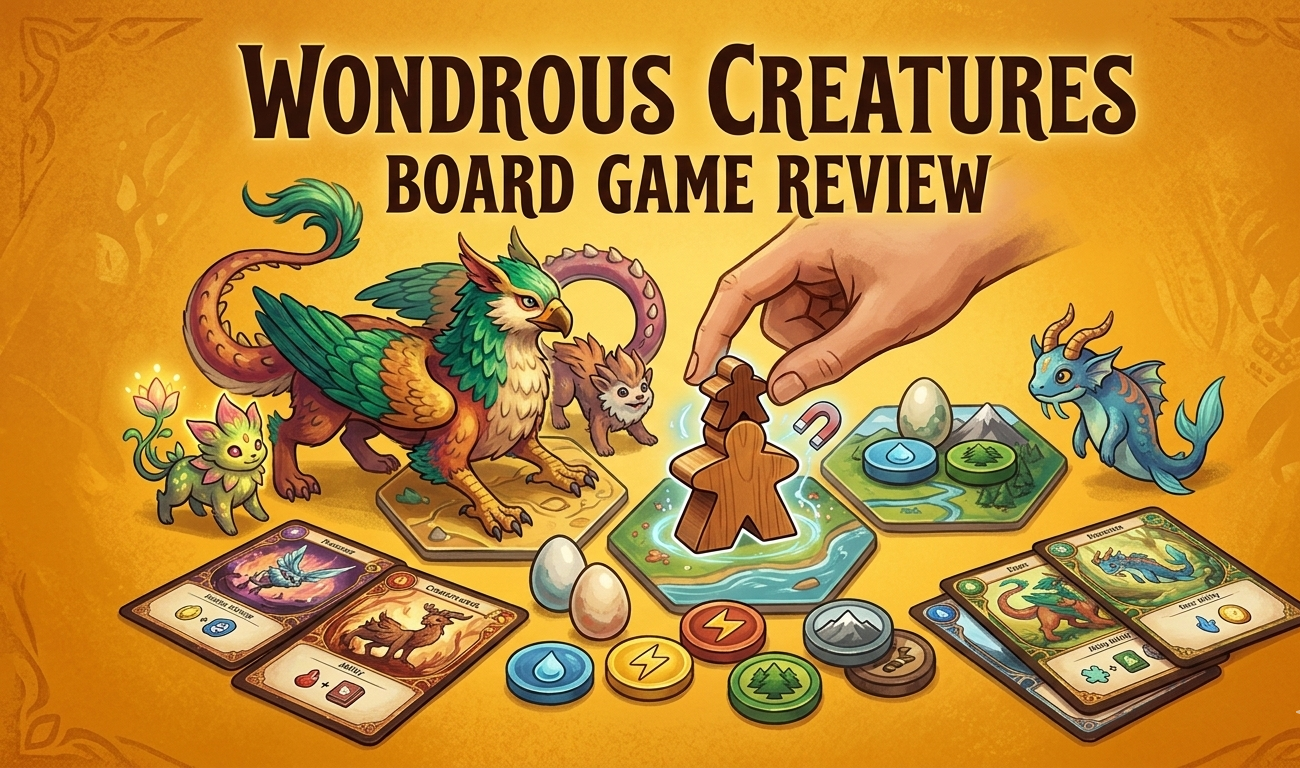
Wondrous Creatures Overview
Players take the role of creature enthusiasts competing to form the world’s most harmonious reserve. Each turn, you place workers on a communal hex board to gather resources and creature cards, then spend those resources to populate your personal tableau. Achievements—scored by collecting specific creature types or meeting set conditions—drive the end-game trigger and determine most of the points.
| Detail | Info |
|---|---|
| Designer | Yeom C.W. |
| Artist | Sophia Kang |
| Publisher | Bad Comet |
| Year Released | 2024 |
| Players | 1–4 |
| Age Range | 14+ |
| Playing Time | 40–80 minutes |
| Game Type | Worker Placement, Tableau Building |
| Complexity Rating | 3.05 / 5 |
| BGG Rating | 8.1 |
What’s in the Wondrous Creatures Box
The production quality is the first thing players will notice—and it earns the attention. Bad Comet included magnetic wooden meeples where a rider piece attaches to a mount, a detail that functions as both a game mechanism and a conversation starter. The cards are thick and richly illustrated by Sophia Kang, whose art gives the game a storybook quality.
| Component | Details |
|---|---|
| Creature Cards | 100+ unique cards, each with individual artwork and abilities |
| Crew Meeples | Wooden meeples with magnetic mounting points per player |
| Captain Pieces | Asymmetrical wooden rider meeples, one per player, with magnets |
| Hex Board Tiles | Communal modular hex map representing creature habitats |
| Achievement Tiles | Seven randomised tiles per game with multiple scoring slots |
| Egg Tokens | Thick cardboard tokens used as currency for species counts |
| Resource Tokens | Thick cardboard pieces, one per habitat type |
| Energy Tokens | Used to trigger Energy abilities on creature cards |
| Time Track Board | Tracks recharge actions and board refresh events |
| Trophy Tokens | Awarded for achievement completion; trigger end game |
| Player Boards | Individual reserve boards for tableau display |
| Solo Mode Components | Separate cards and rules for single-player puzzle mode |
Wondrous Creatures Pros and Cons
Pros
- Magnetic wooden meeples are a genuine production highlight, not a gimmick
- 100+ unique creature cards mean the market stays fresh across many plays
- The worker placement hex puzzle creates interesting spatial decisions without over-complicating setup
- Scales well across all player counts, including a functional solo mode
- Asymmetrical captain powers add personal identity without heavy rules overhead
- Card chaining through recharge, energy, and continuous abilities rewards long-term planning
Cons
- Achievement variety is limited—three of seven always focus on species collection in similar ways
- Player interaction is mostly passive; there is little way to slow a runaway leader
- Long tableau chains can slow turns noticeably at higher player counts
- The late game can feel automatic once achievement criteria are met naturally
How to Play Wondrous Creatures
Setup takes roughly 10 to 15 minutes. Each player receives a player board, three crew members, and one asymmetrical captain piece. The communal hex board is assembled with habitat tiles and seeded with resources. Seven achievement tiles are drawn randomly and placed in shared view. A creature market is set up from the shuffled card deck.
Turn Structure
On your turn, choose one of four actions:
Place a crew member. Put one of your three workers on the hex board. The placed worker interacts with surrounding habitat icons, letting you collect adjacent resources or draft a creature card from the market that matches the habitat. Landing on egg tokens collects them directly and may trigger printed bonuses on your board.
You can also attach your captain magnetically to any placed crew member, activating that captain’s unique ability on top of the standard placement effect.
Play a creature card. Pay the resource cost shown on the card and add it to your tableau. Each creature carries one or more ability types: Instant (triggers immediately), Recharge (activates when you recall workers), End (scores points based on end-game criteria), Energy (activated by spending an energy token as a free action), or Continuous (activates whenever its listed condition is met).
Claim an achievement. If your reserve meets the requirements of an available achievement tile, spend the necessary eggs or meet the creature count threshold to claim it. Achievements have multiple slots with decreasing point values, so earlier claims score more. Claiming awards a trophy token.
Recharge. Recall all your placed crew members back to hand, trigger every Recharge ability in your tableau, and advance the time track. Advancing the time track refreshes parts of the communal board and can unlock new special effect spaces.
Win Condition
The game ends when a set number of trophies have been claimed. Players total victory points from creature cards (including End ability scoring), achievement slots claimed, and any remaining eggs or resources converted by card effects. The highest score wins.
Where to Buy Wondrous Creatures
| Retailer | Format | Notes |
|---|---|---|
| Amazon | New & used | Check for Prime shipping eligibility |
| Miniature Market | New | Frequent sales and bundle deals |
| Cool Stuff Inc. | New | Competitive pricing on new releases |
| Card Haus | New | Specialty game retailer |
| Local Game Store | New | Supports local retail; call ahead to check stock |
| BGG Geek Market | Used | Peer-to-peer sales with community ratings |
Wondrous Creatures Game Mechanics
The hex board is the game’s most distinctive mechanical element. Rather than a standard grid or simple action spaces, each placement interacts with surrounding icons. A worker dropped on a central hex might pull resources from two or three adjacent habitats simultaneously, or snag a creature card if the correct habitat icon is adjacent. This creates a small spatial puzzle each time you place, rewarding players who plan a turn or two ahead.
The tableau-building layer builds on this by creating chains. A Continuous ability might produce an energy token whenever you place a worker near water habitats. That token then fuels an Energy ability on a second card, which produces a resource. That resource offsets the cost of your next creature play. The loop is the game. Once your engine reaches three or four cards deep, turns feel satisfying in a way that shorter chains don’t.
The recharge action is the engine’s reset switch. Recalling workers not only replenishes your placement options but fires every Recharge ability at once, which can produce a small burst of resources, eggs, or card draws. Timing your recharge—rather than waiting until all three workers are placed—is often the smarter move when a chain of recharge triggers lines up favorably.
Egg tokens act as a secondary currency tied specifically to achievements. They count toward species numbers without occupying a card slot, letting players hit achievement thresholds faster than pure card collection would allow. The deck cycling tools—cards that let you discard and redraw from the market—prevent the common frustration of waiting too long for the card you need in any engine-building game.
Who Should Play Wondrous Creatures
Wondrous Creatures fits players who enjoy engine-building games but find heavier titles like Terraforming Mars or Wingspan: Asia too long for a regular rotation. The 40-to-80-minute window is accurate for most groups once players know the rules.
It plays similarly to Everdell in structure—workers generate resources, resources buy cards, cards generate more resources—but the hex placement adds a spatial layer that Everdell lacks. Compared to Wyrmspan, the creature variety is higher and the achievement system gives clearer short-term goals to chase each session.
It works well with two players, where the hex board feels tighter and the achievement race more tense. At four, turns can slow when someone builds a large tableau with deep card chains, but the blocking tension from placement becomes more interesting.
Skip it if your group prefers direct conflict, trading, or negotiation. There is minimal take-that here. Players who want to disrupt opponents or slow engines will find the interaction too light. It is also worth noting that new players may need a full round or two before the card ability types click—Instant, Recharge, Continuous, and Energy behave differently and each player board takes some reading.
FAQ
Is Wondrous Creatures good for beginners?
It’s a moderate step up from gateway games. The four action types are simple, but understanding how the five card ability types interact takes a game or two. Players familiar with Everdell or Wingspan will find the learning curve comfortable. Complete newcomers to hobby games may find the tableau abilities initially confusing.
How long does Wondrous Creatures take to play?
Most two-player games finish in around 45 minutes once both players know the rules. Four-player games can run 75 to 90 minutes, especially when players build large tableaux with multiple card chains. The first play typically adds 20 to 30 minutes for rules explanation and setup.
What’s the best player count for Wondrous Creatures?
Two or three players tends to be the sweet spot. At two, placement tension is high and downtime is minimal. At three, the achievement race stays competitive without excessive waiting. Four players works, but long tableau chains can slow turns and extend the game noticeably.
Are there expansions for Wondrous Creatures?
As of early 2025, no official expansions have been announced by Bad Comet. The base game includes over 100 unique creature cards, which provides enough variety for many plays before the card pool feels repetitive. Check Bad Comet’s official channels for any expansion announcements.
What games are similar to Wondrous Creatures?
The closest comparisons are Everdell, Wyrmspan, and Raising Robots—all combine worker placement with tableau building and card engines. Explorers of Navoria shares a similar spatial placement feel. Players who enjoy Splendor’s resource-to-card conversion loop but want more depth will likely enjoy Wondrous Creatures.
