
Ticket to Ride: Europe Board Game Review

Ticket to Ride: Europe, designed by Alan R. Moon and published by Days of Wonder in 2005, takes the route-building idea from the original Ticket to Ride and reshapes it for the European map. The game plays with 2 to 5 players aged 8 and up, and a full session runs 30 to 60 minutes. This review breaks down the gameplay, components, mechanics, and the kind of group that will get the most out of the box.
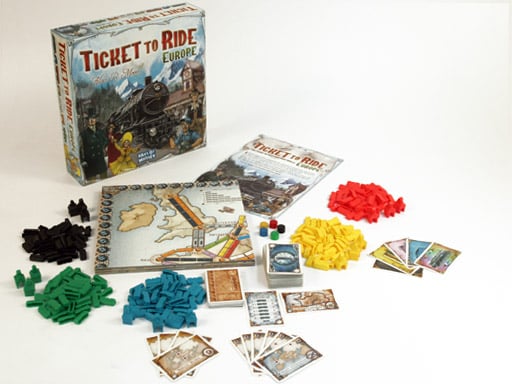
Ticket to Ride: Europe Overview
Players collect coloured train cards and use them to claim routes between cities across Europe, from Lisbon to Moscow and Edinburgh to Constantinople. Each player draws destination tickets that name two cities they need to connect for bonus points at game end. Failed tickets count against the final score, which creates the central tension of the game.
The Europe edition adds tunnels, ferries, and train stations to the base formula. These additions deepen the decision space without making the rules harder to teach.
| Designer | Alan R. Moon |
|---|---|
| Publisher | Days of Wonder |
| Year Released | 2005 |
| Players | 2 to 5 |
| Age Range | 8+ |
| Playing Time | 30 to 60 minutes |
| Game Type | Family / Route Building |
| Complexity Rating | 1.92 / 5 (BGG) |
What’s in the Ticket to Ride: Europe Box
The box has thick components that hold up to repeated play. The train pieces are moulded plastic with crisp detail, and the destination cards use larger format than the original game, which helps with readability across the table.
- 1 large board map of Europe
- 240 coloured train cars (45 per player, plus extras)
- 15 train station markers (3 per player)
- 110 train cards in eight colours, plus locomotive wild cards
- 46 destination ticket cards, including 6 long routes
- 5 wooden scoring markers
- 1 bonus card for the longest continuous route
- 1 rulebook
The map graphic is clear and the colour palette stays readable under low light. Train cards are linen-finished, which lasts longer than smooth cards through heavy shuffling.
Ticket to Ride: Europe Pros and Cons
Pros
- Rules teach in about five minutes, so new players sit down without a long explanation.
- Train stations reduce the frustration of getting blocked, which keeps the mood friendly.
- Tunnels add a push-your-luck moment when claiming forest routes through the Alps or Carpathians.
- Plays well at every count from 2 to 5, with different map pressure at each.
- Game length stays consistent, rarely running past an hour.
Cons
- Card draw luck affects results, especially at higher player counts.
- The map gets crowded with 4 or 5 players, and key routes get claimed early.
- Long ticket cards can feel punishing if drawn at the wrong time.
- Replay value drops once players know the high-value routes by heart.
How to Play Ticket to Ride: Europe
Setup
Each player takes 45 train cars and 3 station markers in one colour. Shuffle the train cards and deal 4 to each player, then place 5 face up next to the deck. Shuffle the destination tickets and deal each player 1 long ticket and 3 regular tickets. Players keep at least 2 of the 4 dealt tickets and return the rest.
Turn Structure
On a turn, a player picks one of four actions:
- Draw 2 train cards from the deck or the face-up row. Locomotive cards from the face-up row use the whole turn.
- Claim a route by playing the matching set of cards and placing trains.
- Draw 3 destination tickets and keep at least 1.
- Build a train station on a city using 1, 2, or 3 matching cards.
Tunnels require the player to flip the top 3 cards from the deck after committing. Any matches force them to play extra cards or pull back the trains. Ferries need a fixed number of locomotive cards as part of the payment.
Win Conditions
The game ends when one player has 2 or fewer trains left. Each player takes one final turn. Scores include points from claimed routes, completed tickets, leftover stations, and a 10-point bonus for the longest continuous route. Uncompleted tickets subtract their face value. Highest score wins.
Where to Buy Ticket to Ride: Europe
| Retailer | Edition | Price (INR) |
|---|---|---|
| Flipkart | Locally distributed | 657 to 751 |
| Satyam Stationers | Standard print | 749 |
| Shopbefikar | Standard print | 749 |
| FirstCry India | Standard print | 852 (approx.) |
| Amazon India | Days of Wonder import | 4,406 |
| Board Games India | Days of Wonder import | 5,500 |
Local prints work fine for casual play, but the imported Days of Wonder edition has heavier components and matches the version shown in most online tutorials.
Ticket to Ride: Europe Game Mechanics
The core mechanism is set collection feeding into network building. Players collect cards of matching colours and trade them in for routes on the map. Hand management drives the early game, since you need enough cards of the same colour to claim a meaningful stretch.
Ticket cards work as hidden objectives. They reward planning two or three routes ahead, and they shape how each player reads the board. The longest route bonus rewards a single connected line, which often pulls play toward the centre of the map.
Tunnels create a small risk-management puzzle each time a player builds through one. Stations work as a release valve, letting a stuck player rent an opponent’s route to complete a ticket. These two elements separate the Europe map from the original game and reduce the all-or-nothing feel that the first version can have.
Who Should Play Ticket to Ride: Europe
Ticket to Ride: Europe suits families with kids aged 8 and up, casual groups that want a 45-minute game, and newer gamers stepping up from titles like Catan Junior or Carcassonne. It works as a regular pick for family game night since the rules stay in memory between sessions.
The two-player game runs tight and quick, which makes it a solid pick for couples and small groups looking for a 30-minute competitive game. Skip it if your group wants heavy strategy, complex player interaction, or a long game. Splendor offers a tighter card game with shorter play time. Power Grid offers a deeper resource and route puzzle. Players who already own the original Ticket to Ride and rarely play with more than 3 people may find the European map a better fit overall.
FAQ
Is Ticket to Ride: Europe good for beginners?
Yes. The rules teach in about five minutes and the turn options stay simple throughout the game. Train stations soften the impact of route blocking, which helps newer players stay competitive. Most gaming groups use this title as a first step into modern board games for kids and adults.
How long does Ticket to Ride: Europe take to play?
A two-player game runs about 30 minutes once both sides know the rules. Three and four-player games sit in the 45 to 60 minute range. Five players push closer to a full hour because of the extra downtime between turns and the increased competition for routes.
What’s the best player count for Ticket to Ride: Europe?
Three players hits the best balance. The map has room to plan without feeling empty, and route blocking matters without becoming punishing. Two players works well for couples or quiet evenings. Four and five players create a tighter, more competitive map where ticket choice matters more than card luck.
Is Ticket to Ride: Europe worth buying?
For most casual and family groups, yes. The Europe map plays better than the original at all counts, and the added mechanics give more decisions without raising the weight. If you already own the first Ticket to Ride, Europe offers enough new content through tunnels, ferries, and stations to justify a second copy.
What games are similar to Ticket to Ride: Europe?
Other route-building games include Ticket to Ride: Nordic Countries, Ticket to Ride: Rails and Sails, and Whistle Stop. Groups who finish the base game and want a campaign experience can try Ticket to Ride Legacy: Legends of the West. For lighter set-collection play, try Sushi Go or Splendor.
