
Terra Mystica Board Game Review

Terra Mystica, designed by Jens Drögemüller and Helge ostertag and published by Feuerland Spiele in 2012, is a heavyweight strategy game for 2 to 5 players. Rated for ages 12 and up with a playtime of 60 to 150 minutes, it puts each player in command of one of 14 distinct factions competing to terraform a shared map, build structures, and score points across six rounds. This review examines whether the game’s complexity pays off at the table.
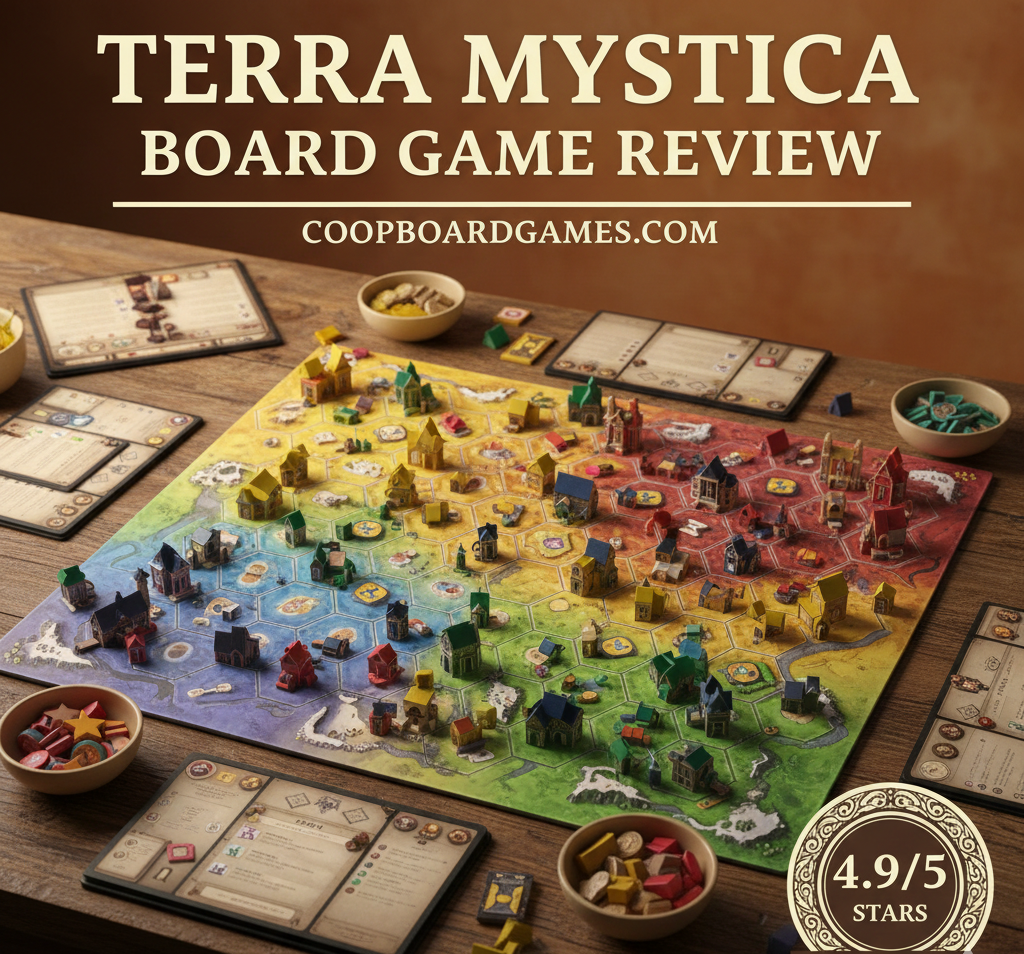
Terra Mystica Overview
The setting is a land divided into seven terrain types — desert, plains, swamp, lake, forest, mountain, and wasteland. Each faction is native to one terrain and must convert adjacent land before it can build there. Players spend workers, money, and power to terraform, construct buildings, and advance along four religious cult tracks. The player who accumulates the most points after six rounds wins.
There is no luck in Terra Mystica. No dice, no card draws, no random events mid-game. Everything on the board is visible to everyone at all times. Outcomes depend entirely on planning and resource management.
| Detail | Information |
|---|---|
| Designer | Jens Drögemüller & Helge Ostertag |
| Publisher | Feuerland Spiele / Z-Man Games |
| Year Released | 2012 |
| Players | 2 – 5 |
| Age Range | 12+ |
| Playing Time | 60 – 150 minutes |
| Game Type | Area Control, Engine Building, Resource Management |
| Complexity Rating | 4.3 / 5 (BoardGameGeek) |
Terra Mystica Components: What’s in the Box
The box is dense. Feuerland Spiele packed a considerable amount of cardboard and wood into the production, and the quality is consistent throughout.
| Component | Quantity / Notes |
|---|---|
| Game Board | 1 large double-sided hex map |
| Faction Boards | 14 individual player boards |
| Wooden Buildings | Dwellings, trading houses, strongholds, temples, sanctuaries — per faction |
| Power Bowls | 3 bowls per player, with power tokens |
| Scoring Tiles | 9 tiles (6 used per game) |
| Bonus Cards | 10 cards |
| Favour Tiles | Multiple tiles for cult track progression |
| Town Tiles | Multiple tiles with one-time bonuses |
| Cult Track Board | 1 board covering Fire, Water, Earth, and Air |
| Resource Tokens | Workers, money, priests — cardboard and wooden pieces |
| Rulebook | 20 pages |
The wooden buildings are chunky and easy to handle. The faction boards are functional and information-dense, with printed income tracks and action reminders. The resource tokens are thick cardboard that sit securely in the bowls. Component quality is high for a game of this weight.
Terra Mystica Pros and Cons
Pros
- Zero luck makes outcomes entirely skill-dependent
- 14 factions each play very differently, giving the game enormous replay value
- Full information means every loss is something to learn from
- Six-round structure keeps games from overstaying their welcome
- The power bowl system creates interesting resource trade-offs every turn
- Strong cult track and town-founding sub-games add strategic layers
Cons
- The rulebook is 20 pages and teaching the game takes significant time
- Early decisions can eliminate you from contention well before round six
- Punishing for beginners — the game offers no grace period
- Mixed-skill groups create miserable experiences for everyone
- Setup takes around 15 to 20 minutes
How to Play Terra Mystica
Each game of Terra Mystica lasts exactly six rounds. Players take turns clockwise, choosing one action per turn or passing. The first player to pass picks a bonus card for next round. Rounds end when all players have passed.
Setup
Place the game board in the center of the table. Each player selects a faction and takes the matching faction board, wooden buildings, and starting resources. Place the six scoring tiles (drawn randomly from a pool of nine) face-up on the scoring track — one tile per round. Deal out bonus cards equal to the number of players plus three. Place priest tokens on the cult tracks.
Each faction places its starting dwellings on its home terrain. Factions vary in how many starting dwellings they receive and where they may place them.
Turn Actions
On your turn, you pick one action from the following options. You may also take free actions — gaining power for workers or money — in addition to your main action.
- Transform a terrain hex and optionally build a dwelling on it (costs workers and shovels)
- Upgrade an existing building (dwelling to trading house, trading house to stronghold or temple, temple to sanctuary)
- Send a priest to a cult track to advance in Fire, Water, Earth, or Air
- Take a power action from the shared board (spend power from bowl three)
- Use a special action on your faction board or bonus card
- Pass and select a new bonus card
Income and Round End
At the start of each round, all players collect income based on the buildings they have on the board. More buildings mean more workers, money, priests, or power. After income, players consult the active scoring tile to understand which actions earn bonus points during that round.
Founding Towns
When a player connects at least four structures with a combined power value of seven or more, they immediately found a town. This earns a town tile, which provides a one-time bonus including keys needed to unlock the top tier of cult tracks.
Winning
After round six, players earn points for their positions on the four cult tracks, for connected structures, and from any remaining resources. The player with the highest total wins. Scores can be close — a few points often separate first and fourth place.
Terra Mystica Mechanics Explained
Terra Mystica operates through several interlocking systems. Understanding each one individually is straightforward; learning how they interact is the real challenge.
Terraforming is the central action of the game. Each terrain type is adjacent to others on a conversion wheel. Shifting terrain one step costs one shovel. Shovels come from workers and from improvements on the faction board. Factions differ in how cheaply they can terraform, which shapes where they can expand on the map.
The power bowl system drives every resource decision. Each player has three bowls that hold power tokens. Tokens cycle from bowl one through bowl two and into bowl three, where they can be spent. When a neighbor builds adjacent to your structures, you gain power — but you displace tokens forward through the bowls. If you cannot meet the cost of displacing tokens, you sacrifice some permanently to pay the difference. This creates constant pressure between short-term gains and long-term capacity.
Building upgrades generate income. Dwellings produce workers. Trading houses produce money. Temples produce power and allow faction board improvements. Strongholds activate a faction’s unique ability, which varies significantly between groups. The Witches, for example, can place new dwellings on any forest hex after building their stronghold — a dramatic mobility boost unavailable to other factions.
The cult tracks run parallel to the main economy. Priests sent to Fire, Water, Earth, or Air tracks earn favour tiles at certain milestones. These tiles grant income bonuses, terraforming discounts, or power. Players leading a track at the end of round six earn substantial points. The tracks interact with the town-founding mechanic because town tiles provide keys needed to reach the top position on each track.
Scoring tiles shift which actions generate points each round. A tile might award points for building trading houses, or for using shovels to terraform. Players who misread the tile sequence and invest in the wrong areas pay a steep cost by round four.Engine building games like Terra Mystica reward players who read several rounds ahead.
Who Should Play Terra Mystica
Terra Mystica suits players who want a game they can study between sessions and improve at over time. If a 20-page rulebook is a barrier to entry, there are lighter area-control games that deliver a comparable feel.Strategy board games at this complexity level demand consistent play partners and patience with a steep learning curve.
The game is best with three or four players. At two, the map feels sparse and the interaction that drives the power gain mechanic is limited. At five, downtime between turns increases noticeably, and analysis paralysis can slow the game to a crawl.
Avoid mixing experienced players with newcomers. The first few games of Terra Mystica are spent learning what not to do, and experienced opponents will exploit those early mistakes before a new player understands why they matter. Games work best when all players are at a similar stage of learning the game.
If you enjoy games like Tzolk’in, Gaia Project (Terra Mystica’s spiritual successor), or worker placement games that reward optimization, Terra Mystica belongs on your shelf. If you prefer games where a skilled player can still have fun alongside less experienced friends without the experience turning punishing for everyone, look elsewhere. Terra Mystica is unforgiving by design — that is either its greatest strength or its central flaw depending on what you look for in a game.
Where to Buy Terra Mystica
| Retailer | Format | Notes |
|---|---|---|
| Amazon | New & Used | Wide availability, check Prime eligibility for faster shipping |
| Board Game Geek Store (BGG) | New | Direct from publisher partners, community marketplace available |
| Miniature Market | New | Frequent discounts on heavyweight euro games |
| Cool Stuff Inc | New | Competitive pricing on in-stock titles |
| eBay | New & Used | Good option for finding discounted used copies |
| Local Game Store (FLGS) | New | Supports local retailers; staff can advise on expansions |
FAQ
Is Terra Mystica good for beginners?
Terra Mystica is not a beginner-friendly game. The rulebook is 20 pages long, setup takes 15 to 20 minutes, and early mistakes often determine the outcome by round three. Players new to heavy strategy games should try something lighter first before committing to the learning curve here.
How long does Terra Mystica take to play?
A typical session runs 90 to 150 minutes with players who know the rules. First games take longer due to rules lookups and slower decision-making. With experienced players the six-round structure keeps things moving, but a full game rarely finishes in under 90 minutes.
What is the best player count for Terra Mystica?
Three or four players is the sweet spot. At two, the map is too sparse and the power-gain mechanic loses tension. At five, turns become slow and downtime increases. Four players gives the best balance of map competition and manageable turn order.
Does Terra Mystica have expansions?
Yes. The main expansion is Fire & Ice, which adds six new factions and variable maps. Gaia Project is also considered a standalone spiritual successor with a science fiction theme and several design refinements. Both are worth exploring once the base game feels familiar.
What games are similar to Terra Mystica?
Gaia Project is the closest comparison — same designers, similar systems, tighter ruleset. Tzolk’in and Vital Lacerda’s games like Lisboa share the same demand for optimization under resource pressure. For a lighter alternative with area control and engine building, Wingspan or Everdell offer far more accessible entry points.
