
Takenoko Board Game Review

Takenoko, designed by Antoine Bauza and published by Bombyx/Matagot in 2011, is a family-weight strategy game about growing bamboo and feeding a hungry panda. It plays 2 to 4 players, ages 8 and up, and takes about 45 minutes per session. With a weight rating of 1.97 on BoardGameGeek, it sits squarely in gateway game territory. This review covers the base game’s components, mechanics, and who it works best for.
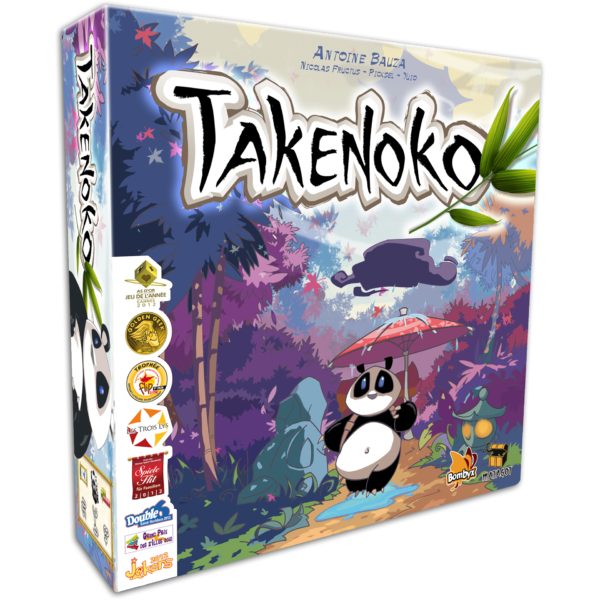
Takenoko Overview
The premise: the Chinese Emperor has gifted a giant panda to the Japanese Emperor, and you (a member of the court) have been tasked with tending the imperial bamboo garden while keeping the panda fed. That tension between growing bamboo and having a panda eat it is the heart of the game.
Players place hexagonal land tiles, grow bamboo in three colors (green, yellow, pink), move a gardener to cultivate it, and move a panda to eat it. You score points by completing objective cards that ask you to arrange tiles in certain patterns, grow bamboo to specific heights, or feed the panda particular combinations of bamboo.
| Detail | Info |
|---|---|
| Designer | Antoine Bauza |
| Publisher | Bombyx / Matagot |
| Year Released | 2011 |
| Players | 2–4 |
| Age Range | 8+ |
| Playing Time | ~45 minutes |
| Game Type | Family / Strategy |
| Complexity Rating | 1.97 / 5 (BGG) |
What’s in the Takenoko Box?
The component quality is one of Takenoko’s strongest selling points. The panda and gardener are painted miniatures with a lot of character. The bamboo sections are stackable plastic pieces in green, yellow, and pink that click together satisfyingly. The 28 garden plot tiles are thick, hex-shaped cardboard with clear illustrations.
| Component | Quantity |
|---|---|
| Garden Plot Tiles | 28 |
| Green Bamboo Sections | 28 |
| Yellow Bamboo Sections | 26 |
| Pink Bamboo Sections | 24 |
| Irrigation Channels | 20 |
| Improvement Tiles | 9 |
| Objective Cards | 46 |
| Individual Player Boards | 4 |
| Action Chips | 8 |
| Weather Die | 1 |
| Panda Figurine | 1 |
| Gardener Figurine | 1 |
The player boards are functional but thin. They track available actions and hold your objective cards behind a small screen. Everything else in the box feels durable and well-made. The art by Nicolas Fructus, Picksel, and Yuio gives the game a warm, storybook look that appeals to families and casual gamers.
Takenoko Pros and Cons
Pros:
- The miniatures and stackable bamboo pieces give the game real table presence. It looks great mid-game with a sprawling garden.
- Rules are simple enough to teach in under 10 minutes. New players can jump in without much friction.
- The weather die adds variety each round without overcomplicating decisions.
- Plays well as a gateway game for people who haven’t tried modern board games before.
- Short playtime keeps sessions from dragging, even with slower players.
Cons:
- With only 2 players, the game loses some of its tension. The garden doesn’t develop as quickly and there’s less competition for objectives.
- Experienced gamers may find the strategy shallow after several plays. Objective card draws introduce a lot of luck.
- The panda objective cards tend to be easier to complete than plot or gardener objectives, which can skew scoring.
- Player interaction is indirect. You rarely feel like you’re competing against anyone specific.
How to Play Takenoko
Setup
Place the pond tile in the center of the table. Stack bamboo sections by color. Shuffle objective cards into three separate decks (plots, gardener, panda). Each player takes a player board and one objective card from each deck. Place the panda and gardener on the pond tile.
Turn Structure
Each turn has two phases. First, roll the weather die (skipped in the first round). The die result gives you a bonus: sun grants an extra action, rain grows bamboo on any irrigated tile, wind lets you take two identical actions, storm lets you move the panda anywhere, clouds let you take an improvement chip, and the question mark lets you choose any weather effect.
After resolving weather, you pick two different actions from five options: draw a plot tile and place it, take an irrigation channel, move the gardener (who grows bamboo wherever he lands and on adjacent irrigated tiles of the same color), move the panda (who eats one bamboo section from his tile), or draw an objective card.
Completing Objectives and Winning
You can complete objective cards at any point during your turn if the conditions on the card match the current board state or your bamboo reserves. Plot objectives require specific tile arrangements. Gardener objectives need bamboo grown to certain heights on certain colors. Panda objectives require you to have eaten specific bamboo combinations.
The end triggers once a player completes a set number of objectives (7, 8, or 9 depending on player count). That player gets the Emperor card for 2 bonus points. Everyone else gets one final turn, and the player with the most points wins. If you enjoy games with similar action-selection mechanics, you might also like 7 Wonders, another Antoine Bauza design.
Where to Buy Takenoko
| Retailer | Link |
|---|---|
| Amazon | Buy on Amazon |
| Walmart | Buy on Walmart |
| Asmodee Store | Buy on Asmodee |
| eBay | Buy on eBay |
| BoardGameGeek Market | BGG Marketplace |
Takenoko Game Mechanics Explained
Takenoko uses an action point system. You get two actions per turn (sometimes three with the sun weather result), and you pick from the five options listed above. The restriction on not repeating actions (unless you roll wind) forces you to spread your efforts across multiple strategies each turn.
The tile-laying mechanic is straightforward. New plots must touch the central pond or sit adjacent to at least two existing tiles. Irrigation channels connect plots to the pond’s water supply, which is required before bamboo can grow. This creates a small spatial puzzle each game, since tiles placed early determine where bamboo can expand later.
The gardener and panda share the board but work against each other. Move the gardener to a tile and bamboo sprouts on that tile and all adjacent irrigated tiles of the same color. Move the panda to a tile and he eats one section. Both figures move in straight lines along hex edges, so positioning matters. If you’re interested in family-friendly games with similar accessibility, there are several options worth comparing.
Improvement chips (fertilizer, enclosure, watershed) add wrinkles. Fertilizer makes bamboo grow two sections instead of one. Enclosures protect bamboo from the panda. Watersheds auto-irrigate a tile. These are limited resources, so timing matters.
Who Should Play Takenoko?
Takenoko is at its best with families and mixed groups where not everyone has the same gaming experience. The rules are light, the theme is friendly, and the game looks appealing on the table. It works as a gateway game alongside titles like Ticket to Ride and Carcassonne.
If your group already plays heavier strategy games, Takenoko may feel too luck-dependent. The objective card draws can hand one player easy points while another gets stuck with tough goals. There’s no way to trade or discard objectives in the base game, which can be frustrating.
The sweet spot is 3 players. At two, the board develops slowly and the game can feel flat. At four, downtime between turns stretches a bit. Three players keeps the garden growing at a good pace without much waiting. For those who like Antoine Bauza’s other work, Hanabi is another accessible game from the same designer, though it’s a fully cooperative card game rather than competitive.
The Chibis expansion (sold separately) adds a female panda, baby pandas, new plot tiles, and new objective cards. It integrates easily and addresses some of the base game’s lack of variety. If you enjoy Takenoko and want more from it, Chibis is worth picking up.
FAQ
Is Takenoko good for beginners?
Yes. The rules take under 10 minutes to explain, and most new players understand the flow within a couple of turns. The action selection is clear, the objective cards are self-explanatory, and the theme makes it easy to remember what each action does. It works well as a first modern board game.
How long does Takenoko take to play?
Most games run 30 to 50 minutes depending on player count and experience. A 2-player game can finish in under 30 minutes. With 4 players who are new to the game, expect closer to an hour for the first session.
What is the best player count for Takenoko?
Three players hits the best balance. The garden fills out at a steady rate, there’s enough competition over objectives to keep things tense, and turns come around quickly. Two works but feels less engaging, and four adds noticeable downtime.
Is the Takenoko Chibis expansion worth buying?
If you already enjoy the base game, Chibis is a solid addition. It brings a female panda, baby panda tokens, new plot tiles with special abilities, and fresh objective cards. The new content slots in without adding much rule complexity, and it gives panda-focused strategies more competition from other objective types.
What games are similar to Takenoko?
Ticket to Ride, Carcassonne, and Kingdomino share a similar weight and family-game appeal. Azul has a comparable mix of simple rules with some tactical depth. If you want something with more interaction at the same complexity level, Splendor is another good option to try.
