
SETI Board Game Review

SETI: Search for Extraterrestrial Intelligence is a 2024 strategy game from designer Tomáš Holek, published by Czech Games Edition. You run a research institution hunting for signs of life beyond Earth, launching probes across the solar system and pointing telescopes at distant stars to catch alien signals. It plays 1 to 4 players, ages 14 and up, in 40 to 160 minutes. This review walks through the components, rules, mechanics, and the kind of player it suits.
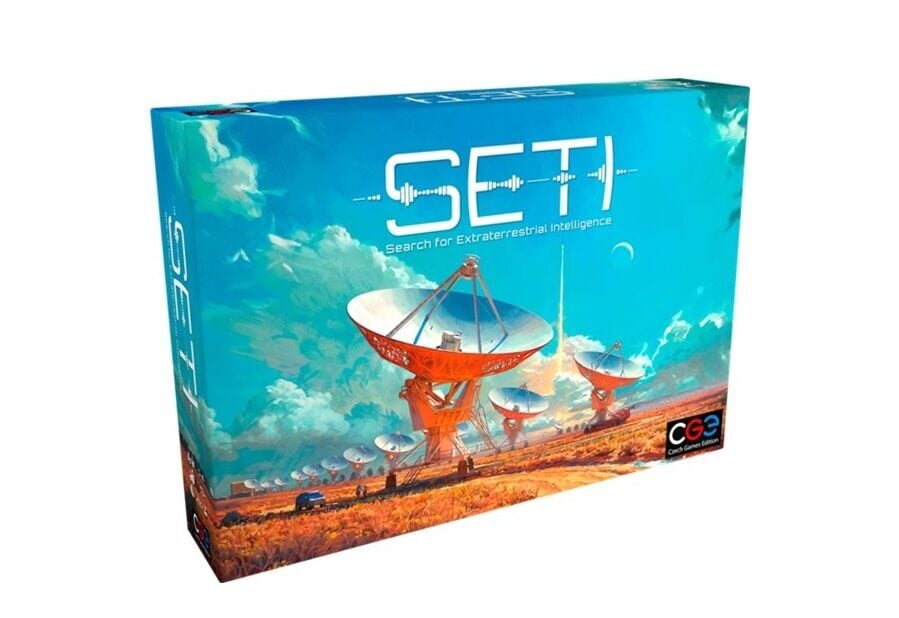
SETI Game Overview
The theme sits close to real science. You launch probes from Earth, time them around shifting planetary positions, and decide whether to land for samples or stay in orbit for wider coverage. Telescopes scan for exoplanets and faint signals you bring home to analyze.
Points come from many directions: probe placement, data analysis, completed research, and an alien storyline that unfolds during play. After five rounds, the highest score wins. Your choices on Earth, where you upgrade equipment and grow income, shape what you can do in space.
| Specification | Detail |
|---|---|
| Designer | Tomáš Holek |
| Publisher | Czech Games Edition (CGE) |
| Year Released | 2024 |
| Players | 1 to 4 |
| Age Range | 14+ |
| Playing Time | 40 to 160 minutes |
| Game Type | Strategy, Science Fiction, Space Exploration |
| Complexity Rating | 3.83 / 5 (BGG weight) |
What’s in the SETI Box
The box holds a central solar system board with a rotating Sun piece, individual player boards, and a deck of more than 200 cards. Each card carries its own art and ties to a real project or technology, including the ISS, Voyager, the Perseverance rover, and the Large Hadron Collider.
Wooden probes, score markers, and player tokens are made from RE-Wood, while the data tokens use RePlastic. Both are recycled materials, and the pieces feel solid in hand. The card art is detailed without being busy.
- Central modular board with movable planets and a Sun centerpiece
- Player boards for tracking income, technology, and resources
- 200+ unique cards depicting real space technology
- RE-Wood probes, score counters, and player markers
- RePlastic data tokens and signal markers
- Rulebook and solo mode reference
SETI Pros and Cons
Pros
- The theme connects tightly to gameplay. Launching a probe and timing it to a planet’s orbit actually feels like running a mission.
- Multi-use cards let you treat one card as an action, a bonus, or income, so each draw gives you a real choice.
- A solo mode ships in the base box and plays well without extra setup.
- The alien storyline shifts each game, which keeps repeat plays from feeling identical.
- Recycled wood and plastic components are sturdy and pleasant to handle.
Cons
- At four players, games can run the full 160 minutes, with noticeable downtime between turns.
- A 3.83 weight makes this a poor first heavy game; the rules take a full play to settle.
- Setup runs around 15 to 20 minutes once you account for card and board layout.
- The card-driven engine can feel swingy if early draws don’t match your plan.
How to Play SETI
Setup
Place the central board with the Sun piece and set the planets in their starting positions. Each player takes a board, starting resources, probes, and an income setup. Shuffle the card deck and lay out the shared display. Pick a starting player and hand them the marker.
Turn Structure
The game runs five rounds. Players take turns clockwise, and anyone who has passed for the round is skipped. On a turn you spend resources to take actions: launch a probe, move a probe through space, land it or hold orbit, scan with telescopes, or analyze data you have gathered.
Back on Earth, you spend turns upgrading equipment, raising income, or playing cards for their effects. You keep taking turns until you pass, then wait for the round to end before the next one begins.
Winning the Game
After round five, you total points from probes on planets, analyzed data, completed research goals, the alien track, and end-game card bonuses. The player with the most points wins.
Where to Buy SETI
| Platform | Notes |
|---|---|
| Czech Games Edition store | Publisher direct, English edition |
| Online board game retailers | Widely stocked since the 2024 release |
| BoardGameGeek Marketplace | New and used copies from sellers |
| Local game stores | Check stock and demo availability in person |
SETI Game Mechanics
The core loop ties together income, area majority, and a card engine. You earn resources each round, then spend them to act in space. Probes you place on planets contribute to majority scoring, so other players’ positions affect where you want to commit. If terms like area control and engine building are new to you, it helps to read up on them before the first session.
Multi-use cards drive most decisions. A single card might be a one-time action, a permanent upgrade, or a source of income, and you rarely get to use it all three ways. Choosing how to spend each card is where much of the game lives.
Resource-to-move rules govern probe travel, which forces planning around the shifting planet positions. The alien storyline and end-game bonuses reward players who build toward specific goals rather than spreading their effort thin. The systems here click together by the second or third round.
Who Should Play SETI
SETI fits players who enjoy medium-heavy strategy and a science theme that earns its weight. If you liked the engine building in Terraforming Mars or the discovery arc in Beyond the Sun, this lands in familiar territory with its own probe-and-signal twist.
Solo players get a full single-player mode, and the game holds up well as one of the better games for two players. Skip it if your group wants something light, fast, or low on rules overhead, or if long sessions at four players test your patience. For fans of space-themed games, it rewards repeated plays as the card pool and alien track keep shifting.
FAQ
Is SETI good for beginners?
Not as a first hobby game. With a 3.83 weight, it expects players who already know engine building and area control. Newcomers can learn it, but plan for a full teaching game before the systems feel natural. A few gateway games make a smoother entry point.
How long does SETI take to play?
A game runs 40 to 160 minutes depending on player count and experience. Two players who know the rules can finish near the low end. A four-player game with newer players sits closer to two and a half hours, including setup and scoring.
What’s the best player count for SETI?
Two and three players hit the sweet spot. You keep meaningful area control on the planets while avoiding long waits between turns. Four players works and adds more competition for spaces, but downtime grows. The solo mode is a solid option for practice or quiet evenings.
Is SETI worth buying?
If you want a themed medium-heavy strategy game and have room for a roughly two-hour session, it earns its place. The tight link between theme and mechanics stands out. Players who prefer short or rules-light games will get less from it.
What games are similar to SETI?
Terraforming Mars and Beyond the Sun share its science theme and engine building. If you want something lighter in the same family, Wingspan covers similar engine-building ground at a gentler weight. SETI separates itself with probe movement timed to shifting planet positions and a changing alien storyline.
