
Scout Card Board Game Review

SCOUT is a ladder-climbing card game designed by Kei Kajino and published by Oink Games in 2019. It won the 2022 Origins Award for Best Card Game and earned a Spiel des Jahres nomination the same year. The game seats 2 to 5 players, is recommended for ages 9 and up, and finishes in about 20 minutes. This review breaks down what SCOUT does differently from other card games in its category and whether it belongs in your collection.
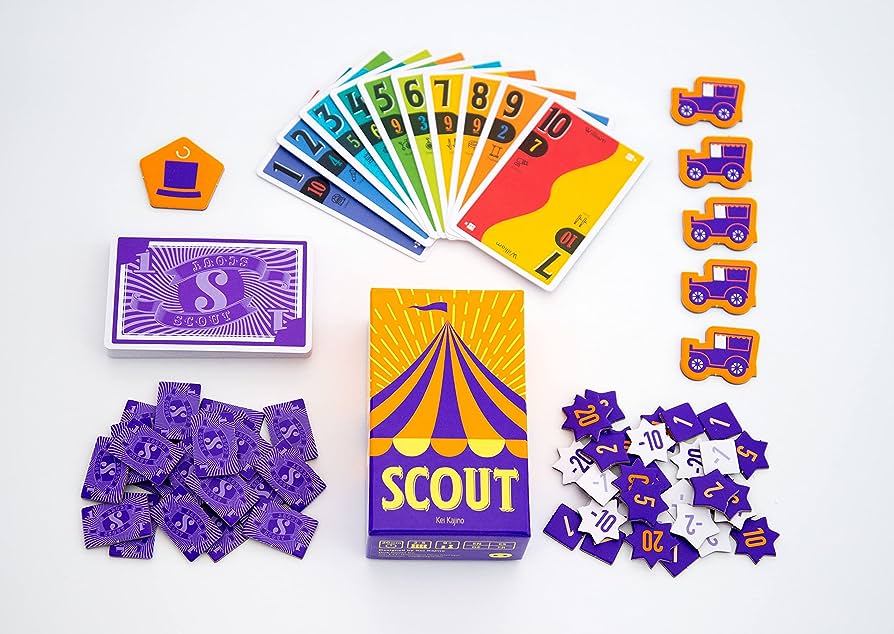
Scout Card Game Overview
Each player runs a circus show and competes to put on the best performances. The goal is to end each round with as few cards as possible while capturing cards from other players’ shows. The circus theme is light — it’s really a game about reading your hand, managing your options, and knowing when to take a card versus when to play.
SCOUT sits in the ladder-climbing family of card games, alongside classics like Tichu and The Great Dalmuti. But it differs from all of them in one fundamental way: you cannot rearrange the cards in your hand. What you’re dealt is the order you’re stuck with, and that single restriction creates every interesting decision the game has to offer.
| Detail | Info |
|---|---|
| Designer | Kei Kajino |
| Publisher | Oink Games |
| Year Released | 2019 |
| Players | 2–5 |
| Age Range | 9+ |
| Playing Time | 20 minutes |
| Game Type | Card Game — Ladder Climbing |
| Complexity Rating | 1.39 / 5 (BGG) |
What’s in the SCOUT Box?
Oink Games is known for squeezing full experiences into tiny boxes, and SCOUT is no exception. Everything fits inside a box roughly the size of a deck of playing cards.
| Component | Quantity | Notes |
|---|---|---|
| Dual-indexed cards | 45 | 57×88mm; each card has two different numbers (1–10), one on each end |
| Scout chips | 23 | Awarded when opponents scout from your played set |
| Scout & Show chips | 5 | One per player; used once per round |
| Score chips | 30 | Double-sided; denominations of 1, 2, 5, 10, and 20 |
| First Player marker | 1 | Passes each round |
| Rule sheets | 4 | English, Spanish, German, French |
The card stock is solid, and the dual-indexed design is clear enough that you won’t confuse which number is which. The colour coding on each value helps too. The score chips are thick enough to handle without fumbling, though the small box means everything fits tightly.
SCOUT Pros and Cons
Pros:
- The “no rearranging your hand” rule is simple to explain but generates real tension on every turn
- Games run about 15–20 minutes, making it easy to fit in multiple rounds during a session
- The dual-indexed cards mean every hand has two possible configurations, adding a layer of decision-making right from the deal
- Easy to teach — new players can start their first game within three minutes of opening the box
- The tiny box travels well; it fits in a jacket pocket
- Earned a Spiel des Jahres nomination, which speaks to its broad appeal across different gaming groups
Cons:
- The two-player variant uses modified rules that feel less natural than the 3–5 player game
- Players dealt strong adjacent runs have a clear advantage, and there’s no way to balance that through skill alone
- The circus theme is pasted on — you’ll forget about it after the first hand
- The small box, while portable, makes storage inside it a tight squeeze once components are unpacked
How to Play SCOUT
Setup
Shuffle all 45 cards, randomizing both order and orientation (flip some face-up, some face-down). Deal the entire deck evenly among players. Any leftover cards go face-down to the side.
Players pick up their dealt cards without reordering them. You then choose which end of your hand to read — rotate the whole hand 180 degrees if the other set of numbers looks better. Once you decide, you’re locked in for the round. Each player gets one Scout & Show chip.
Turn Actions
On your turn, you do one of two things:
Play (Show): Pick one or more adjacent cards from your hand that form a valid set — either all matching values or a consecutive run (ascending or descending). Your set must beat whatever is currently on the table. A set beats another if it has more cards, or is the same size but consists of matching values instead of a run, or has the same type and size but higher values. When you overplay someone’s set, you capture their cards face-down as points.
Scout: Take one card from either end of the set currently on the table and slot it anywhere into your hand, in either orientation. The player who originally played that set gets a 1 VP chip as a reward.
Once per round, you can use your Scout & Show chip to scout a card and then immediately play a set on the same turn.
End of Round and Scoring
A round ends when one player empties their hand or when every player except one has chosen to scout consecutively. Each player scores 1 point per captured (face-down) card and loses 1 point per card remaining in hand. Play as many rounds as there are players, then total the scores. Highest total wins.
Where to Buy SCOUT
| Retailer | Notes |
|---|---|
| Amazon | Usually in stock; Prime eligible in most regions |
| Cardhaus Games | Board game specialist retailer |
| Game Nerdz | Often has competitive pricing |
| Noble Knight Games | New and used copies available |
| Philibert | Good option for European buyers |
| eBay | Secondary market; check for edition details |
| BoardGameGeek GeekMarket | Peer-to-peer marketplace; various editions |
SCOUT Game Mechanics Explained
SCOUT uses three mechanisms: ladder climbing, hand management, and score-and-reset. The ladder-climbing part works like a traditional climbing game — each played set must outrank the previous one — but the locked hand order changes how you approach it. In most climbing games, you sort your hand and plan combos. Here, you scan left to right for adjacent groupings that form legal plays.
The scouting action is where the game separates itself. Taking a card from the table and inserting it anywhere in your hand lets you build new runs and sets that weren’t possible before. It’s a trade-off: you’re giving your opponent a point, but you might be setting up a play that clears three or four cards at once.
The score-and-reset structure means each round is independent. Bad luck in round one won’t snowball if you play well in later rounds. This keeps the game from feeling punishing, even when you get a rough deal.
If you enjoy card-driven board games, SCOUT’s mix of constraint and flexibility is worth experiencing. The closest comparison in feel is probably Stick ‘Em or No Thanks — games where a single restriction reshapes familiar mechanics.
Who Should Play SCOUT?
SCOUT works best with 3 to 5 players who want a quick card game with more bite than Uno but less commitment than a full evening game. It’s a strong opener or closer for game nights, and it plays well with mixed groups of experienced and newer gamers because the rules take almost no time to learn.
If your group enjoys games like The Crew or Hanabi — quick card games with clever twists on traditional formats — SCOUT fits that same shelf. The difference is that SCOUT is competitive rather than cooperative, so it scratches a different itch while sharing that “small box, big decisions” quality.
Skip it if you strongly dislike luck of the draw. The initial hand you receive matters a lot, and no amount of clever scouting can always overcome a truly scattered deal. Players who want full control over their strategy may find that frustrating over many plays.
For family game nights, SCOUT is a safe pick. The 9+ age rating is accurate — younger players can handle the rules, though they may not grasp the subtleties of when to scout versus play until a few rounds in.
FAQ
Is SCOUT good for beginners?
Yes. SCOUT has two actions to choose from on your turn: play cards or scout a card. The rules fit on a single page. Most new players understand the game within one practice round, and the 20-minute playtime means a rough first game doesn’t waste the evening.
How long does SCOUT take to play?
A full game runs about 15–20 minutes with experienced players. You play one round per player, so a five-player game takes slightly longer than a three-player one. Setup is under two minutes — shuffle, deal, pick your hand orientation, and go.
What’s the best player count for SCOUT?
Three or four players is the sweet spot. At these counts, the table has enough competition to make scouting decisions tense without rounds dragging. The two-player variant uses dummy cards and modified rules that change the feel of the game noticeably.
Is SCOUT worth buying?
At its typical price point of $15–$20, SCOUT delivers a lot of replay value. It earned a Spiel des Jahres nomination and an Origins Award, and it consistently holds a 7.8 rating on BoardGameGeek with over 28,000 ratings. For a game that fits in your pocket, that’s a strong track record.
What games are similar to SCOUT?
Tichu and The Great Dalmuti are traditional ladder-climbing games with different structures. Cat in the Box and Startups, both listed as fan favorites on BoardGameGeek alongside SCOUT, offer similar quick-play card game experiences. For a cooperative alternative, The Crew uses trick-taking in a team-based format.
