
Sagrada Board Game Review

Sagrada, designed by Adrian Adamescu and Daryl Andrews and published by Floodgate Games in 2017, is a dice-drafting puzzle game where 1 to 4 players construct stained glass windows by placing coloured and numbered dice into personal window frames. It plays in 30 to 45 minutes and is recommended for ages 14 and up. This review covers the base game edition sold in India, which includes an additional Hindi rulebook alongside the standard English rules.
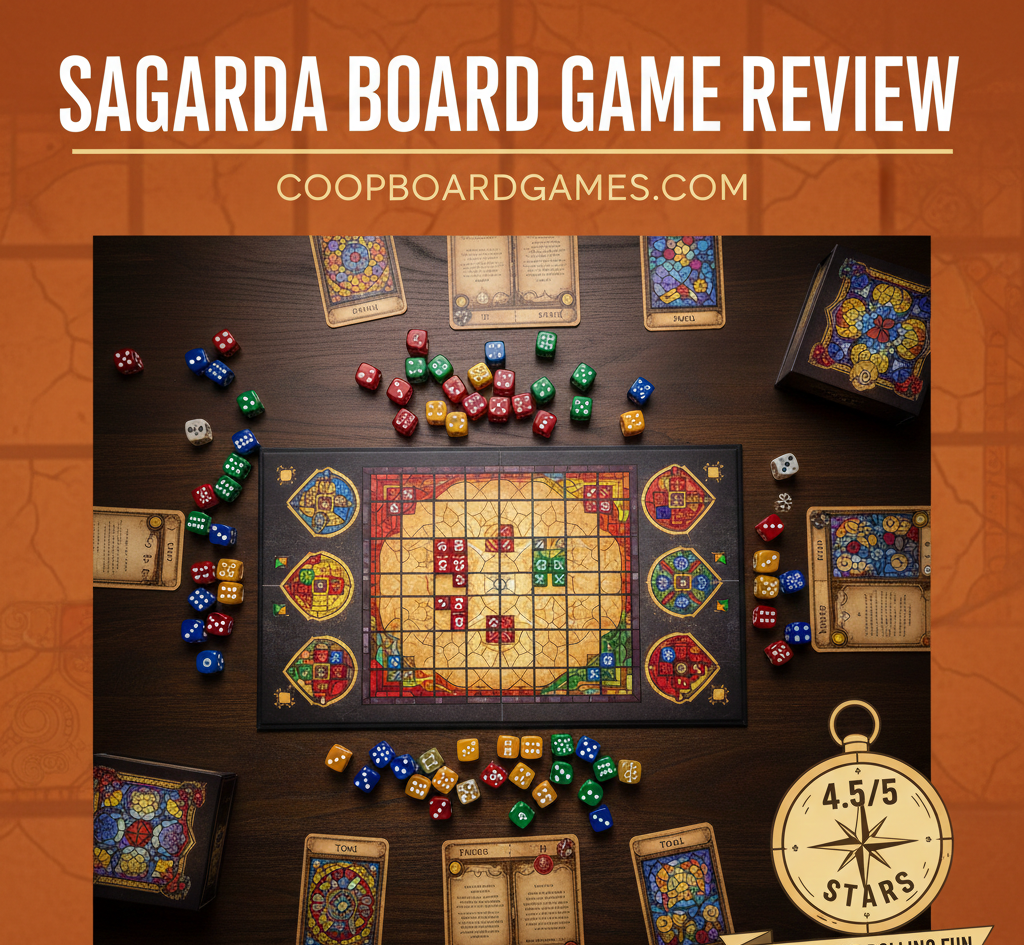
Sagrada Overview
In Sagrada, each player builds a stained glass window inspired by the breathtaking windows of the Sagrada Familia basilica in Barcelona. Every round, a pool of coloured translucent dice is drawn and rolled. Players draft one die at a time and slot it into their window frame, following placement restrictions based on colour and number. After ten rounds, scores are tallied from private objectives, public objectives, and leftover favour tokens, minus any empty spaces.
| Specification | Detail |
|---|---|
| Designer | Adrian Adamescu & Daryl Andrews |
| Publisher | Floodgate Games |
| Year Released | 2017 |
| Players | 1 to 4 |
| Age Range | 14 years and above |
| Playing Time | 30 to 45 minutes |
| Game Type / Category | Dice Drafting, Puzzle, Abstract Strategy |
| Complexity Rating | Light-Medium |
What’s in the Sagrada Box
The base box delivers an impressive component count for its price, centred on 90 translucent 12mm dice in five colours. These are the star of the show and they are genuinely eye-catching when scattered across the table. The cardboard quality is solid throughout, and the window frame boards have recessed spaces that hold the dice securely in place during play.
- 90 Translucent Dice (12mm, five colours)
- 4 Player Boards (Window Frames)
- 12 Window Pattern Cards (80 x 90mm)
- 12 Tool Cards (63 x 88.5mm)
- 15 Objective Cards (63 x 88.5mm)
- 1 Dice Bag
- 1 Round Track
- 4 Score Markers
- 24 Favour Tokens
- English and Hindi Rulebook
The window pattern cards are double-sided, giving 24 distinct window layouts in total. Colour-coded constraints are clearly printed and easy to read under normal lighting. The translucent dice catch light beautifully on the table, which reinforces the stained glass theme better than any artwork could.
Sagrada Pros and Cons
Pros
- Translucent dice create an immediately striking table presence that draws players in before a word of rules is spoken
- The puzzle scales naturally with difficulty: easier window cards for newcomers, harder ones for experienced players, without changing a single rule
- Tension builds organically each round as the pool of available dice gets drafted and the choices narrow
- Tool cards offer just enough decision-making flexibility to prevent any turn from feeling hopeless
- Short rules explanation makes the game genuinely accessible to people outside the hobby
- High replayability from randomised dice, varied window cards, and different objective combinations each session
Cons
- Downtime at four players is noticeable, particularly in later rounds when decisions become more involved and players puzzle through their options
- The draft order mechanic means the last player in a round consistently gets a thinner selection of dice, which some players find frustrating
- Randomness from the dice pool can occasionally produce a round where no useful colour or number is available, leaving a player with a bad forced choice
- The solo mode, while functional, lacks the tension created by other players competing for the same dice
How to Play Sagrada
Setup takes around ten minutes. Each player receives a window frame board and two double-sided window pattern cards. They choose one side of one card and slot it into their frame. The number of pips marked on the bottom of the chosen card determines how many favour tokens that player receives to start. More pips mean a harder window and more favour tokens to compensate.
Setup
- Deal each player a window frame board and two random double-sided window pattern cards.
- Each player selects one side of one pattern card and inserts it into their frame. Note the pip count on the bottom: this sets both the difficulty and the number of starting favour tokens.
- Deal each player one secret private objective card, face down.
- Place three tool cards and three public objective cards face up in the centre of the table.
- Place the round track at the top of the play area. It has ten spaces for tracking rounds.
Turn Structure
Each of the ten rounds begins with the first player drawing and rolling a number of dice from the bag. The formula is the number of players multiplied by two, plus one. In a three-player game, seven dice are drawn. Players then draft in a snake order: the first player picks, then the second, then the third, then the third again, then the second, and finally the first. One die remains and is placed on the round tracker as a marker for that round.
When placing a die, the first die must touch an edge of the window. Every subsequent die must be placed adjacent to an existing die, including diagonal adjacency. Two dice of the same colour cannot sit orthogonally next to each other, and neither can two dice showing the same number. Some window spaces show a colour or a number icon, and only matching dice can fill those spaces.
On their turn, a player may also spend favour tokens to activate one of the three tool cards on the table. The first use of any tool card costs one token. Every use after that costs two tokens. Tool cards offer abilities such as swapping placed dice, re-rolling a die, or retrieving a die from the round tracker instead of drafting from the pool.
Scoring and Win Conditions
After ten rounds, players score their private objective, which awards points equal to the sum total of the pip values on all dice of a specific colour in their window. Public objectives are scored by all players and reward patterns such as rows with no repeated colours, sets of all five colours, or diagonal chains. Players also score one point for each unused favour token and lose one point for each empty space remaining in their window.
Where to Buy Sagrada
| Platform | Edition Available | Notes |
|---|---|---|
| Amazon India | English / Hindi Edition | Frequently available with Prime delivery |
| Flipkart | English / Hindi Edition | Check for discounts during sale events |
| BoardsAndBeyond.in | English Edition | Specialist board game retailer in India |
| GetMeBoards.com | English Edition | Dedicated Indian hobby game store |
| Amazon (Global) | International English Edition | May include expansion availability |
Sagrada Game Mechanics Explained
Sagrada combines two core mechanisms: dice drafting and spatial puzzle placement. The drafting layer produces the tension. Every die pulled from the bag represents a resource that all players compete for simultaneously. Because the snake draft order means the middle players get fewer turns, early picks carry real weight. Players must decide not only which die fits their own window but also whether taking a particular die denies a critical resource to another player.
The placement puzzle layer is where the brain work happens. The colour and number adjacency restrictions mean that every die placed changes the available options for every surrounding space. A decision that looks efficient in round three can close off two spaces in round seven. This is the central tension of Sagrada: short-term gain versus long-term window health.
The tool cards act as a pressure-release valve. Without them, a single bad dice roll could strand a player with an unusable window space and no recourse. With them, players have ways to correct mistakes or push through constraints, but at a token cost that must be weighed against end-game scoring. Players who burn all their favour tokens early gain flexibility but lose the single point per token that adds up at the end.
The private objective creates hidden asymmetry. Two players filling what looks like identical windows may score very differently depending on which colour their private objective rewards. This gives each player a personal priority within the shared draft, which is what prevents Sagrada from becoming purely reactive. If you enjoy drafting games where your decisions affect others at the table, Sagrada delivers that interaction in a relatively relaxed format.
Who Should Play Sagrada
Sagrada works well as an entry point for people who enjoy puzzles but have little experience with hobby board games. The rules explain quickly, the visual appeal makes the game immediately inviting, and the difficulty adjusts through the window card selection rather than a rule change. A group mixing first-timers and experienced players can give the newcomers easy window patterns and the veterans the harder ones, and both groups will feel challenged.
Players who prefer games with near-zero randomness or deep strategic planning multiple turns ahead may find Sagrada frustrating. The dice roll introduces luck that no amount of planning can fully eliminate. What mitigates this is the snake draft: players always have multiple dice to choose from, so a single bad roll rarely destroys a position entirely.
Sagrada fits well in the same collection as light to medium puzzle games. It occupies a different space from worker placement or engine-building games, sitting closer to Azul or Barenpark in terms of the type of thinking required. If the group enjoys those games, Sagrada is worth trying. If the group prefers heavier strategic titles with more direct conflict, this may feel too gentle for regular rotation.
The solo mode is included in the base box and provides a competent solo challenge, though the absence of other players competing for dice removes the primary source of tension. Solo sessions are good for learning the placement rules before introducing the game to new players.
FAQ
Is Sagrada good for beginners?
Yes. The core rules cover a single page and explain quickly in around five minutes. New players can choose easier window pattern cards to reduce the placement challenge while learning. The mechanics of dice drafting and adjacency restrictions become clear within the first two rounds of play.
How long does a game of Sagrada take to play?
At two players, expect around 30 minutes. At four players, the snake draft and more complex late-game decisions can push the session to 50 or 60 minutes, slightly over the stated 30 to 45 minutes on the box. Setup and cleanup together add about 10 minutes.
What is the best player count for Sagrada?
Three players balances draft tension with manageable downtime. At two players the game moves quickly but the competition for dice is lighter. At four players the snake draft creates the most pressure on available dice, but turns take longer as decisions become harder in later rounds.
Does Sagrada have expansions?
Yes. Sagrada: The Great Facades is a series of expansions that introduce solo campaign modes and new challenges. There are also Promo Window Pattern Cards available separately. The base game is complete on its own and does not require any expansion for a full experience.
What games are similar to Sagrada?
Azul shares the spatial puzzle feel with less dice randomness. Barenpark and Patchwork both involve fitting pieces into personal boards. For more dice-heavy puzzle games, Roll Player offers a similar dice-placement experience with more complexity and a character-building theme.
