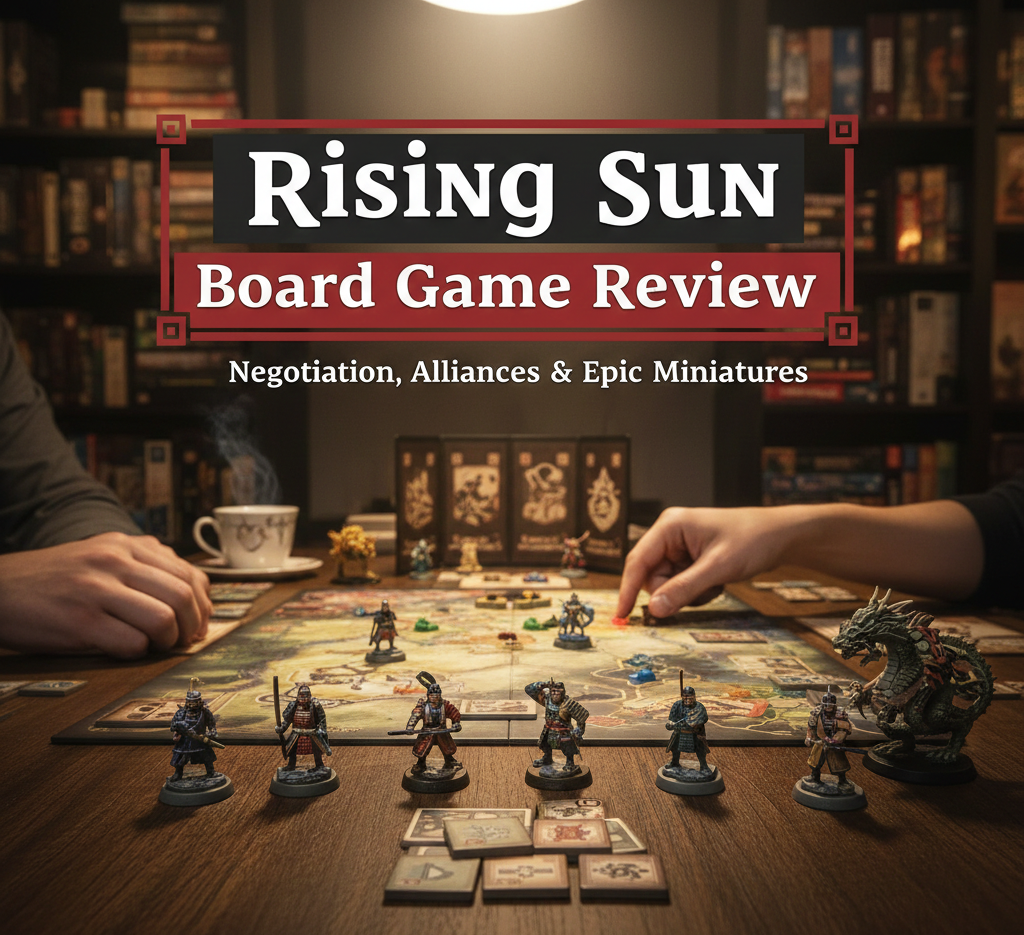
Rising Sun Board Game Review

Rising Sun, designed by Eric M. Lang and published by CMON Global Limited in 2018, is a feudal Japan-themed strategy game built around negotiation, alliance-building, and area control. It supports 3 to 5 players, runs about 90 to 120 minutes, and carries a recommended age of 14+. With a BGG complexity rating of 3.30 out of 5, it sits in that mid-heavy range where the rules are approachable but the decisions run deep. This review breaks down what the game offers and whether it belongs on your shelf.
Rising Sun Game Overview
Players each lead a mythological Japanese clan trying to accumulate the most Victory Points across three active seasons — Spring, Summer, and Autumn. Winter ends the game and triggers final scoring. The path to victory runs through political maneuvering, shrine worship, territorial battles, and temporary alliances that can be broken at any moment.
Each clan has a unique special ability, different starting honor, and varying seasonal income. These asymmetric powers push players toward different strategies from the first turn.
| Detail | Info |
|---|---|
| Designer | Eric M. Lang |
| Artist | Adrian Smith |
| Publisher | CMON Global Limited / Guillotine Games |
| Year Released | 2018 |
| Players | 3–5 |
| Age Range | 14+ |
| Playing Time | 90–120 minutes |
| Category | Strategy / Negotiation / Area Control |
| Complexity | 3.30 / 5 |
What’s in the Rising Sun Box
The box is packed. You get a full game board depicting Nippon’s eight provinces, five clan screens, seven shrine tiles, and ten political mandate tiles. The season card system includes 21 core cards plus three full sets (Horseman, Archway, Teapot) of 15 cards each, giving the game solid replay variety.
The miniatures are the standout. Each clan gets 10 figures — 6 Bushi warriors, 3 Shinto priests, and 1 Daimyo leader — plus there are 8 monster figures with oversized bases. The sculpt quality is high, with distinct designs for each clan and monster.
Beyond the figures, you’ll find 65 plastic coins, 20 ronin tokens, 24 war province tokens, 20 stronghold tokens, alliance tokens, and war number tokens. Component quality is strong across the board. The coins have good weight, and the clan screens are functional for hiding war bids.
How to Play Rising Sun
The game spans four seasons. Spring, Summer, and Autumn are active rounds. Winter is final scoring. Each active season follows the same five-phase structure.
Seasonal Setup
War province tokens get placed on the board — the number equals player count plus two. New season cards are laid out, and each player collects their seasonal income in coins. Starting in Summer, any hostage figures from the previous season get returned to their owners.
Tea Ceremony
Players negotiate alliances in pairs. Allied players gain bonuses during the political phase and avoid killing each other’s figures in battle. But alliances last only one season, and the Betray mandate can shatter them early. An unallied player loses those bonuses but gains total freedom of action.
Political Phase
This is the core of the game. Players take turns selecting political mandates across seven turns, broken up by three Kami worship turns. Mandates let you recruit figures, move forces, harvest resources, betray allies, or build strongholds. Your ally also benefits from the mandate you pick, so choosing the right action at the right time matters enormously.
War Phase
Battles happen only in provinces marked with war tokens. If two non-allied players both have forces in a province, they fight. Combat uses a blind bidding system across four war advantages: Seppuku (sacrifice your troops for honor and points), Take Hostage (capture an enemy figure), Hire Ronin (add mercenary force), and Imperial Poets (score points for all figures killed in the battle).
The twist: the winner of the battle pays their bid coins to the losers. So losing a battle you didn’t invest much in can actually leave you richer for the next fight.
Seasonal Cleanup
All coins and ronin tokens go back to the supply. Shinto figures return from shrines. Political mandates get reshuffled. Then the next season begins.
Rising Sun Game Mechanics
Rising Sun blends area majority, alliance negotiation, action drafting, and sealed-bid auctions. The political mandate system is the engine — each mandate you choose shapes both your position and your ally’s, creating constant tension between personal gain and shared benefit.
The war bidding mechanic sets this apart from other area control games. Rather than rolling dice or comparing static numbers, you split your coins secretly across four slots. Reading your opponents and bluffing your way through battles is where much of the game’s tension lives.
Honor acts as a persistent tiebreaker throughout. Ties in battle force, coin bids, and even final scoring all go to the player with higher honor. This makes honor management a quiet but constant concern.
Rising Sun Pros and Cons
| Pros | Cons |
|---|---|
| The blind bidding war system creates tense, memorable battles every game | Requires exactly 3–5 players — no solo or two-player option in the base game |
| Alliance and betrayal mechanics make negotiation feel genuinely high-stakes | First-time setup and rules explanation can take 30+ minutes |
| Miniature quality is excellent, with distinct sculpts for all clans and monsters | Players eliminated early from key provinces can feel sidelined in later battles |
| Three different season card sets add replay value out of the box | The honor tiebreaker system can feel punishing if you fall behind early |
| Asymmetric clan abilities push players toward different strategies each game | Table space requirements are large — the board and components need room |
| Losing battles can still be profitable through war reparations | At five players, downtime between turns can stretch |
Who Should Play Rising Sun
If your group enjoys games where talking, deal-making, and backstabbing are the main event, Rising Sun fits well. It rewards social play more than pure optimization. Players who prefer multiplayer solitaire or low-conflict euros will likely bounce off it.
Fans of Blood Rage will find familiar DNA here — same designer, same publisher, similar blend of drafting and combat. Rising Sun leans harder into negotiation, though, and the blind bidding replaces Blood Rage’s card-driven combat.
It also compares to Kemet in the area control space, though Kemet is more aggressive and less negotiation-dependent. Groups that enjoy Twilight Imperium but want something shorter will find Rising Sun scratches a similar itch in a fraction of the time.
The sweet spot is 4 players. At three, alliances feel lopsided since one player is always left out. At five, the game runs longer and downtime increases. Four gives the best balance of alliance options and game length.
Where to Buy Rising Sun
| Retailer | Notes |
|---|---|
| Amazon | Usually in stock; check for base game vs. bundled editions |
| Cardhaus Games | Board game specialty retailer |
| Noble Knight Games | New and used copies available |
| All Systems Go Games | Independent game shop |
| eBay | Secondary market; often has Kickstarter editions with extras |
| BoardGameGeek GeekMarket | Peer-to-peer sales from the board gaming community |
FAQ
Is Rising Sun good for beginners?
It depends on your group’s experience. The rules themselves are straightforward, but the negotiation and blind bidding layers add complexity that can overwhelm newer players. If your group has played a few strategy games before, you should be fine. Complete beginners may want to start with something lighter first.
How long does Rising Sun take to play?
Expect 90 to 120 minutes once everyone knows the rules. A first game with rules explanation can push past two hours easily. At five players, games trend toward the longer end. Four-player games tend to stay closer to 90 minutes after a few plays.
What is the best player count for Rising Sun?
Four players is the consensus sweet spot. It gives two clean alliance pairs with room for shifting politics each season. Three works but leaves one player permanently unallied each round. Five adds variety but increases downtime between turns and stretches the game length.
Is Rising Sun worth buying?
If your group likes negotiation-heavy games with strong table talk, it delivers. The miniatures and production quality justify the price for many buyers. If your group prefers quiet, low-interaction strategy or you rarely have 3+ players available, you may want to look elsewhere.
What games are similar to Rising Sun?
Blood Rage shares a designer and publisher with a similar draft-and-battle structure. Kemet: Blood and Sand offers comparable area control with more direct aggression. Ankh: Gods of Egypt rounds out Eric Lang’s mythology trilogy. Eclipse: Second Dawn brings similar alliance tension in a sci-fi setting.
