
Galactic Cruise Board Game Review

Galactic Cruise is a heavy euro game designed by T.K. King, Dennis Northcott, and Koltin Thompson, published by Kinson Key Games in 2025. Players compete as supervisors building luxury space cruise ships, managing resources, and sending guests on interstellar vacations. The game supports 1-4 players, takes 90-150 minutes to play, and carries an age recommendation of 14+. This review covers the gameplay, components, and whether Galactic Cruise belongs on your shelf.
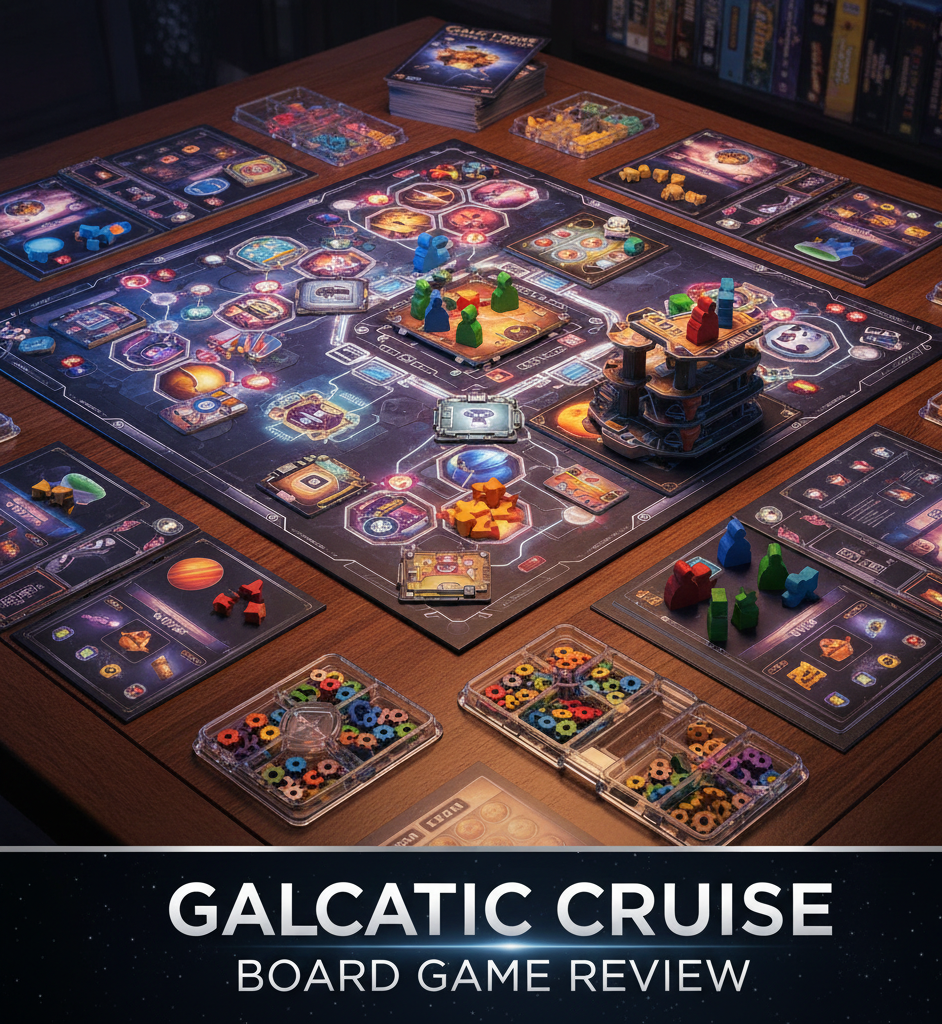
Galactic Cruise Overview
In Galactic Cruise, you run a division of a space tourism company. Your goal is to become CEO by earning the most victory points through launching cruises, completing company goals, and advancing your reputation. The game blends worker placement with engine building across an interconnected network of action spaces.
Each turn, you place a worker on a location to take two actions. These actions can come from your current space or any space connected by technology tokens. The catch: occupied spaces can be used, but doing so bumps the existing worker and rewards its owner with bonuses.
| Specification | Details |
|---|---|
| Designer | T.K. King, Dennis Northcott, Koltin Thompson |
| Artist | Ian O’Toole |
| Publisher | Kinson Key Games |
| Year Released | 2025 |
| Players | 1-4 |
| Age Range | 14+ |
| Playing Time | 90-150 minutes |
| Game Type | Heavy Euro, Worker Placement, Engine Building |
| Complexity Rating | 4.00 / 5 |
What’s in the Galactic Cruise Box
The component quality matches the premium price point. Ian O’Toole’s graphic design combines visual appeal with clear iconography. Everything has a designated spot in the included Game Trayz organizer, which holds sleeved cards and keeps components secure regardless of storage orientation.
| Component Type | Contents |
|---|---|
| Boards | 1 Main board (880x460mm), 1 Marketing board, 4 Dual-layer player boards |
| Tiles | 48 Blueprint tiles, 18 Cruise tiles, 15 Cockpit tiles, 15 Engine tiles, 8 Technology tiles, 6 Company Goal tiles, 6 Expert Worker tiles, 12 Action tiles, 9 Progress Track tiles |
| Tokens | 64 Money tokens, 48 Ad tokens, 32 Upgrade tokens, 5 Guest Bonus tokens |
| Wooden Pieces | 39 Development gears, 51 Cubes, 36 Guest meeples, 8 Workers, 8 Expert Workers, 15 Resource trackers |
| Cards | 36 Agenda cards, 15 Solo cards |
| Documentation | 48-page Rulebook, 16-page Reference book, 4 Player Aids (8 pages each) |
| Storage | 3 Game Trayz for components, 4 Player Trayz (rocket ship shaped) |
The dual-layer player boards feature recessed spaces that hold meeples, cogs, and tiles securely. Guest meeples come in three colors representing Family, Leisure, and Adventure travelers.
Galactic Cruise Pros and Cons
Pros
- Worker bumping creates constant interaction without direct conflict
- Technology network expands strategic options as the game progresses
- Reputation system offers meaningful trade-offs between scoring and immediate benefits
- Variable setup with randomized action spaces, technologies, and goals
- Outstanding component quality and storage solution
- Clear iconography despite initial learning curve
Cons
- Solo mode has complex bot rules that are easy to forget between plays
- 48-page rulebook may intimidate new players
- Cruise launching process takes time to internalize
- Two-player mode requires a dummy player
- High complexity limits the potential audience
How to Play Galactic Cruise
Setup
Place the main board centrally and shuffle the action tiles to create a randomized layout. Deal technology tiles, company goals, and expert worker tiles for the game. Each player takes a player board, starting resources, two workers, and a cruise consultant.
Turn Structure
On your turn, you choose one of three options. You can place a worker on any action space and take two actions from that space or connected spaces. Alternatively, you can launch a prepared ship to send guests on a cruise. Your third option is recalling all your earthbound workers to collect funding bonuses.
Actions include acquiring blueprints, constructing ship segments, attracting guests, building technologies, and advancing on the reputation track. Resource markets for food, oxygen, and fuel fluctuate based on player actions throughout the game.
Building and Launching Ships
Ship construction requires adding cockpit, engine, and segment tiles to your player board. Each segment tile provides either a one-time bonus or an ongoing ability. After construction, you schedule a cruise by placing a cruise tile, then advertise to attract matching guests.
Launching requires sufficient food, fuel, and oxygen for the journey. One of your workers becomes the pilot and leaves Earth until the cruise returns. As your ship visits destinations, you earn resources and victory points based on the guests aboard and the stops along the route.
Game End and Scoring
The Progress Track determines game length. Cubes are added when players complete company goals or launch ships. When sections fill, intermittent scoring occurs based on reputation and goal completion. The game ends when the final section fills, and the player with the most victory points becomes the new CEO.
Galactic Cruise Game Mechanics
The worker placement system stands out because spaces never block. Placing on an occupied space bumps the existing worker, rewarding its owner with a funding bonus. This encourages players to spread across the board while creating opportunities for opponents.
Technology tokens connect action spaces into networks. Using your own technologies costs nothing, but accessing opponent networks requires spending reputation or money. Each technology removed from your player board increases your storage capacity, creating tension between keeping technologies available and expanding resource limits.
The reputation track serves multiple purposes. Higher reputation earns victory points during scoring phases. It also reduces the cost of using opponent technologies and can be spent for emergency resources. Some agenda cards offer powerful effects in exchange for reputation, forcing decisions between long-term scoring and immediate tactical advantages.
Agenda cards break standard rules in significant ways. Selecting just two from the display when taking the draw action feels restrictive given how powerful each card can be. The refill mechanics reward patience—bonuses increase the longer players wait to refresh displays—but waiting too long lets opponents claim the rewards first.
Where to Buy Galactic Cruise
| Retailer | Notes |
|---|---|
| Amazon | Standard retail edition available |
| BoardGameBliss | Base game and expansions |
| Cardhaus Games | US-based retailer |
| Meeples Corner | UK-based option |
| Noble Knight Games | New and used copies |
| eBay | Secondary market listings |
Two expansions exist: Galactic Cruise: Accommodations and Galactic Cruise: Advancements. Both add new content to the base game.
Who Should Play Galactic Cruise
This game suits experienced players who enjoy heavy euros with interlocking systems. Fans of games like Ark Nova, Darwin’s Journey, or Vital Lacerda designs will find familiar satisfaction in building an efficient engine across multiple tracks and currencies.
The complexity rating of 4.0 out of 5 is accurate. New players should expect two or three games before the cruise launching process feels natural. The 48-page rulebook looks intimidating, but most rules are intuitive once explained. An official tutorial video covers everything if reading manuals isn’t your preference.
Groups of three or four players get the best experience. The two-player variant works but requires managing a dummy player. Solo players should know the bot has numerous rules and exceptions that take multiple plays to memorize.
Skip Galactic Cruise if your group prefers lighter fare or if your game nights rarely exceed 90 minutes. The setup and teardown add time beyond the listed play duration.
FAQ
Is Galactic Cruise good for beginners?
No. With a complexity rating of 4.0 out of 5 and a 48-page rulebook, Galactic Cruise targets experienced gamers. New hobbyists should try lighter euros first before tackling this level of complexity. The rules are intuitive once learned, but the initial learning curve is steep.
How long does Galactic Cruise take to play?
Expect 90-150 minutes depending on player count and experience. First games run longer as players learn the cruise launching process. Add 15-20 minutes for setup and teardown. Experienced groups can finish in under two hours.
What’s the best player count for Galactic Cruise?
Three or four players deliver the optimal experience. Worker bumping and technology sharing create more interaction at higher counts. Two players works with a dummy player, but the game loses some appeal. Solo mode functions but has complex bot rules.
Is Galactic Cruise worth buying?
For heavy euro fans, absolutely. The combination of worker placement, engine building, and the unique cruise launching system creates a deeply rewarding experience. Component quality matches the premium price. Skip it if your group prefers lighter or shorter games.
What games are similar to Galactic Cruise?
Fans of Ark Nova, Darwin’s Journey, Apiary, and Vital Lacerda games will find familiar appeal. The interlocking systems and engine building share DNA with these heavy euros. The theme and mechanics feel closest to Apiary among recent releases.
