
Critter Kitchen Board Game Review

Critter Kitchen comes from designers Alex Cutler and Peter C. Hayward, published by Cardboard Alchemy in 2025. Players run competing restaurants during Restaurant Week in Bistro Bay, sending three chefs into town to grab ingredients before rivals get there first. The game plays 1 to 5 players, suits ages 12 and up, and runs about 60 minutes. This review covers the components, the rules, the mechanics, and the kind of group that will get the most out of it.
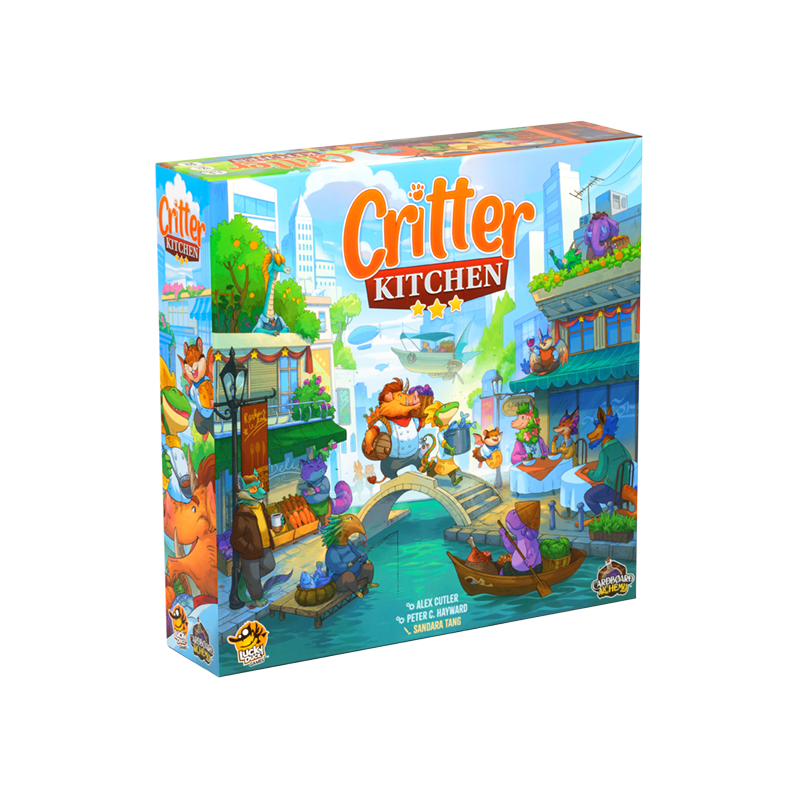
Critter Kitchen Overview
Every player runs a restaurant staffed by three animal chefs. You send them out to city locations, collect ingredients, and turn those ingredients into dishes.
Challenges come out in the first six rounds and pay stars for dishes that match their requirements. After round seven, everyone cooks one big meal for a visiting celebrity critic. Most stars wins.
| Designer | Alex Cutler, Peter C. Hayward |
|---|---|
| Publisher | Cardboard Alchemy |
| Year Released | 2025 |
| Players | 1 to 5 |
| Age Range | 12 and up |
| Playing Time | 60 minutes |
| Game Type | Family game, animal theme |
| Complexity Rating | 2.47 out of 5 (BoardGameGeek weight) |
| Artist | Sandara Tang |
What’s in the Critter Kitchen Box
The box is dense for a family game. Wooden meeples, a cloth bag, and a chipboard insert all come standard rather than as upgrade extras.
| Component | Quantity |
|---|---|
| Waterfront board (long) | 1 |
| Location gameboards (2 larger) | 8 |
| Player boards | 5 |
| Solo player mat | 1 |
| Folding player shields | 5 |
| Punchboard A (ingredients, spice, rumors, soup, stars, Zous Chefs) | 6 sheets |
| Punchboard B (player plates) | 5 sheets |
| Poker-size cards (locations, critics, challenges, restaurateurs, rumors, solo decks, reference) | 160 |
| Mouse, lizard and boar chef meeples | 5 of each |
| Chef hat meeples | 5 |
| Wooden round marker | 1 |
| Cloth bag, rulebook, chipboard insert | 1 each |
All the meeples are silk screen printed on both sides, so a mouse chef reads as a mouse from either seat. The cloth bag holds the ingredient tokens for random draws each round.
The folding shields matter more than they look. They hide your chef assignments until everyone reveals, which is the whole engine of the game.
Critter Kitchen Pros and Cons
What the game does well:
- Simultaneous planning keeps everyone busy. Nobody sits idle while a slow player thinks.
- The three chefs have different speeds and carry limits, so every placement is a real trade-off.
- Rumor tokens let you learn what the critic wants, which rewards paying attention instead of guessing.
- Variable critics, rumors and restaurateur powers change the target from game to game.
- Wooden meeples and a cloth bag in a mid-weight family box is generous.
- A solo mat and dedicated solo decks ship in the base game.
Where it falls short:
- The card text needs a crib sheet. BoardGameGeek rates language dependence as moderate for good reason.
- Two ingredients you counted on can vanish if two rivals send a fast chef to the same spot.
- The 12+ age rating is honest. Younger kids will struggle with the bidding and the ingredient math.
- Setup means punching and sorting a lot of tokens the first time out.
How to Play Critter Kitchen
Critter Kitchen Setup
Lay out the waterfront board and the eight location boards. Each player takes a player board, a shield, a plate, and three chefs: mouse, lizard and boar.
Deal a restaurateur card to each player for a special ability. Set aside a critic card face down and shuffle the challenge deck. Draw ingredient tokens from the cloth bag and place them at the city locations.
Critter Kitchen Turn Structure
Every round, players secretly assign their three chefs to location cards behind their shields. Everyone reveals at the same time.
Chefs resolve in speed order. The mouse arrives first but carries one item. The boar carries three but shows up last, so it takes whatever is left.
When more chefs want a location than it has ingredients, the faster chefs win the goods. Chefs can also pick up rumor tokens that reveal what the critic likes.
Critter Kitchen Win Conditions
Rounds 1 through 6 reveal challenges. Match a challenge’s ingredient requirements with a dish and you earn stars.
After round 7, everyone builds one final meal for the critic. Stars from challenges and the critic’s scoring combine, and the highest total takes the win.
Where to Buy Critter Kitchen
| Retailer | Notes |
|---|---|
| Cardboard Alchemy | Publisher store, base game and the A La Cart expansion |
| Amazon | Retail edition and expansion, widest availability |
| Miniature Market | US online retailer |
| Lucky Duck Games | Distribution partner store |
| Cardhaus Games | Stocks the expansion alongside the base game |
| BoardGameGeek GeekMarket | Used and Kickstarter copies from other collectors |
| eBay | Secondhand listings, including out-of-region editions |
Critter Kitchen Game Mechanics
The core is worker placement with different worker types, run as a sealed bid. You commit all three chefs before you see anyone else’s plan.
Speed is the currency. Sending the mouse to a crowded fish stall guarantees one ingredient. Sending the boar there gambles three slots on rivals staying away.
Rumors add hidden information that you can buy with a chef action. Spending a chef on a rumor costs you ingredients now for a better final meal later.
Challenge cards work as contracts. They tell everyone which ingredients pay out, which turns the shared board into a scramble for the same few tokens.
Restaurateur cards give each player a different ability, so two people can chase the same challenge by different routes. The result plays like a lighter, friendlier take on the blind planning in Food Chain Magnate, with a fraction of the rules load.
Who Should Play Critter Kitchen
Groups that like simultaneous action selection will get on with this fast. If you enjoy the reveal moment in games such as cooperative board games but want direct competition, this hits that spot.
It works best at 4 or 5 players. Locations get genuinely crowded, and reading opponents starts to matter more than optimizing your own board.
At two players the blocking thins out and the game becomes a puzzle about ingredient efficiency. The solo mode is a decent single-player option if that is your usual table.
Skip it if your group wants heavy euro depth. At 2.47 weight it sits closer to a family game night pick than a strategy centerpiece.
FAQ
Is Critter Kitchen good for beginners?
Yes, for players who have tried a worker placement game before. The rules are light at 2.47 weight, but the card text needs reading and the hidden bidding takes a round to click. Most groups pick it up by the second round of play.
How long does Critter Kitchen take to play?
About 60 minutes once everyone knows the rules. A first game with teaching and setup runs closer to 90 minutes. Turns resolve quickly because all players plan at the same time behind their shields instead of waiting for each other.
What is the best player count for Critter Kitchen?
Four or five players. Locations fill up, chef speed matters, and guessing where rivals will go becomes the main skill. Two-player games lose most of that pressure. A solo mat and solo decks are included for single-player sessions.
Does Critter Kitchen have an expansion?
Yes. Critter Kitchen: A La Cart adds content to the base game and changes the supported player count. It is sold through Amazon, Cardhaus Games and other hobby retailers. The base game plays fine on its own, so the expansion is optional.
What games are similar to Critter Kitchen?
Anyone who likes the blind chef planning in Food Chain Magnate will recognize the tension here at a much lighter weight. It also appeals to fans of animal-themed worker placement games where ingredient collection and set matching drive the scoring.
