
Captain Sonar Board Game Review

Captain Sonar puts two submarine crews in the same room and asks them to hunt each other by ear. Roberto Fraga and Yohan Lemonnier designed it, Matagot published it in 2016, and it still plays unlike almost anything else on the shelf. It handles 2 to 8 players, ages 14 and up, in 45 to 60 minutes. This review covers the components, the rules, the four crew roles, and who the game actually suits.
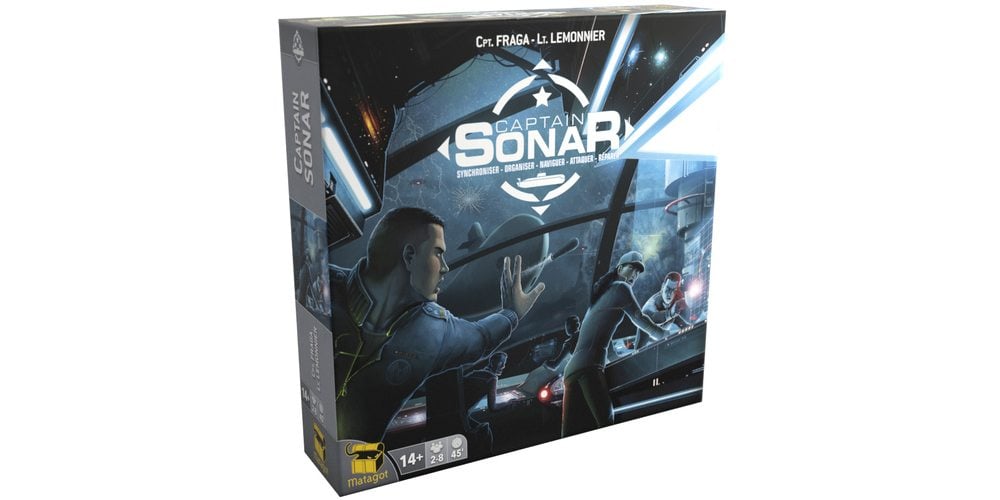
Captain Sonar Overview
Two teams sit on opposite sides of a long screen. Each crews one submarine and tries to sink the other before taking four points of damage itself.
Nobody sees the enemy boards. You only hear what the other side says out loud, which is why the captain must announce every course change.
| Designer | Roberto Fraga, Yohan Lemonnier |
|---|---|
| Publisher | Matagot |
| Year Released | 2016 |
| Players | 2–8 (best at 8) |
| Age Range | 14+ |
| Playing Time | 45–60 minutes |
| Game Type | Party, thematic, real-time deduction |
| Complexity Rating | 2.20 / 5 (BoardGameGeek weight) |
What’s in the Captain Sonar Box: Components
Open the box and you find no cards and no dice. The contents are paper, plastic and marker pens, which feels strange for a game this heavy.
| Component | Details |
|---|---|
| Screens | 2 screens, 28 x 113 cm each, split into two pieces |
| Role sheets | 2 sets of 12 double-sided map and role sheets |
| Radio Operator overlays | 2 transparent sheets, 28 x 28 cm |
| Markers | 8 erasable pens |
| Rulebook | 8 pages |
The screen is the heaviest piece and does the real work, blocking sight lines across a full table. The plastic overlays are the clever bit: you plot the enemy course on them, then slide it around the map to find a fit.
Sheets wipe clean. Five scenarios ship in the box: Alpha, Bravo, Charlie, Delta and Echo.
Captain Sonar Pros and Cons
Pros
- Real-time play creates real tension, and a torpedo hit lands like an event at the table.
- Rules are short enough to teach non-gamers in about ten minutes.
- Four roles mean four different jobs, not four copies of the same turn.
- Five maps ship in the box, and the harder ones have fewer islands, so hiding gets easier.
- The first mate role is simple, so a late arrival can join without a full rules recap.
Cons
- It needs eight players to shine. Gathering that many is the main barrier.
- Strategic depth is thin. The fun sits in execution, not planning.
- A captain who mumbles his moves wrecks the enemy radio operator’s game and starts arguments.
- Stress runs high, and radio operators burn out fast.
- Uneven team sizes tilt the game, since a three-player crew coordinates more quietly.
How to Play Captain Sonar
Setup
Assign four roles: captain, first mate, radio operator and engineer. Below eight players, some people double up.
Both teams pick the same map, set the screen between them, and each captain marks a starting square with an X.
Turn Structure
The captain announces a direction, then draws that step on his map. His path cannot cross itself, so a long run shrinks his options.
On the same announcement, the first mate charges one piece of equipment by a step and the engineer crosses out one component in the matching direction group. Turn-by-turn rules exist, but the game is built for real time.
Using Equipment
Equipment fires only when fully charged and undamaged on the engineer’s board. When the captain announces a use, both teams stop and resolve it.
The drone names a sector and the enemy captain must answer truthfully. Sonar forces him to give two facts from sector, row and column, one true and one false.
Torpedoes strike up to four steps away for two damage on target, one adjacent. Mines do the same but sit on the board until detonated. Silence moves you up to four steps without announcing anything.
Surfacing and Win Conditions
Surfacing erases your drawn path and repairs every breakdown. The cost is steep: you announce your current sector, and your crew must trace four sections of the submarine outline without touching the edges, initialling each one, while the enemy plays on.
The fourth damage point sinks you, whether it came from a torpedo or your own engineer’s mistakes. Last submarine floating wins.
Where to Buy Captain Sonar
| Platform | Notes |
|---|---|
| Amazon | Base game and Upgrade One expansion |
| Miniature Market | Bermuda Triangle map expansion |
| Noble Knight Games | Base game plus Upgrade One |
| BGG GeekMarket | Used copies, including first-print English editions |
| eBay | Multilingual and out-of-print editions |
Captain Sonar Game Mechanics Explained
Hidden movement drives everything. You know your own position and nothing else, so the game becomes an audio deduction problem.
Line drawing turns that deduction into a physical act. The radio operator traces the enemy path on plastic, then slides the overlay across his map hunting for a spot where it fits without crossing an island.
The engineer’s board is the sharpest design here. Every move breaks something, and coloured circuits reset a group of four when all four break, so the engineer steers the captain toward free repairs.
Real time is the multiplier. No single decision is hard, but making all four at once while an enemy captain shouts coordinates is where the game lives. It rewards teams that communicate well over teams that plan well.
Who Should Play Captain Sonar
Groups of eight who like noise. Captain Sonar suits offices, clubs and parties, not a quiet Tuesday couple.
It handles mixed experience levels. Put a new player on first mate, an attentive listener on radio operator, and someone who projects in the captain’s chair.
Fans of large-group party games will get more from it than fans of heavy euros. Groups who prefer long turns and deep planning should skip it.
Next to Deception: Murder in Hong Kong or Two Rooms and a Boom, Captain Sonar gives each player a concrete job instead of a social read. The closest alternative is Sonar, the two-to-four player reimplementation.
FAQ
Is Captain Sonar good for beginners?
Yes. The rules run eight pages and teach in about ten minutes. Each role has one main job, so new players only learn their own board. Start beginners on first mate, which charges equipment one step at a time, then move them to engineer or captain once they have seen a full game.
How long does Captain Sonar take to play?
A game runs 45 to 60 minutes, though a decisive early torpedo can end one much faster. Setup takes a few minutes: hand out role sheets, stand the screen, and mark starting positions. Groups often play two games back to back so players can swap roles.
What is the best player count for Captain Sonar?
Eight, with four players per team. Every role gets its own person, and the communication problem the game is built around actually appears. Smaller counts force players to double up, which makes coordination quieter and easier, and gives that team an advantage over a full four-player crew.
Does Captain Sonar have expansions?
Yes. Upgrade One adds new equipment and rules, and separate map expansions include Bermuda Triangle, Chicago, Foxtrot and New York. The base box already ships five scenarios, so most groups play for a long time before needing more maps.
What games are similar to Captain Sonar?
Sonar is the direct reimplementation for two to four players. For real-time team pressure, look at Space Alert. For hidden movement, Scotland Yard and Fury of Dracula cover similar ground at a slower pace. Deception: Murder in Hong Kong suits groups who want the crowd size without the clock.
