
Camel Up Board Game Review

Camel Up (Second Edition), designed by Steffen Bogen and published by eggertspiele in 2018, delivers chaotic camel racing wrapped in a betting game. This Spiel des Jahres winner supports 3-8 players, plays in 30-45 minutes, and works for ages 8 and up. The game combines luck-driven racing with strategic wagering, creating moments of tension and laughter around the table.
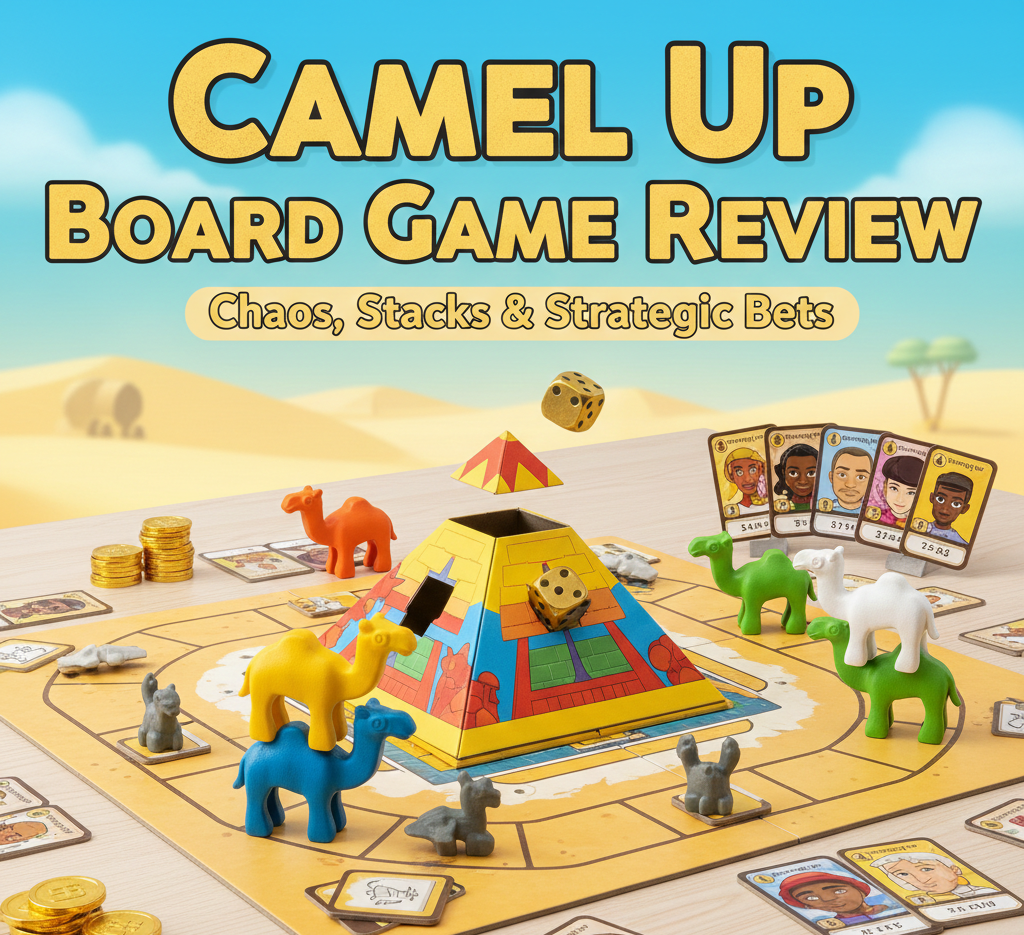
Camel Up Game Overview
Players bet on five racing camels circling a pyramid-themed track. The twist? Camels stack on top of each other when they land on the same space. A camel carrying others moves the entire stack forward, completely reshuffling the race order in seconds.
Your goal is to end with the most Egyptian Pounds. You earn money by correctly predicting which camel leads at the end of each leg and which camel wins or loses the entire race.
| Attribute | Details |
|---|---|
| Designer | Steffen Bogen |
| Publisher | eggertspiele / Plan B Games |
| Year Released | 2018 |
| Players | 3-8 |
| Age Range | 8+ |
| Playing Time | 30-45 minutes |
| Game Type | Family / Party |
| Complexity Rating | 1.51 / 5 (Light) |
What’s in the Camel Up Box
The Second Edition upgraded the components from the original 2014 release. The centrepiece is the cardboard pyramid with a built-in dice dispenser—shake it, press the slider, and one die tumbles out.
| Component | Quantity |
|---|---|
| Game board | 1 |
| Dice pyramid | 1 |
| Racing camels | 5 |
| Crazy camels (grey/black) | 2 |
| Engraved dice | 5 racing + 1 grey |
| Leg betting tiles | 15 |
| Pyramid tiles | 5 |
| Race betting cards | 40 |
| Desert tiles | 8 |
| Egyptian Pound coins/cards | 70 |
| Partnership cards | 8 |
The camel meeples are chunky and stack securely. The engraved dice feel premium compared to standard printed dice. Overall, the production quality matches the game’s price point well.
Camel Up Pros and Cons
Pros
- Accommodates up to 8 players without dragging
- The pyramid dice dispenser creates genuine excitement
- Rules explanation takes under 10 minutes
- Stacking mechanic generates unpredictable comebacks
- Works well with mixed ages and gaming experience
- Crazy camels variant adds replay value
Cons
- Heavy luck factor can frustrate strategic players
- Less engaging with only 3 players
- Early betting often feels like guessing
- Pyramid occasionally jams or releases multiple dice
How to Play Camel Up
Setup
Place the board centrally. Stack leg betting tiles by colour with highest values on top. Each player receives five race betting cards and one desert tile in their chosen character colour, plus 3 Egyptian Pounds starting money. Roll all five dice to determine starting camel positions.
Turn Actions
On your turn, pick one of four actions. First option: take a leg betting tile to bet on which camel leads when this leg ends. Earlier bets pay more if correct. Second option: place your desert tile on an empty track space to affect camels landing there.
Third option: shake the pyramid and release one die. Move that coloured camel 1-3 spaces based on the result. Collect a pyramid tile worth 1 Egyptian Pound at leg end. Fourth option: place a race betting card face-down on the winner or loser pile to predict the race outcome.
Camel Movement
When a camel moves onto an occupied space, it lands on top of any camels already there. Moving camels carry all camels stacked above them. The camel on top of a stack always ranks ahead of camels beneath it.
Leg Scoring
Once all five dice leave the pyramid, a leg ends. Players score their leg betting tiles: correct first-place bets pay 5, 3, or 2 pounds depending on timing. Second-place bets pay 1 pound. Wrong bets cost 1 pound. Return tiles to the board and reload the pyramid.
Race End
The race finishes when any camel crosses the finish line. After final leg scoring, reveal the winner and loser betting piles. Correct early predictions earn 8, 5, 3, 2, or 1 pound. Every wrong prediction costs 1 pound. Highest total wins.
Where to Buy Camel Up
| Retailer | Region |
|---|---|
| Amazon | Worldwide |
| BoardGameBliss | Canada |
| Noble Knight Games | USA |
| Zatu Games | UK |
| BoardGameGeek Market | Worldwide |
Camel Up Game Mechanics
Betting and bluffing form the core experience. You assess probabilities based on remaining dice and camel positions, then commit money before outcomes resolve. The leg betting system rewards reading the race state and acting before opponents claim high-value tiles.
The stacking mechanic creates cascading effects. One die roll can carry a trailing camel from last to first. Desert tiles add player agency—place your oasis to push favoured camels forward or your mirage to drop opponents backward and collect coins when triggered.
Race betting introduces hidden information. You cannot see what camels opponents backed, creating tension around the final reveal. Timing matters: bet early for bigger rewards, but risk backing a camel before the race picture clarifies.
Who Should Play Camel Up
Camel Up suits groups wanting light competition without heavy rules overhead. It shines at 5-7 players where betting races feel crowded and outcomes stay unpredictable. Family gatherings and party settings match the game’s energy well.
Players seeking deep strategy will find less satisfaction here. The dice determine movement, and no amount of planning fully controls outcomes. If you enjoy games like Ticket to Ride or party games where luck blends with light tactics, Camel Up fits that space.
Skip this if your group dislikes gambling mechanics or randomness deciding winners. The game works poorly at 3 players where betting options thin out and the race feels less dynamic.
FAQ
Is Camel Up good for beginners?
Camel Up works well for beginners. The rules take about 10 minutes to explain, turns offer only four simple choices, and the luck element keeps new players competitive against experienced ones. The visual stacking mechanic makes game state easy to read.
How long does Camel Up take to play?
Most games finish in 30-45 minutes. Setup takes 5 minutes. Player count affects length slightly—larger groups mean more betting activity but turns stay quick. The race typically lasts 3-5 legs depending on dice rolls.
What’s the best player count for Camel Up?
Camel Up plays best with 5-7 players. This range creates competitive betting without excessive downtime. At 3 players, the game loses energy. At 8 players, it stays fun but individual impact decreases slightly.
What are the crazy camels in Camel Up?
The Second Edition includes two crazy camels (grey and black) that run backwards around the track. They add unpredictability—landing on a crazy camel moves your camel backward. This variant increases chaos and suits groups wanting extra randomness.
What games are similar to Camel Up?
Try Downforce for racing with betting mechanics and more strategic card play. Ready Set Bet offers pure betting excitement. For family-weight games with luck and tension, consider Diamant or The Quacks of Quedlinburg.
