
Calico Board Game Review

Calico is a tile-laying puzzle game by designer Kevin Russ, first published by Flatout Games in 2020 and now distributed by AEG. You sew a quilt from hexagonal patch tiles, earn buttons for colour groups, and lure cats with pattern combinations. It plays 1 to 4 players, ages 10 and up, in 30 to 45 minutes. This review covers the components, rules, scoring and who the game suits so you can decide whether it belongs on your shelf.
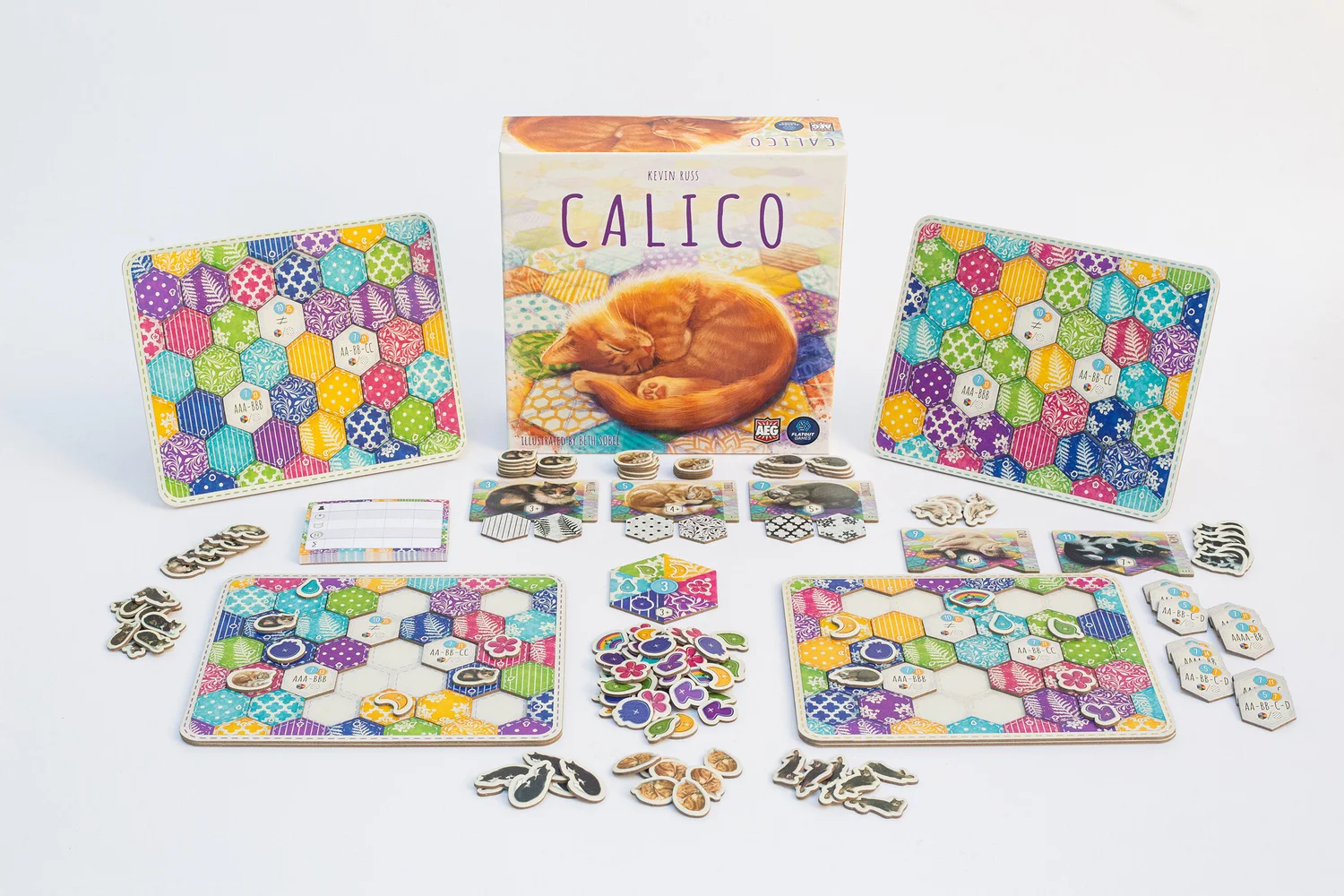
Calico Game Overview
Each player builds a quilt on a personal hex board. Tiles come in six colours and six patterns, and every placement serves three scoring systems at once: buttons, cats and design goals. The only interaction is taking a market tile someone else wanted.
| Designer | Kevin Russ |
|---|---|
| Artist | Beth Sobel |
| Publisher | Flatout Games / AEG |
| Year Released | 2020 |
| Players | 1 to 4 |
| Age Range | 10+ |
| Playing Time | 30 to 45 minutes |
| Game Type | Abstract strategy, tile placement, puzzle |
| Complexity Rating | 2.20 / 5 (BoardGameGeek weight) |
What’s in the Calico Box
The dual-layer quilt boards are the standout piece: tiles drop into recessed hexes and stay put if the table gets bumped.
| Component | Count | Notes |
|---|---|---|
| Dual-layer quilt boards | 4 | Thick cardboard with recessed hex slots |
| Patch tiles | 108 | Six colours by six patterns, three copies each |
| Design goal tiles | 24 | Four sets of six, one set per player |
| Cat scoring tiles | 5 | Double-sided, ten cats in total |
| Cat tokens | 80 | Chunky cardboard, each cat has its own art |
| Button tokens | 52 | Eight per colour plus four rainbow buttons |
| Black and white patch tiles | 6 | Mark which patterns each cat likes |
| Extras | 1 each | Cloth bag, score pad, button scoring tile, master quilter tile, rulebook |
Beth Sobel’s art gives every cat a personality, and the patterns are distinct enough to read across the table.
Calico Pros and Cons
Pros:
- Turns take seconds, so four-player games rarely drag past 45 minutes.
- The three scoring systems pull against each other, which makes every placement a real choice.
- Cat and goal tiles change each game, so no two quilts score the same way.
- Family mode strips out the design goals for a lighter game with kids.
- The solo mode works with no extra components, just a target score.
Cons:
- The last third of the game can lock up. A bad market draw with two spaces left can cost a cat worth 11 points.
- Almost no player interaction. If you want to block or race opponents, look elsewhere.
- Colour groups and pattern groups often overlap, and new players find it hard to track both at once.
- The cozy theme hides a tight puzzle. Some families expecting a relaxed game find it stressful.
How to Play Calico
Calico Setup
Pick one cat from each of the three difficulty groups and give each two black and white pattern tiles to show which patterns it wants. Each player takes a quilt board, draws four of their six design goal tiles, keeps three, and places them in the marked hexes. Deal two patch tiles to each player and reveal three more as the market. Setup takes about five minutes.
Calico Turn Structure
On your turn, place one tile from your hand into any empty hex on your quilt. Then check for scoring. Three or more touching tiles of the same colour earn a button worth three points. A cluster of matching patterns that meets a cat’s size or shape requirement attracts that cat. Finally, take one of the three market tiles into your hand and refill the market from the bag.
Calico Scoring and Win Conditions
The game ends when every quilt is full, which takes 22 turns each. Add up buttons, cats and design goals. A design goal scores when the six tiles around it match its rule, for example three pairs of colours or patterns, with a bigger bonus if you satisfy both colour and pattern. Collecting one button of every colour earns a rainbow button for three more points. Highest total wins, and ties go to whoever has more buttons.
Where to Buy Calico
| Platform | Edition | Typical Price |
|---|---|---|
| AEG / local game stores | Physical, MSRP | $39.99 |
| Amazon (US and international) | Physical | $35 to $50 before shipping |
| Amazon India | Physical import | Around Rs 7,242 |
| Indian specialty stores (Cryptic Cardboard, Gameistry) | Physical | Rs 2,459 to 2,749 when stocked |
| Steam | Digital | $11.99 (Rs 399); bundle with art book and soundtrack $23.96 |
| Apple App Store | Digital | Varies by region |
| Tabletopia | Online tabletop | Free with account |
Calico Game Mechanics
The core mechanism is open drafting from a three-tile market combined with grid coverage on a hex board. You always hold two tiles, so you can plan one move ahead but never further.
Enclosure drives the tension. Once a design goal’s six neighbours are filled, its score is locked. Cats and buttons need clusters, and those clusters compete for the same hexes.
The design that makes Calico different from Cascadia, its sibling from the same publisher, is that a single tile carries two scoring attributes. A blue stripes tile can complete a blue button group and a stripes cat cluster in one placement. Finding those double-duty spots is where good players separate from average ones.
Who Should Play Calico
Calico suits players who enjoy quiet spatial puzzles. If you like Patchwork or Azul but want more scoring layers, this is a natural next step. It also works well as a solo game on a weeknight.
Couples get the most from it, since two players finish in about 30 minutes with little downtime, which is why it turns up on lists of couples board games.
Skip it if your group wants to talk and trade during play, or if anyone dislikes losing points to a bad tile draw. Compared with Cascadia, Calico is tighter and less forgiving.
FAQ
Is Calico good for beginners?
Yes, with a caveat. The rules take five minutes to teach: place a tile, take a tile. The hard part is juggling buttons, cats and goals at once. Start new players in family mode, which removes the design goals, then add them once the button and cat scoring feels natural.
What is the best player count for Calico?
Two or three players is the sweet spot. Turns are fast at any count, but with four the market changes so much between your turns that planning becomes guesswork. Solo play is also strong, since the puzzle does not depend on opponents at all.
How long does Calico take to play?
Plan on 30 minutes for two players and 45 for four, plus five minutes of setup. Every player takes exactly 22 turns, so game length is predictable. Analysis paralysis near the end of the game is the main thing that stretches it.
Does Calico have any expansions?
The Calico Cats mini expansion adds two cats, Luna and Shop Cat, plus new scoring options. Knitting Circle, released in 2025, is a standalone follow-up about knitting garments that integrates with Calico. A further mini expansion was included with the Knitting Circle Kickstarter campaign.
What games are similar to Calico?
Cascadia is the closest match, sharing a publisher and the tile-and-token format with a looser puzzle. Patchwork and Azul cover the same abstract pattern-building space at two players. Harmonies offers a similar hex-based puzzle with stacked tokens and animal cards for scoring.
