
Bubble Tea Board Game Review

Bubble Tea is a real-time spatial puzzle game by Taiwanese designer Aza Chen, first released through Li-He Studio in 2016 and brought to a wider audience by Renegade Game Studios in 2019. Players race to layer transparent ingredient cards onto a drink base to match a customer order. It plays in about 20 minutes, suits 1 to 5 players, and carries an age rating of 8 and up. This review covers the components, the two ways to play, and who the game actually suits.
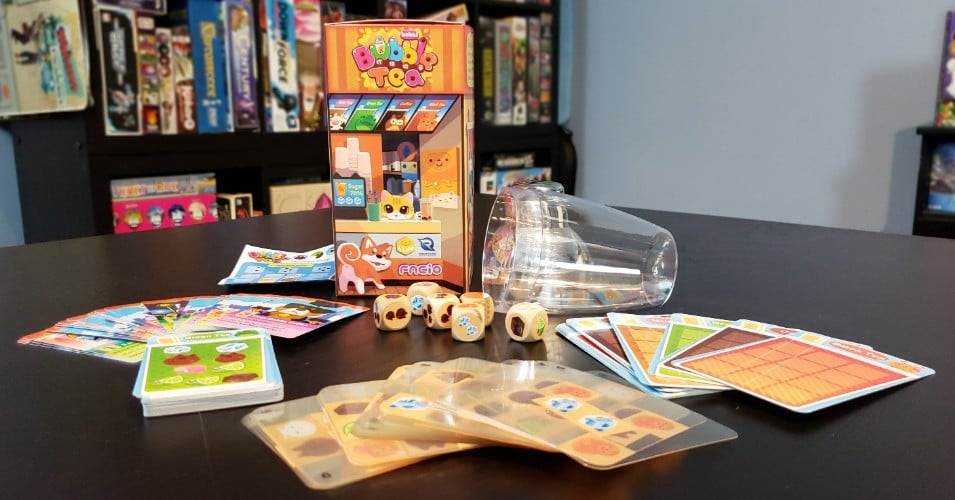
Bubble Tea Game Overview
The theme is a boba shop. Each player works their own drink station, and the goal is to assemble a tea that matches what the next customer wants before anyone else manages the same. Speed and pattern matching decide every round.
You win by collecting three Customer cards. There is no point salad and no long endgame. The first person to fill three orders correctly takes the shop.
| Designer | Aza Chen |
|---|---|
| Publisher | Li-He Studio (2016), Renegade Game Studios (2019) |
| Year Released | 2016 |
| Players | 1 to 5 |
| Age Range | 8 and up |
| Playing Time | About 20 minutes |
| Game Type | Real-time, dice, spatial puzzle |
| Complexity Rating | 1.0 out of 5 (very light) |
What’s in the Bubble Tea Box
The box is one of Renegade’s odd shapes, taller than it needs to be, which makes it stand out on a shelf. Inside, the contents are simple but well chosen.
- Transparent plastic ingredient cards, called Moji Moji cards, that you stack and overlap to build a drink.
- Tea Base cards that act as the bottom layer of each order.
- Customer cards showing the combination you need to recreate.
- A set of dice you sticker yourself before the first game.
- A plastic drink shaker for rolling the dice and signalling a finished cup.
The transparent cards are the standout. Layering them so the right colors and shapes show through is the heart of the puzzle. The art carries Aza Chen’s usual round-faced animals, and pieces reuse characters from his other titles like Shiba Inu House. The shaker is more of a toy than a tool, but kids enjoy it.
Bubble Tea Pros and Cons
- Teaches in two minutes. Anyone at the table can join a round without a rules lecture.
- The transparent layering puzzle is genuinely clever and reads well at a glance.
- Plays fast, so a full game rarely outstays its welcome.
- Works as a quick filler between heavier games or as a starter for younger players.
- The solo mode gives you a timed personal challenge against your own best run.
- You have to apply dice stickers yourself, and a misplaced sticker can affect play.
- Real-time speed games favor quick reactors, so the same person often wins.
- The shaker adds noise without adding much to the actual decisions.
How to Play Bubble Tea
Bubble Tea includes two modes. Both share the same idea: build a drink that matches a target as fast as you can.
Setup
Give each player a Tea Base card and their set of transparent Moji Moji cards. Place the Customer cards within reach of everyone. Setup takes a minute or two once the dice are stickered.
Round Structure
In the dice version, one player rolls the six dice in the shaker. The faces show the ingredients needed. Everyone then races to layer their transparent cards over their base so the shapes line up with the rolled result.
In the card version, players flip a Customer card together on a count of three and rush to match that order instead. The first to finish grabs the shaker or calls out, and the table checks the layering against the target.
Winning
A correct, first-place build earns one Customer card. Collect three Customer cards and you win the game.
Bubble Tea Game Mechanics
The core mechanic is real-time pattern matching through tile placement. Because the ingredient cards are see-through, the puzzle is about stacking order, not just which pieces you pick. A green topping under a brown one looks different from the reverse, so you read the order top to bottom as you build.
The dice introduce a shared, random target each round, which keeps everyone solving the same problem at once. There is no take-that and no blocking. Your only opponent is your own hands and the clock.
The two modes change the pressure slightly. Dice rolls feel chaotic and loud, while the Customer card flip feels cleaner and more head-to-head. Both reward people who can spot a layout and execute it without second-guessing.
Who Should Play Bubble Tea
This is a pick for family game night first. It lands well with kids around age eight, mixed-age groups, and anyone who likes the speed of Set or the simplicity of a quick filler. If your table enjoys other real-time board games, the format will feel familiar even though Bubble Tea is competitive rather than cooperative.
It also scales for slightly larger nights, holding up well as a warm-up before heavier titles. Skip it if your group wants strategy with depth or dislikes speed games, since reaction time decides most rounds and the puzzle stays shallow after several plays.
Where to Buy Bubble Tea
The Renegade edition carries a US list price around $20, though stock and price vary by region. These retailers regularly list it.
| Platform | Notes |
|---|---|
| Amazon | Renegade edition, varies by stock |
| Board Game Bliss | Canadian retailer, ships widely |
| board-game.co.uk | UK stockist |
| BoardGamePrices.com | Compares current store prices |
FAQ
Is Bubble Tea good for beginners?
Yes. The rules take about two minutes to explain, and the complexity rating sits at 1.0 out of 5. New players and children around age eight can join a round straight away, since the game asks for fast pattern matching rather than learned strategy, which makes it a solid gateway game.
How long does Bubble Tea take to play?
A full game runs about 20 minutes. Individual rounds last under a minute each, and you collect three Customer cards to win, so the game ends quickly. That speed makes it a good filler between longer titles or a warm-up at the start of a night.
What’s the best player count for Bubble Tea?
It plays well from 2 to 5, with 3 or 4 hitting the sweet spot for shared dice rolls and tight finishes. A solo mode lets one player race their own best time. At five, the table gets loud but stays manageable thanks to the short rounds.
Is Bubble Tea worth buying?
It is worth it if you want a light, fast, family-friendly puzzle race with strong art. The transparent layering idea holds up and travels well. Skip it if your group prefers strategy with depth, since reaction speed decides most rounds and the puzzle stays simple.
What games are similar to Bubble Tea?
Set is the closest comparison, sharing the real-time pattern spotting. Fans of quick reaction games like Dobble or speed-stacking puzzles will recognize the rhythm. Other Aza Chen titles such as Shiba Inu House share the artwork and the light, fast design approach.
