Bloodborne Board Game Review

Bloodborne: The Board Game is a cooperative campaign adventure designed by Eric M. Lang and Michael Shinall, published by CMON in 2021 after a Kickstarter campaign that raised over $4 million. It adapts FromSoftware’s gothic action game for one to four Hunters, ages 14 and up, with a complexity rating of 3.08 out of 5. This review covers the components, combat, and campaign structure so you can decide whether it belongs on your table.
Bloodborne: The Board Game Overview
The game is set in Yharnam, a city once known for its healing techniques and now overrun by a plague that turns its residents into beasts. Players take the role of Hunters who work together against the game itself, moving through the streets, fighting monsters, and piecing together the source of the plague as they go.
The board is not laid out in advance. Tiles are drawn from a campaign-specific deck and added as the Hunters explore, so the exact shape of a mission only becomes clear as you play it. On BoardGameGeek, Bloodborne carries a 7.7 average score across more than 4,500 ratings, and ranks 775th overall and 146th among thematic games, putting it among the more recognized cooperative board games released in the last five years.
| Category | Details |
|---|---|
| Designer | Eric M. Lang, Michael Shinall |
| Publisher | CMON Global Limited |
| Year Released | 2021 |
| Players | 1 to 4 |
| Age Range | 14 and up |
| Playing Time | 45 to 75 minutes per chapter (players report sessions can stretch toward 90 minutes) |
| Game Type / Category | Thematic, adventure, exploration, fantasy, horror, cooperative |
| Complexity Rating | 3.08 out of 5 |
What’s in the Box: Bloodborne Board Game Components
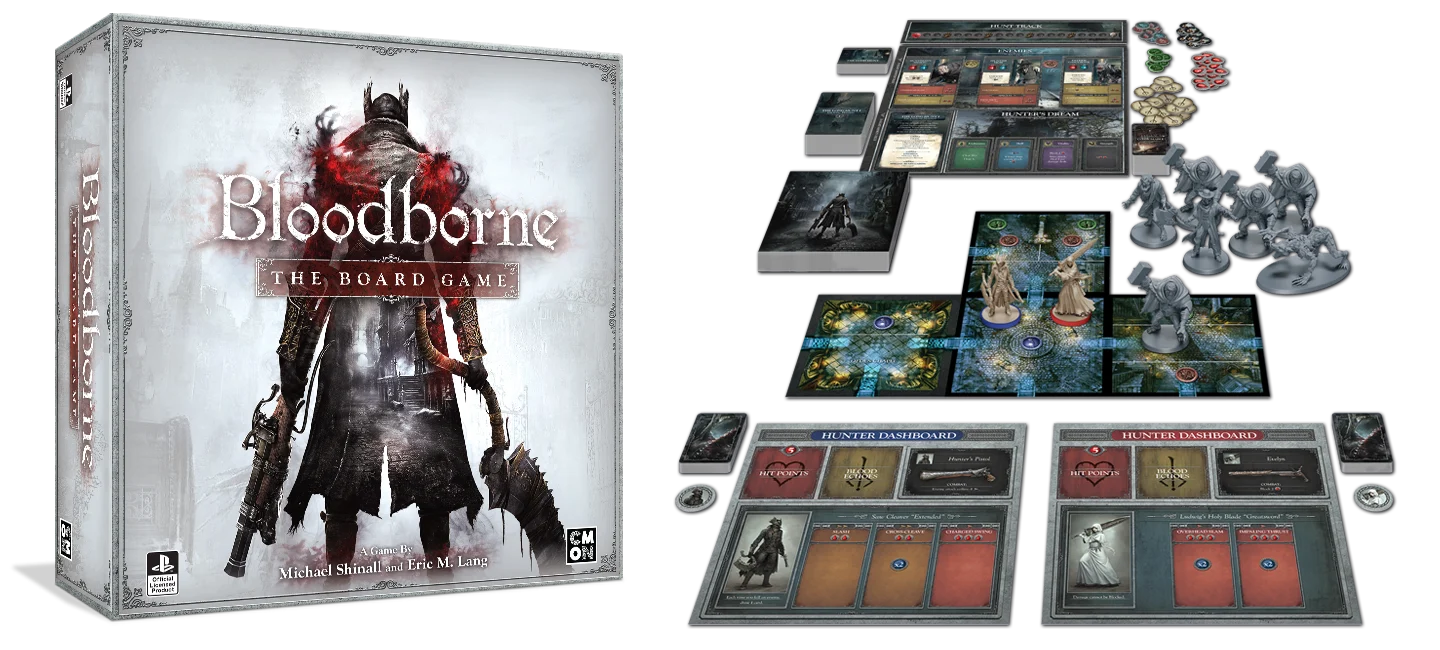
The base game ships with 37 miniatures: 4 Hunters, 28 standard enemies, and 5 bosses, including the Cleric Beast. Each figure is sculpted with the same gruesome detail as the video game’s enemy designs, though they arrive unpainted, so you’ll need primer and paint if you want them finished for the table.
- Four Hunter miniatures, each tied to a starting Trick Weapon such as the Saw Cleaver or Threaded Cane
- Trick Weapon dashboards that track a Hunter’s attacks, health, and stamina
- Basic Stat Card decks for each Hunter, upgradeable as the campaign progresses
- Four Campaign Decks, each with its own setup, story beats, and enemy roster
- Enemy Action decks and separate Boss Action decks for combat resolution
- Modular board tiles that expand the city as Hunters explore it
- Blood Echo tokens used as currency to upgrade equipment in the Hunter’s Dream
- Rulebook and campaign guide
Card and token quality holds up to repeated shuffling and handling, and the modular tiles fit together cleanly on the table without curling.
Bloodborne Board Game Pros and Cons
Pros:
- Combat runs on card-driven enemy behavior instead of dice, so a Hunter who tracks the Enemy Action deck can predict and plan around an incoming attack rather than gambling on a roll.
- The 37 miniatures, especially the five bosses like the Cleric Beast, are sculpted with a level of detail that matches the source material closely.
- The Hunt Track ties risk and reward together directly: spending a turn in the Hunter’s Dream to upgrade gear also pushes the clock forward, so every trip back costs something.
- Four campaigns with multiple chapters each give the box a solid amount of content before you need an expansion.
- Trick Weapons that transform between forms mid-combat add a layer of decision-making that standard melee weapons in similar games don’t offer.
Cons:
- Cooperative interaction between Hunters is thin. Beyond piling onto the same enemy or splitting up to cover more ground, there isn’t much tactical exchange between players.
- Solo play is difficult by design, and the game more or less expects solo players to run two Hunters at once to stay competitive against the Hunt Track.
- The Hunt Track’s board resets can undo progress on a mission that was going well, which frustrates newer players before they learn to manage the pacing.
- At an RRP of around £110, it’s a pricier entry than many campaign board games, even with retail discounts bringing it closer to £70 to £80.
How to Play Bloodborne: The Board Game
Each Hunter starts with a basic weapon, a starting deck of Stat Cards, and a spot on the Hunt Track. Setup for a chapter takes roughly 10 to 15 minutes once you know the flow, since most of it is drawing the correct Campaign Deck and placing the starting board tile.
Setup
Players choose a Hunter, take the matching Trick Weapon dashboard and basic Stat Card deck, and shuffle the campaign’s specific Enemy Action decks. The first board tile goes down, and the Campaign Deck is placed within reach to reveal the mission as it unfolds.
Turn Structure
On a turn, a Hunter plays a Stat Card onto their Trick Weapon dashboard to trigger one of three actions: attack, parry, or a support move like healing. Every action has a speed value, and faster actions resolve before slower ones, so a heavy attack can get interrupted by a quicker enemy strike.
Progression and the Hunter’s Dream
Killing enemies and completing objectives earns Blood Echoes. Spending them in the Hunter’s Dream upgrades a Hunter’s Stat Cards to stronger versions, but each visit advances the Hunt Track, which triggers board resets and eventually a full mission failure if the group takes too long.
Win and Loss Conditions
A chapter is won by completing its main mission before the Hunt Track runs out. Hunters who fall in combat wake up in the Hunter’s Dream and can rejoin the fight, though previously cleared enemies and obstacles may have returned to the board.
Where to Buy Bloodborne: The Board Game
| Platform | Notes |
|---|---|
| CMON official store | Base game and individual expansion boxes |
| BoardGameGeek GeekMarket | Used and new copies listed by individual sellers, prices vary by condition |
| eBay | Multiple active listings, including international editions |
| Amazon | Base game and select expansions, subject to stock |
| Noble Knight Games | Base game plus several expansion boxes |
| Wayland Games | Frequently discounted from RRP |
Bloodborne Board Game Mechanics Explained
The core of Bloodborne’s combat is card-driven conflict resolution. Instead of rolling dice, each enemy has three set attacks or abilities drawn from its own action deck, and with a little attention a Hunter can start predicting what’s coming and react to it, choosing when to parry, dodge, or simply eat a lighter hit to save a resource for something bigger.
Speed values on every action decide the order combat resolves in. A Hunter who commits to a slow, high-damage attack risks getting hit by a faster enemy move first, which pushes players toward reading the deck rather than just picking the biggest number available.
Trick Weapons add another system on top of this. Each one has to be transformed between its two forms periodically to access its full range of attacks, and different weapons reward different playstyles, from the Saw Cleaver’s straightforward damage to the Threaded Cane’s longer reach.
The Hunt Track is the mechanism that ties everything together. It advances every turn, and returning to the Hunter’s Dream to upgrade cards pushes it forward even faster, so players constantly weigh whether to bank a Blood Echo now or push on and risk the board resetting around them.
Who Should Play Bloodborne: The Board Game
Bloodborne suits players who already know and like the video game, since a lot of the appeal comes from recognizing enemies, locations, and the risk-reward loop it borrows directly from the source material. Fans of Cthulhu: Death May Die or Massive Darkness 2: Hellscape will find a familiar miniature-driven campaign structure here, though Bloodborne leans harder into card-based combat than either of those.
Because cooperative interaction between Hunters stays limited, groups looking for the deep teamwork of something like Descent: Legends of the Dark may find Bloodborne closer to parallel solo play at a shared table. For a similarly themed dungeon crawler with more give-and-take between allies, Castle Ravenloft is a lighter comparison point. Solo players should go in expecting to run two Hunters at once, since single-Hunter solo runs are punishing by design, and anyone building out a shelf of solo board games worth playing should know this one leans toward the difficult end of that list.
Skip it if you want a lighter entry point to campaign board games or a game built around player interaction rather than individual combat puzzles. Pick it up if you want detailed miniatures, tactical card-based fights, and a campaign that rewards learning enemy patterns over multiple sessions.
FAQ
Is Bloodborne: The Board Game good for beginners?
It’s approachable for newcomers to campaign games, but the punishing Hunt Track and card-driven combat have a learning curve. Expect a rough first chapter or two while your group figures out pacing, then smoother sessions once the timing of the Hunt Track clicks.
How long does Bloodborne: The Board Game take to play?
A single chapter runs 45 to 75 minutes based on the publisher’s listing, though some groups report sessions closer to 90 minutes, especially early on. A full campaign, split across multiple chapters, takes several sessions to finish.
What’s the best player count for Bloodborne: The Board Game?
Two to three Hunters generally gives the smoothest experience, balancing enemy difficulty against manageable turn length. Solo players should plan to control two Hunters at once, since the game scales difficulty assuming multiple active characters on the board.
Is Bloodborne: The Board Game worth buying?
If you’re a fan of the video game and want detailed miniatures with tactical, dice-free combat, yes. At an RRP around £110, it’s a bigger investment than many campaign games, so shop around for the £70 to £80 street price most retailers offer.
What games are similar to Bloodborne: The Board Game?
Cthulhu: Death May Die, Massive Darkness 2: Hellscape, and Tainted Grail: The Fall of Avalon all share the miniature-heavy campaign format. Descent: Legends of the Dark offers a closer comparison for groups wanting more cooperative depth between players.
