
Bandida Board Game Review

Bandida, designed by Martin Nedergaard Andersen with artwork by Odile Sageat and published by Helvetiq in 2020, is a small-box cooperative card game where players use tunnel cards to either trap an escaped prisoner or help her break free. The game supports 1 to 4 players ages 6 and up, with sessions running about 15 minutes. This review covers the components, three game modes, mechanics, and whether the pocket-sized package earns its place on the shelf.
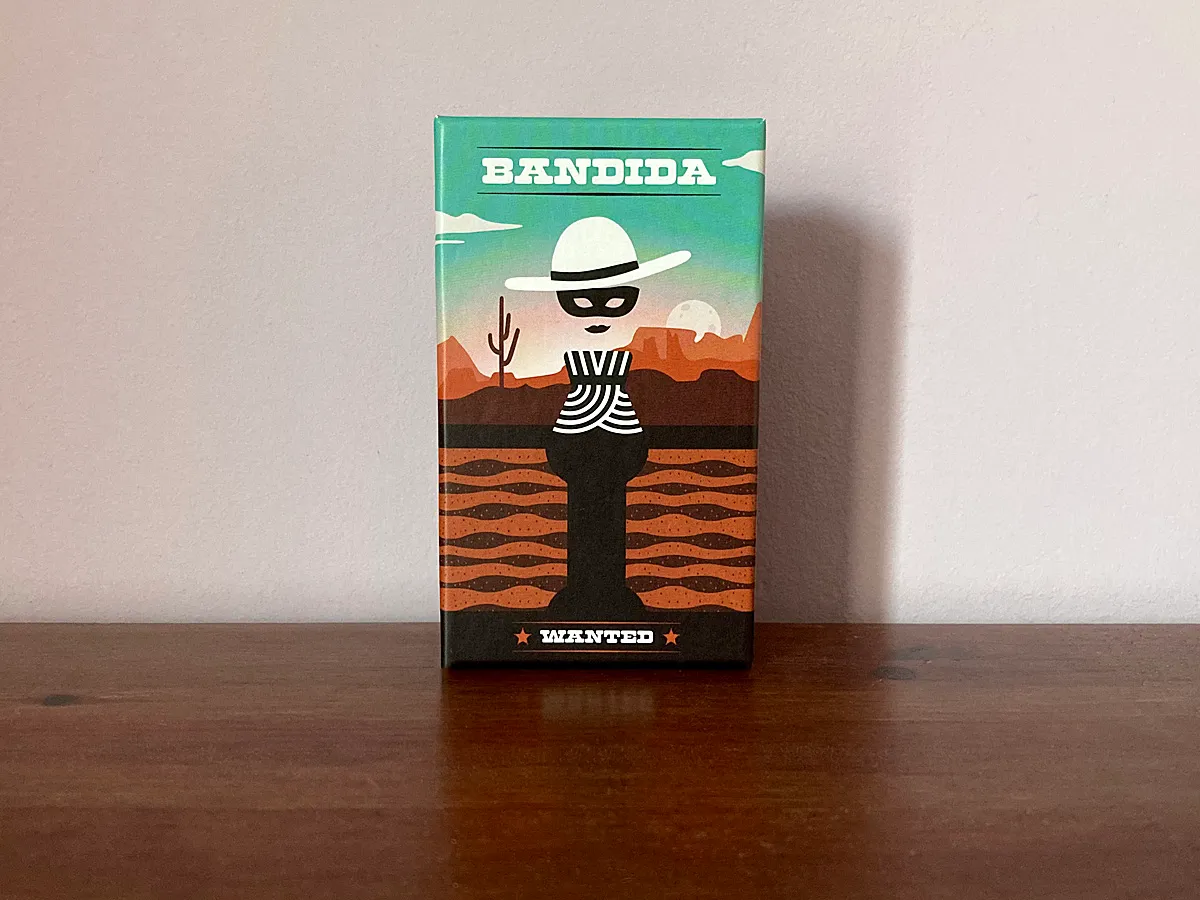
Bandida Overview
Bandida is a sequel and companion to Bandido, the 2016 prison-break card game. The setup looks identical to its predecessor: a central card showing the prisoner, with tunnels branching outward that players extend by adding cards. The twist is that Bandida adds three ways to play, including modes where players actively help the escape instead of stopping it.
| Specification | Details |
|---|---|
| Designer | Martin Nedergaard Andersen |
| Artist | Odile Sageat |
| Publisher | Helvetiq |
| Year Released | 2020 |
| Players | 1-4 |
| Age Range | 6+ |
| Playing Time | 15 minutes |
| Game Type | Cooperative card game, Family |
| Complexity | 1.46 / 5 (Light) |
What’s in the Bandida Box
Bandida ships in a small rectangular box from the Helvetiq Pocket Games line. Components are minimal but well produced, with thick cardstock and clear iconography that does not require any in-game text.
- 1 starting card showing Bandida in her cell
- 68 tunnel cards with various tunnel layouts
- Special action cards including the ladder, alarm, and broken tool
- Rulebook in multiple languages (English, Spanish, French, German, Italian, Dutch)
The cards are language-independent, which makes the game easy to play across mixed-language groups. The box is small enough to fit in a coat pocket or backpack, which has become Helvetiq’s signature for this product line.
Bandida Pros and Cons
Pros
- Three game modes give the small package more variety than most filler card games
- Plays from solo up to four players with no changes to the core rules
- Teaches in under five minutes, which makes it a strong opener for game nights
- Combines with Bandido for a longer, more chaotic experience
- Low price point of around $12-15 keeps the cost-per-play favorable
- Language-independent components travel well internationally
Cons
- Card draw luck heavily influences whether a game is winnable
- Strategic depth is shallow once the basic loop is understood
- The trap mode can feel solvable rather than tense at lower difficulty
- Repeated plays in one session start to blur together
How to Play Bandida
Setup
Place the starting Bandida card in the middle of the table, showing four tunnel exits leading outward. Shuffle the tunnel deck and deal three cards to each player. Place the remaining deck within reach as the draw pile.
Turn Structure
On your turn, play one card from your hand by matching one of its tunnel ends to an open tunnel on the table. You can play up to three cards per turn, but you must end your turn with three cards in hand by drawing back up.
If you cannot play any cards, you discard your full hand and draw three new cards. Players talk freely about strategy, since this is a cooperative game.
The Three Game Modes
Mode one is the trap, where the group closes off every open tunnel before the deck runs out. Mode two is the escape, where players work to play the ladder card onto an open tunnel, helping Bandida break free. Mode three combines the two into a longer scenario.
Win Conditions
In trap mode, the team wins if every tunnel is closed before the deck empties. In escape mode, the team wins when the ladder is successfully placed. The team loses if the deck runs out before either condition is met.
Where to Buy Bandida
| Retailer | Region | Price Range |
|---|---|---|
| Helvetiq Direct | Worldwide | Around €13-15 |
| BGG Store | US | $12.99 |
| Amazon | US / UK / EU | $13-18 |
| Zatu Games | UK | £11-14 |
| eBay | Global | Used and new copies regularly listed |
| Board Game Arena / Tabletopia | Digital | Free to subscribers |
Bandida Game Mechanics
The core mechanism is tile placement using cards. Each tunnel card has segments that must match the open ends of cards already on the table, creating a growing maze of pathways. Network and route building emerges as the table expands outward.
Cooperative discussion drives most decisions, since hand visibility varies by group preference. Some tables play with open hands for full coordination; others keep hands hidden for a tougher challenge. The rules support both approaches.
Special action cards add small disruptions. The alarm card forces players to discard cards from the draw pile, while the broken tool card limits options. These create swing moments that can flip a winnable game into a loss, which is what gives the simple system its tension. Fans of other cooperative card games will recognize the pattern.
Who Should Play Bandida
Bandida fits families with younger children, casual gaming groups, and anyone looking for a filler before or after a heavier main game. The 6+ age rating is accurate, and parents will find this works well as a teaching tool for cooperative play.
Solo players get good value too, since one of the modes is built for single-player puzzling. The 15-minute runtime makes it easy to fit in between other games or during a lunch break.
Skip Bandida if you want a deep strategic challenge or hate luck-driven outcomes. Heavy gamers will likely solve the puzzle in two or three plays and move on. The game also offers little for competitive groups, since there is no player-versus-player tension. Anyone who already owns Bandido may find the overlap too close unless they specifically want the extra modes and the combined play option.
FAQ
Is Bandida good for beginners?
Yes. The rules teach in under five minutes and use no in-game text. The 6+ age rating is realistic, and the cooperative structure means new players can be guided by experienced ones without anyone losing on their behalf. This makes it a strong choice for introducing card games to family members.
How long does Bandida take to play?
A single game runs around 15 minutes. The trap mode tends to finish slightly faster than the escape mode, since closing tunnels can happen quickly with the right card sequence. Many groups play two or three rounds back-to-back, totaling about 45 minutes of play in a sitting.
What’s the difference between Bandida and Bandido?
Bandido is the original 2016 game with a single trap mode. Bandida is the 2020 follow-up that adds two more modes (escape and combined) and uses a different protagonist. The two games can be combined for a larger maze with both characters in play, which adds about 10 minutes to the runtime.
Can Bandida be played solo?
Yes. Solo mode uses the same setup with one player playing all cards. The trap variant translates well to single-player puzzling, where you try to close every tunnel before the deck runs out. Solo players typically find Bandida tighter and more strategic than the cooperative game.
What games are similar to Bandida?
Bandido is the obvious starting point. Other small-box cooperative games include The Crew, Hanabi, and The Mind. For tile-laying with a maze-building feel, Carcassonne and Tsuro share the same core appeal at a heavier weight. Saboteur uses similar tunnel cards in a hidden-role format. Several appear on lists of small-box board games worth owning.
