
Anomia Board Game Review

Anomia, designed by Andrew Innes and published by Anomia Press in 2010, is a real-time card game where players race to name examples from categories before their opponents do. The game won a Mensa Select award and supports 3 to 6 players, ages 10 and up, with sessions running roughly 30 minutes. This review covers gameplay, components, mechanics, pricing in India, and whether the game suits your group.
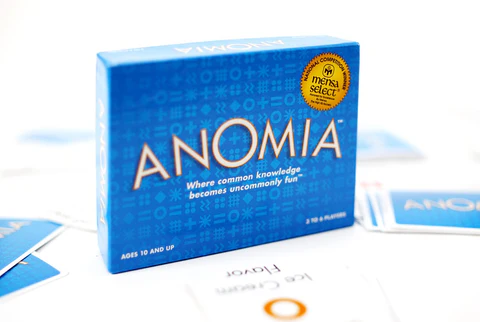
Anomia Overview
The objective is direct: collect the most cards by beating opponents to a correct answer. When two players reveal cards with matching symbols, they face off. Whoever names something from the opposing player’s category first wins that card.
Anomia sits in the same party game category as Catch Phrase and Snake Oil, though its speed-matching twist creates a different kind of tension at the table.
| Specification | Details |
|---|---|
| Designer | Andrew Innes |
| Publisher | Anomia Press, Asmodee, Broadway Toys, Cocktail Games |
| Year Released | 2010 |
| Players | 3 to 6 |
| Age Range | 10+ |
| Playing Time | 30 minutes |
| Game Type | Party / Word / Real-time |
| Complexity Rating | 1.04 / 5 (Light) |
What’s in the Anomia Box
The base game ships with two decks of 92 category cards plus 8 wild cards, for 184 cards in total. Each card has a category printed on it (frozen food, dog breed, pop song, website) and a colored symbol in the corner that drives the matching.
Card stock is standard playing-card quality. The cards survive regular shuffling but show wear after heavy use. The box is small enough to carry to a friend’s house in a bag.
- 92 cards in Deck A with categories and symbols
- 92 cards in Deck B with categories and symbols
- 8 wild cards (4 per deck) that change symbol pairings
- Rules sheet
Anomia Pros and Cons
Pros
- Rules take two minutes to teach, so new players join quickly
- Plays well across the full 3 to 6 player range
- Compact box fits in a bag or backpack pocket
- Affordable price for the play hours it delivers
- Cascading face-offs produce chain reactions that swing card counts
Cons
- Categories repeat across sessions, which reduces freshness over time
- Players who freeze under pressure can feel discouraged
- Not a fit for shy or quiet players
- Adults usually beat younger kids unless you use the Kids edition
How to Play Anomia
Setup
Shuffle both decks together and place the stack face-down in the center of the table. Each player needs space in front of them for a personal play pile. Setup takes about a minute.
Turn Structure
On your turn, draw the top card from the center pile and place it face-up on your own pile. Check whether the symbol on your top card matches the symbol on any other player’s top card.
If two symbols match, the affected players face off. Each must name an example from the category on the opposing player’s card. The first to blurt out a valid answer wins that card.
Wild Cards and Cascades
Wild cards override the usual matching rule. When a wild card appears, it pairs unrelated symbols on the players’ top cards, expanding the matches you need to watch. When someone wins a card, the loser exposes their next top card, which can trigger another face-off straight away.
Winning
Play continues until the draw pile runs out. Whoever holds the most cards at the end wins the game.
Where to Buy Anomia
Anomia is available on several Indian platforms. Pricing varies by edition and seller.
| Platform | Edition | Approximate Price |
|---|---|---|
| Bear Hugs | Anomia Base Game | ₹2,999 |
| Maya Toys | Anomia Party Edition | ₹3,499 |
| Gameistry | Anomia Party Edition | ₹3,200 |
| Ubuy India | Anomia X (Adult) | ₹2,980 |
| Ubuy India | Anomia Kids | ₹4,236 |
Anomia Game Mechanics
Anomia runs on two core mechanisms: speed matching and pattern recognition. Speed matching means the game has no turns in the traditional sense once a match appears. Anyone at the table can call out the answer first.
Pattern recognition forces you to scan every visible card for symbol pairs. Your attention splits between the new card you just drew and the top card on every other player’s pile. This split focus produces the brain-freeze moments the game is built around.
The category-and-symbol combination drives every decision. You read the category, recognize the symbol pair, and search for an answer in a second or two.
Who Should Play Anomia
Anomia works for casual gamers, large families, and groups who like loud, fast games. It teaches in under five minutes, which puts it among the easier simple board games to bring to a mixed group. Players who enjoy Bananagrams, Spot It, or Taboo will recognize the appeal here.
Skip Anomia if your group prefers strategy or quiet thinking. Players who get anxious about being put on the spot may find the pressure unpleasant. The 10+ age suggestion holds up in practice; younger kids struggle with the category recall.
The game works well as a filler between heavier games or as the main event at a casual party. Three or four players keeps the pace tight, while five or six adds chaos and more frequent face-offs.
FAQ
Is Anomia good for beginners?
Yes. The rules take about two minutes to explain, and new players can join mid-session without confusion. Anomia is one of the easier party games to introduce because there is no scoring math or special abilities to remember. The only skill needed is quick category recall under pressure.
How long does Anomia take to play?
A full game runs about 30 minutes, though it depends on player count and pace. With three players, expect around 20 minutes. With six players, the time can stretch to 40 minutes because matches happen more often and cascading face-offs slow the deck down.
What’s the best player count for Anomia?
Four players hits the sweet spot. Three feels lighter because matches happen less often. Six creates frequent face-offs and chain reactions but can overwhelm quieter players. Four balances pace, attention, and downtime well for most groups, and gives everyone a fair share of moments in the spotlight.
Is Anomia worth buying?
For groups that host game nights or have kids over 10, yes. At around ₹2,999 for the base game, the cost-per-play ratio is favorable. Skip it if you already own similar word-recall games like Scattergories or Taboo, since the recall mechanic overlaps with both.
What games are similar to Anomia?
Spot It uses the same symbol-matching mechanic but without categories. Snake Oil and Catch Phrase share the party-word-game space. Taboo demands fast recall under pressure. Anomia stands apart with the cascading face-off rule, which most other speed-matching games do not include.
