
Above and Below Board Game Review

Above and Below is a 2015 town-building and storytelling game designed and illustrated by Ryan Laukat, published by Red Raven Games. It plays 2–4 players, takes about 90 minutes, and is listed for ages 13+. The game blends worker management with a choose-your-own-adventure encounter book, and it’s the first entry in Laukat’s Arzium universe, which later expanded into Near and Far and Now or Never. This review covers what’s inside the box, how the game plays, and whether it’s worth picking up in 2026.
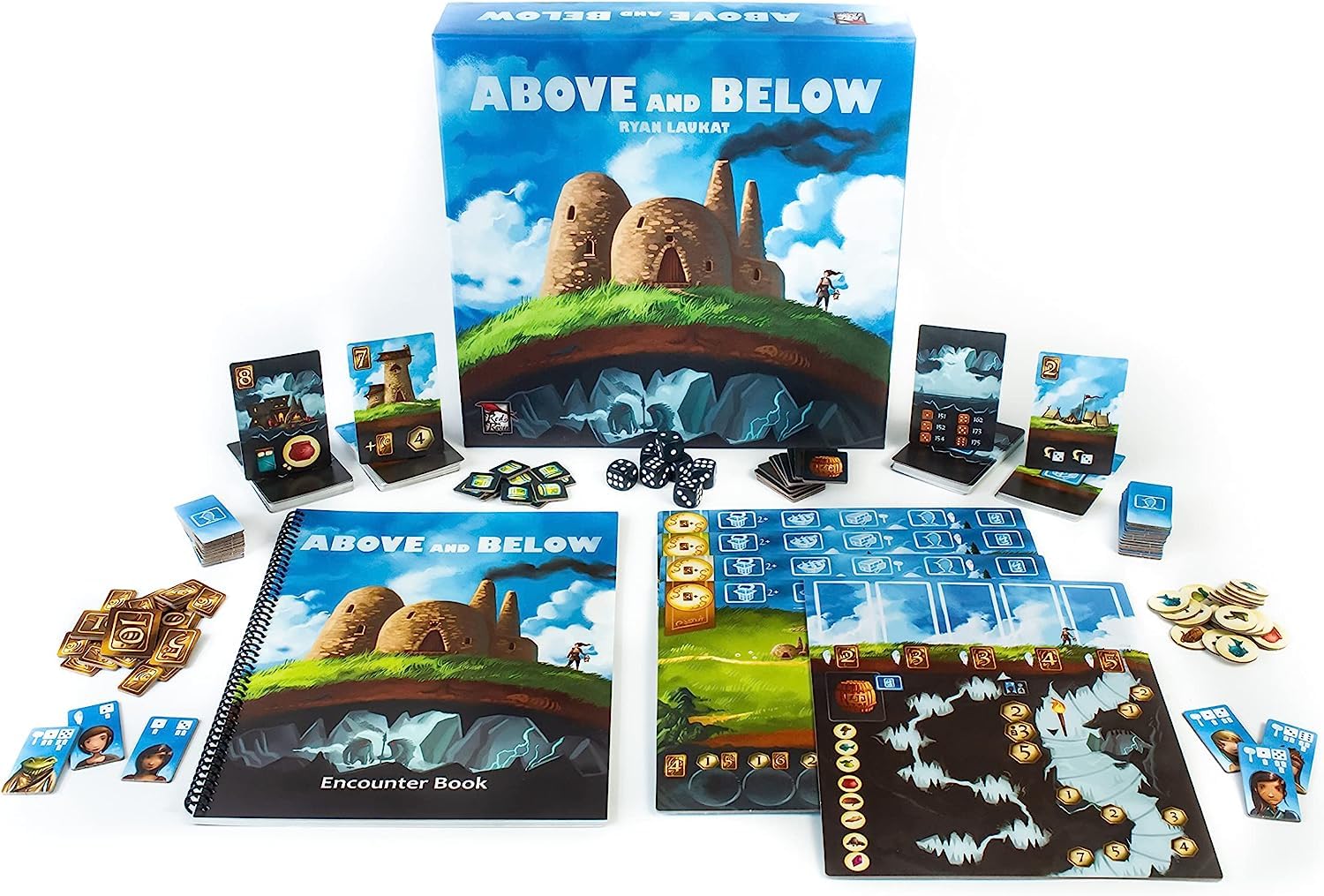
Above and Below Overview
The premise is straightforward. Your village has been destroyed by barbarians, and you’ve fled to a new location to start over. As you build your settlement on the surface, you discover a network of caverns below ground, full of strange creatures, rare goods, and stories waiting to unfold. The goal across seven rounds is to accumulate the most village points through buildings, reputation, goods, and card bonuses.
Above and Below sits in an unusual space between euro-style resource management and narrative storytelling games. It doesn’t commit fully to either camp, and that tension is part of what makes it interesting to discuss.
| Specification | Details |
|---|---|
| Designer | Ryan Laukat |
| Publisher | Red Raven Games |
| Year Released | 2015 |
| Players | 2–4 |
| Age Range | 13+ |
| Playing Time | 90 minutes |
| Game Type | Town Building, Storytelling, Worker Management |
| Complexity Rating | 2.51 / 5 (BGG) |
What’s in the Above and Below Box?
The retail edition comes packed with a decent spread of components. Nothing here screams premium, but the quality is solid across the board.
| Component | Quantity |
|---|---|
| Player Boards | 4 |
| Reputation Board | 1 |
| Cards (villagers, buildings, outposts, caves) | 94 |
| Dice | 7 |
| Wooden Cubes | 4 |
| Game Tokens (coins, resources, etc.) | 198 |
| Encounter Book | 1 |
| Rule Book | 1 |
The cards have a linen finish and feel good in hand. Player boards and villager tokens are thick enough. Resource and coin tokens are standard cardboard — functional, not flashy. Laukat’s illustration work is the real standout here. The art across every card, board, and the encounter book itself creates a warm, storybook quality that ties the whole package together. If you’ve seen any of his other Red Raven titles, you know the style — soft colors, lots of blues and greens and golds, and a world that feels friendly rather than grim.
The Kickstarter edition included extra content like Villager Tool tokens, Lost Villagers, Swamp Villagers, Creature Villagers, Quest Tokens, Underforest Tokens, and Desert Labyrinth content. Those extras aren’t necessary for the core experience, though.
Above and Below Pros and Cons
- The encounter book (215 paragraphs) adds genuine surprise and replayability to every game session
- Laukat’s art direction gives the game a distinct, inviting personality that few competitors match
- Multiple paths to victory — you can focus on goods, exploration, building, or a mix
- Accessible weight at 2.51/5 complexity, making it easy to teach to newer players
- Quick individual turns keep downtime low even at four players
- Only seven rounds — many players feel rushed, especially when exploration competes with building for limited worker actions
- Exploration outcomes depend heavily on dice rolls, which can feel unfair after committing two or more villagers
- You can win without ever going underground, which undermines the game’s most distinctive feature
- No resolution or follow-up to encounter stories — you get a reward (or don’t) and move on
- The strategic layer is thin compared to pure euro games at a similar weight
How to Play Above and Below
Setup
Each player takes a player board, three starting villagers, a starting house, and some coins. The reputation board goes in the center with available villagers lined up along it, and building/outpost cards are arranged in a shared market. The encounter book stays with whoever is reading stories that round.
Turn Structure
On your turn, you assign one or more villagers to an action space on your player board. The five main actions are: explore, harvest, build, train, and labor.
Exploring requires at least two villagers. When you explore, the player to your right opens the encounter book to a randomly determined paragraph and reads you a short story. You’ll face a choice — usually a safe option with a small reward or a risky one that could pay off big or cost you a villager. You roll dice based on your explorers’ skill values to determine success. If things go well, you might gain resources, coins, or cave outpost cards. If they don’t, your villagers end up injured.
Building lets you pay coins to buy a building or outpost card from the market and add it to your player board. These provide end-game points, ongoing income, or bed space for more villagers. Training costs coins too, and adds a new villager from the reputation board to your workforce. Harvesting collects resources from your buildings, and laboring earns a few coins when you’re short on better options.
After using a villager, they move to the exhausted area on your board. At end of round, exhausted villagers recover (if you have enough beds), you collect income based on your advancement track, and a new round begins.
How Does Above and Below End?
After seven rounds, you total up points from buildings, cave outpost cards, goods placed on your advancement track, reputation, and any bonus cards. Highest score wins.
Above and Below Game Mechanics
Above and Below uses action point management as its core system. Each villager is essentially one action point per round, and since you start with only three, every assignment matters. The game layers a few different types of board game mechanics on top of this framework.
Set collection drives the advancement track. Resources placed there score more points the further along you go, and identical resources grouped together multiply in value. This creates a quiet puzzle about which goods to keep and when to place them.
The storytelling mechanic through the encounter book is the standout. It’s a paragraph-based narrative system similar to Tales of the Arabian Nights, but tied to a strategic game underneath. The encounters are written by Laukat and a few other authors, and they range from meeting strange creatures underground to finding hidden treasures. Each encounter gives you a choice, and dice determine the outcome. This element is what separates Above and Below from other mid-weight euros, but it’s also where the game’s luck dependency lives.
The tension between exploring and building is the central decision. Sending villagers underground is exciting but expensive — you need at least two workers and the outcome is uncertain. Staying above ground and building your engine is safer but less interesting. That push and pull carries the game, even when the strategy feels limited.
Who Should Play Above and Below?
Above and Below works best as a gateway into heavier tabletop games or as a lighter midweek option for experienced players. It’s a good fit for groups who enjoy a bit of story with their strategy but don’t want a full campaign commitment.
If you like the idea of a euro game with personality — something warmer than a typical point salad — this delivers. It also works well for couples at two players, though the exploration feels more dynamic with three or four at the table.
Players looking for deep strategic control may bounce off this one. The seven-round limit and dice-heavy exploration can frustrate planners. If you want something in the same universe but with more depth, Near and Far or Now or Never expand on what Laukat started here.
The closest comparison outside Laukat’s catalog is probably Viticulture in terms of weight and accessibility, though the theme and feel are entirely different. If you’ve played Tales of the Arabian Nights and wished it had more game attached, Above and Below is exactly that attempt.
Where to Buy Above and Below
| Retailer | Link |
|---|---|
| Amazon | Buy on Amazon |
| Miniature Market | Buy on Miniature Market |
| Walmart | Buy on Walmart |
| BoardGameGeek Market | View on BGG |
| eBay | Search on eBay |
| Board Game Oracle | Compare Prices |
FAQ
Is Above and Below good for beginners?
Yes, with a complexity rating of 2.51 out of 5, Above and Below is accessible to players new to modern board games. The rules are straightforward, individual turns are quick, and the encounter book adds excitement without adding mechanical burden. It works well as a step up from gateway games like Catan or Ticket to Ride.
How long does Above and Below take to play?
A typical game runs about 90 minutes, though your first play might push past that while everyone learns the turn options. At two players, games tend to finish closer to 60 minutes. Setup takes roughly 10 minutes once you know where everything goes.
What is the best player count for Above and Below?
Three players hits the sweet spot. At two, the exploration encounters feel a bit flat since there’s less variety in who reads stories. At four, downtime between turns can stretch. Three keeps the pace tight while giving the encounter system room to breathe.
Is Above and Below worth buying in 2026?
It depends on what you’re after. If you want a light-to-mid weight game with a storybook feel and strong art direction, it still holds up well. Players who found it too light when it launched may prefer Near and Far or Sleeping Gods instead, both of which build on what Laukat started here.
What games are similar to Above and Below?
Near and Far is the direct sequel and expands on nearly every system. Tales of the Arabian Nights shares the paragraph-book storytelling. For a similar weight and feel without the narrative, try Everdell or Viticulture. Sleeping Gods is another Laukat title with deeper cooperative storytelling.
