
Why FreeCell Feels So Satisfying to Finish: The Psychology of Winning

That specific moment when the final card snaps into place and the victory animation cascades across your screen creates an unmatched wave of relief. Understanding why FreeCell feels so satisfying to finish comes down to more than just passing a few idle minutes during a busy day.
Completing a deal triggers a powerful psychological reward loop powered by cognitive closure, absolute tactical control, and a clean dopamine release that leaves your brain feeling genuinely recharged.
For puzzle enthusiasts who love exploring alternative variants like double freecell, deciding to play freecell online and reaching that final cascade offers a distinct sense of intellectual triumph.
The Psychology of Cognitive Closure and Mental RAM
As long as you have an incomplete task in front of your eyes, you keep your brain working on a subconscious level that is aware of the incomplete activity.
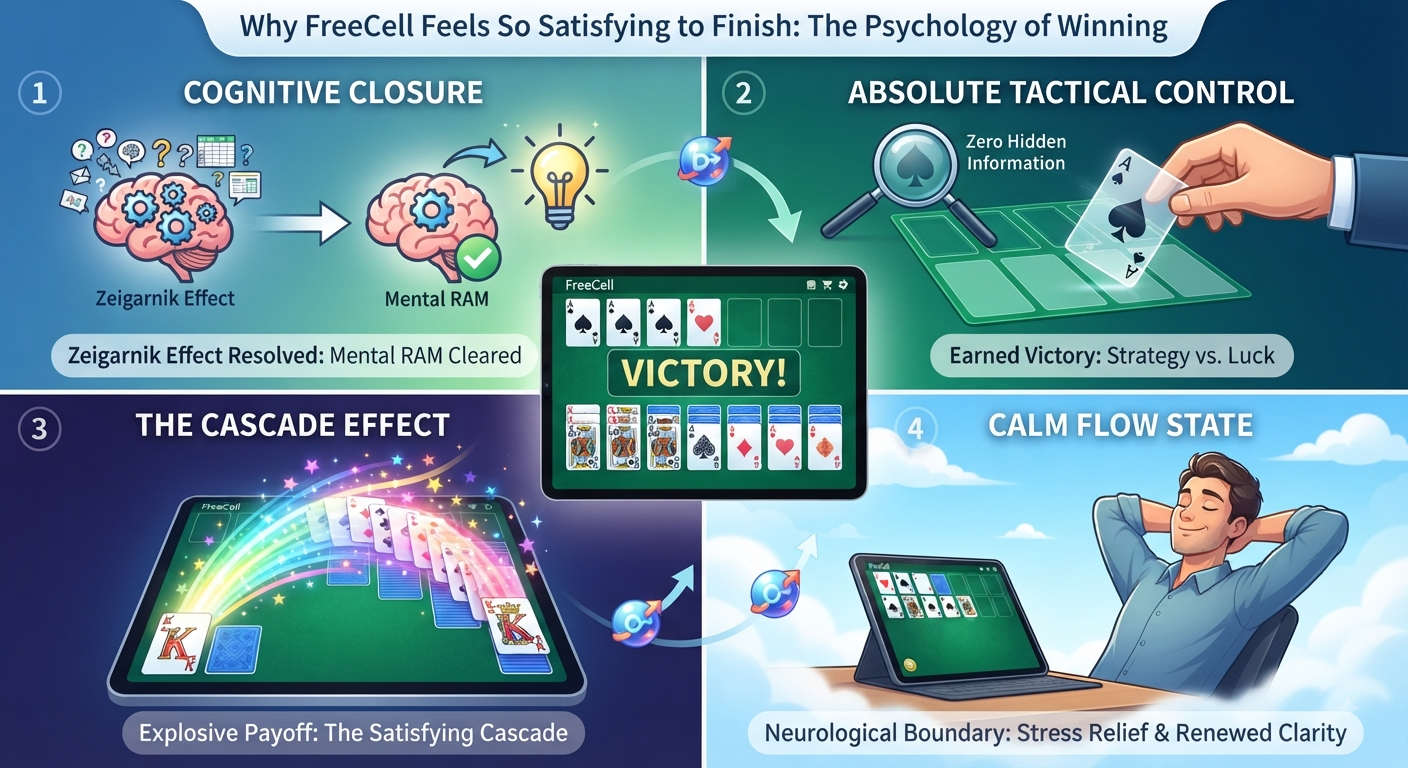
In psychology, the phenomenon of incomplete tasks occupying your mind is known as the Zeigarnik Effect, which is like losing your brain’s mental energy while trying to solve the mystery.
When you finally clear the tableau and send that last King home, your brain experiences absolute cognitive closure. In that sudden decision, the built-up garbage comes pouring out of the system, thus providing clarity of thought and converting the stress into a state of psychological fulfillment.
The decision serves as the perfect ending to your concentration, allowing your exhausted brain the opportunity to relax. While some people prefer to unwind by learning how to set up freecell layouts manually with a physical deck, the digital experience streamlines this entire psychological release.
Zero Hidden Information: Why Earned Victories Feel Better

While card games involving a lot of luck rely on finding a lucky card in a secret deck, FreeCell reveals all cards from the get-go. This means all cards are visible from the start; there will be no unpleasant surprises from a closed deck.
If you want to dive deeper into how this open board impacts your choices, learning how to play freecell effectively highlights why transparency makes the game so rewarding.
Because every single move belongs entirely to your own strategic choices, the final victory feels completely earned. Your brain recognizes that you navigated a complex maze entirely through logic rather than blind luck.
This absolute transparency transforms every successful puzzle into a testament to your analytical thinking, providing an intellectual high that standard luck-based games simply cannot match.
The Domino Effect: The Thrill of the Final Cascade
The physical mechanics of the late game build an incredible amount of psychological tension. For minutes, you wrestle with stubborn bottlenecks, burying cards and carefully shuffling reserves to unlock a single buried card. The pressure mounts as your free cells fill up and your movement options narrow down to a razor-thin margin.
Once you break through that final structural jam, the game accelerates into a stunning cascade. Seeing cards rapidly fly upward to the foundation piles on their own acts as an organic reward sequence, delivering a massive burst of satisfaction for the patience you practiced during the middle turns. That fast-paced conclusion rewards your long-term planning with an explosive, visually satisfying payoff.
From Stressful Chaos to Calm Flow States
Working through a chaotic layout requires intense visual tracking and spatial reasoning, which forces your mind into a tight state of focused flow.
By occupying your working memory completely, the puzzle elbows out lingering office anxiety or project stress. It functions as a brilliant cognitive anchor, keeping your mind delightfully busy with tangible, solvable problems.
Closing out the game serves as a hard neurological boundary. It lets you know that the game is complete and allows you to switch gears and concentrate on other daily activities with a fresh outlook and renewed clarity.
The key to successfully balancing logic and control is what makes people come back each day to play FreeCell, just as challenging as it is to play Baker’s Game.
The attraction of cracking a puzzle using playing cards goes way beyond just being entertained. Thanks to its structural simplicity and the positive effects of cognitive closure, the game turns a 2-minute intermission into a very effective mind-refreshing tool.
Whether you need to relax your mind before tackling another assignment or unwind after a busy afternoon, that sense of accomplishment from completing a cascade is unparalleled in keeping your mind sharp and alert.
