Why Chess Belongs in the Conversation About Strategic Games for Kids

This is a cooperative board games site, and chess is famously not cooperative. So why are we talking about it? Because if you’ve spent time playing co-ops with your kids like Forbidden Island, Outfoxed!, Castle Panic or Mysterium, they’ve already done most of the work of getting introduced to the kind of structured strategic thinking chess is built on.
The transition from co-op strategy to head-to-head strategy is more natural than most parents expect. ChessKid, a free online platform built specifically for children, has made that transition vastly more accessible: more than 13 million kids worldwide have learned the game through its guided lessons, age-appropriate puzzles and child-safe playing environment.
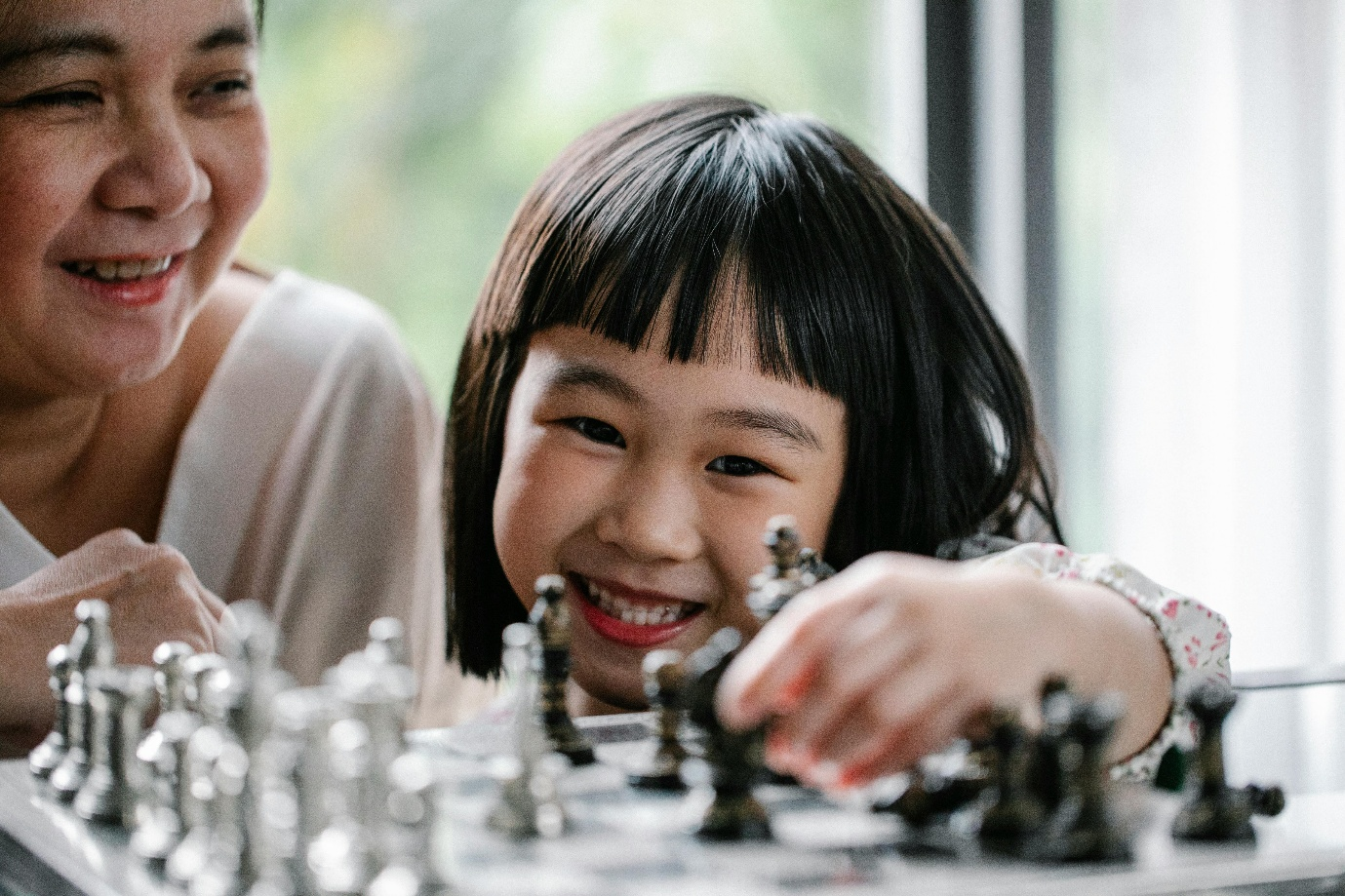
Chess belongs in any serious conversation about strategic games for kids not because it’s better than cooperative games, but because it teaches a parallel set of skills.
If your group has spent a year working together against Pandemic or Forbidden Island, your kids have already absorbed the basics of pattern recognition, threat assessment, action planning, resource management, and trade-off thinking. Chess applies those same cognitive habits in a one-on-one context. The skills don’t change. The opponent does.
The cognitive overlap between cooperative games and chess
Modern cooperative games for families teach a specific bundle of skills. Players have to read the current board state, identify threats, sequence their actions, predict what the game will do on its turn, and coordinate with teammates without violating the rules about sharing information. Those skills are the same ones chess players use, just packaged differently.
What both formats teach kids
- Reading the current board state accurately
- Identifying threats in order of urgency
- Sequencing actions to deal with priority problems first
- Predicting what the game will do on its turn
- Trade-off thinking: every action means another one is delayed
What chess adds on top of those skills
- The same cognitive load, in a 1v1 context with no team buffer
- Complete game state visibility (no hidden information)
- Direct causal reasoning: one move propagates through the whole game
- Long-term planning across dozens of turns
What the research actually shows?
Multiple studies have found that chess training improves executive function, working memory, planning ability and problem-solving in children. The MindMATCH research project, a collaboration between the University of Cambridge, Virginia Commonwealth University and the U.S. Department of Education’s Institute of Education Sciences (Grant R305A110932), found that children attending after-school chess programs showed measurable improvements in their ability to plan and sequence actions.
Other research has linked chess instruction to gains in mathematics test scores, reading comprehension and critical thinking.
This is part of why chess is increasingly recognized as a STEM activity in U.S. educational settings. None of this is unique to chess; cooperative games likely produce similar gains.
The point is that chess gives kids another structured environment to exercise the same mental machinery, in a context that scales further in complexity over time.
The competitive transition that scares some families off
The most common reason families that love co-ops avoid chess is the competitive element. Cooperative games sidestep the meltdowns that come from a six-year-old losing Candy Land four times in a row. Chess is, by definition, head-to-head. Someone wins. Someone loses.
Why chess at the beginner level feels more like a puzzle than a contest
When two children of similar skill play each other, neither knows what’s going to happen. The focus is on figuring out what their pieces can do rather than on winning.
The competitive sting comes later, if at all, and even then it tends to be productive. Kids who learn to handle losing in chess often handle losing better in other parts of their lives too.
How online platforms reduce the social stakes
The structure of an online platform like ChessKid removes some of the social pressure. A child playing a computer opponent at an appropriate level can lose without anyone watching, try again, and gradually build the resilience the format requires. By the time they’re playing actual humans, they’ve usually adjusted to the cycle of win and loss that’s central to the game.
How ChessKid solves the practical teaching problem?
Anyone who’s tried to teach a child chess from scratch knows the real obstacle. It’s hard to teach a game when you have to play badly enough that the kid can compete, but well enough that they’re actually learning.
Most parents either lose interest after a few games or end up frustrating their kids by playing too well. The chess teaching problem has been a barrier to chess as a family game for as long as the game has existed.
How the platform structures the learning?
ChessKid’s solution mirrors what good cooperative game designers do for kids: structure the learning into incremental, age-appropriate units a child can work through at their own pace, with feedback built in. The platform includes:
- Thousands of puzzles organized by skill level
- Video lessons featuring the in-game instructor FunMasterMike
- AI opponents calibrated to a child’s current ability
- Matchmaking with other children of similar skill level
- A gamified belt system that tracks progress through ranks
For a hobby gaming family used to thinking about progression and mechanics, the design will feel familiar. It’s closer to a campaign game like Zombie Kidz Evolution than to a static skills app. The mechanics of incremental achievement are the same ones that keep co-op campaigns engaging.
Safety and the online environment
ChessKid was built specifically for children, and the safety architecture shows that. Most online gaming environments for kids retrofit safety features on top of an adult product.
ChessKid started from the assumption that no adult should be able to contact a child user, and every part of the platform’s design enforces that.
The specific safety features that matter
- No public chat between players
- No contact from adults to children
- No outside advertising directed at kids
- No external links to the broader internet
- All interactions filtered through child-safety systems
For families appropriately cautious about online gaming, this is a significant departure from the default. The platform is used in schools across the U.S. and internationally, including through programs like Chess in Education – US and the US Chess Title I School Outreach Program, which deploys ChessKid in schools serving low-income communities.
Why safety matters specifically for chess practice?
Chess, more than most games, benefits from regular practice with varied opponents. A child who plays only against family members tops out quickly. ChessKid provides that variety, with opponents of similar skill from around the world, without the safety concerns that normally come with online play.
For families that have hesitated to introduce children to online gaming for reasonable reasons, chess on a purpose-built platform is one of the cleanest options available.
The case for chess as the next step after kids master co-ops
If your kids have worked through the cooperative game canon (Forbidden Island, Castle Panic, Mysterium, Zombie Kidz Evolution, Pandemic) and you’re looking for what comes next, chess deserves serious consideration. It’s not a replacement for co-ops. Co-ops will continue to be the right format for many family game nights.
What chess adds that co-ops don’t?
- Every decision belongs to one player alone, with no team coordination buffer
- Complete game state visibility (no hidden information, unlike most co-ops)
- Direct causal reasoning: each move propagates through the rest of the game in ways that teach consequences more starkly than any other format
- Long-term planning across many turns, without scenario rotation
The longevity factor
Chess is one of the rare games that travels with a child for life. A five-year-old who learns the basic moves on ChessKid can keep playing the same game at any age, against any opponent, anywhere in the world, for decades. Few other games have that property.
The cooperative games on your shelf are excellent, but most of them will be played for a few years and then retired. Chess, properly introduced, becomes a lifelong activity.
Done through a platform like ChessKid, it costs nothing to start, scales with the child’s growing ability, and gives them access to one of the deepest and best-studied strategic games ever designed.
