The Best Board Games That Teach Probability, Risk & Decision-Making

In an era where data literacy and analytical thinking have become professional prerequisites, an unexpected educational resource has emerged from living room shelves and gaming cafés worldwide.
Board games, long dismissed as mere recreation, are now recognised by educators, cognitive scientists, and business strategists as powerful tools for developing probabilistic reasoning, risk assessment capabilities, and strategic decision-making skills.
Understanding expected value, calculating odds, and weighing potential outcomes against their probabilities, these fundamental skills form the backbone of informed decision-making, whether one is playing a game of poker, managing an investment portfolio, or choosing to place bets with established betting operators.
What distinguishes educational board gaming from passive learning is the immediate feedback loop: decisions lead to outcomes, patterns emerge through repetition, and strategic intuition develops organically through play.
Why Board Games Excel at Teaching Analytical Skills
Unlike traditional educational materials, games create intrinsic motivation; players want to improve because winning feels rewarding, not because improvement has been assigned as homework. This emotional investment accelerates learning in ways that passive instruction cannot replicate.
Research from institutions including MIT and Carnegie Mellon has demonstrated that strategic games activate multiple cognitive systems simultaneously, strengthening neural pathways associated with planning, prediction, and adaptive thinking.
Furthermore, modern board game design has evolved considerably from the roll-and-move simplicity of earlier generations.
Contemporary designers craft experiences that balance randomness with skill, creating scenarios where understanding probability genuinely improves outcomes while acknowledging that uncertainty remains irreducible.
This mirrors real-world conditions far more accurately than deterministic puzzles, preparing players for environments where perfect information is unavailable and decisions must be made under conditions of genuine uncertainty.
Poker: The Foundation of Probabilistic Thinking
No discussion of probability-teaching games can omit poker, which has served as an entry point to statistical thinking for generations. Texas Hold’em offers a masterclass in expected value calculation, pot odds assessment, and reading incomplete information.
Players must constantly update their probability estimates as community cards are revealed, balancing mathematical calculations against psychological reads of their opponents.
The game teaches that making the mathematically correct decision does not guarantee success in any single instance, but consistently making better decisions than opponents produces positive results over time, a lesson with profound implications beyond the card table.
What makes poker particularly valuable as an educational tool is its emphasis on decision quality over outcome quality. A player can make a perfect decision based on available information and still lose to an unlikely draw.
Learning to evaluate choices by their reasoning rather than their results develops intellectual resilience and protects against results-oriented thinking, a cognitive trap that leads people to abandon sound strategies after experiencing normal variance.
Settlers of Catan: Resource Management Under Uncertainty
Settlers of Catan revolutionised modern board gaming by demonstrating that probability could serve as a game mechanism accessible to casual players while remaining strategically deep.
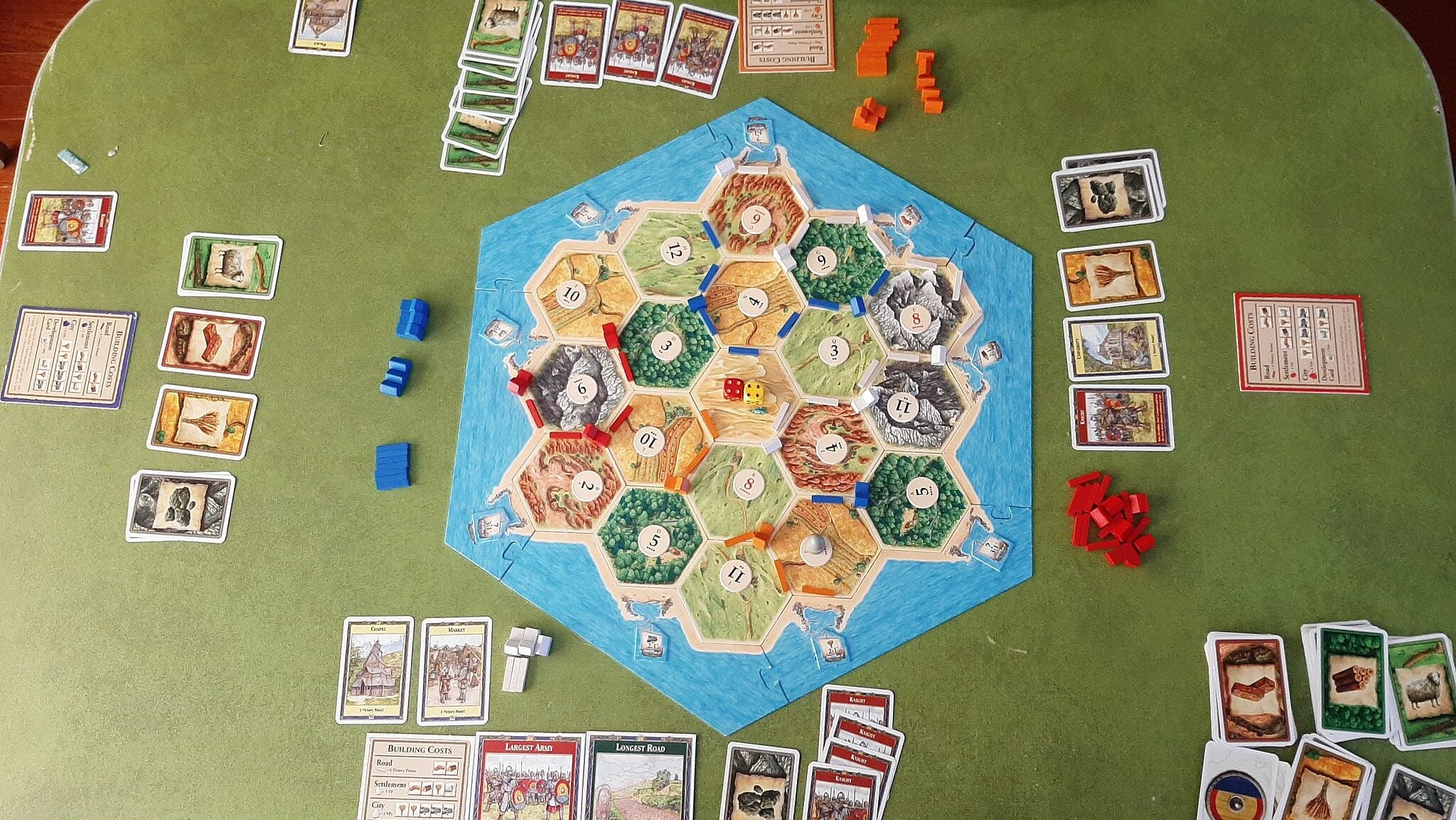
Tiles associated with numbers like six and eight are produced more frequently than those linked to two or twelve, and understanding this distribution informs optimal settlement placement.
Beyond basic probability, Catan teaches resource scarcity management, negotiation under asymmetric information, and adaptive strategy.
Players must balance concentration (focusing on high-probability tiles) against diversification (ensuring access to all resource types).
The trading mechanism introduces game theory considerations: when to negotiate in good faith, when to drive hard bargains, and how to assess the relative value of resources that fluctuate based on board state and player positions.
Risk: Understanding Variance and Long-Term Planning
The classic game of global conquest teaches probability lessons that extend far beyond its military theme. Combat in Risk involves comparing dice rolls, with attackers rolling up to three dice against defenders’ two.
Strategic Risk players learn to think in terms of expected casualties rather than guaranteed outcomes. They develop intuitions about when aggressive expansion is warranted and when consolidation reduces exposure to negative variance.
The game’s continental bonus system teaches opportunity cost analysis: holding Australia provides reliable income but limited expansion options, while contesting Africa offers greater potential at higher risk.
These trade-offs between security and opportunity appear throughout professional and personal decision-making contexts.
Backgammon: Probability Calculation in Real Time
Backgammon holds a distinguished position among probability-teaching games, having been analysed mathematically for centuries.
Modern players benefit from computer analysis that has solved many positions, yet the game retains strategic depth because calculating optimal plays during actual gameplay requires internalising probability principles rather than merely consulting tables.
The doubling cube deserves particular attention as an educational mechanism. It allows players to propose doubling the stakes, with opponents choosing to accept or forfeit the current game.
Proper cube decisions require assessing one’s winning probability with considerable accuracy: a position worth accepting a double at one score might warrant declining at another.
Modern Strategic Board Games: Sophisticated Decision Frameworks
Contemporary board game design has produced increasingly sophisticated vehicles for teaching decision-making. Games like Pandemic require players to assess probability distributions while coordinating actions as a team, teaching collaborative risk management.
Ticket to Ride introduces opportunity cost analysis as players decide when to claim routes and when to draw additional cards, balancing immediate gains against future flexibility.
Azul and similar abstract strategy games with drafting mechanisms teach players to evaluate options not only for their intrinsic value but for what they deny to opponents.
Power Grid combines auction mechanics with route optimisation and resource market timing, requiring players to maintain mental models of supply, demand, and competitor intentions simultaneously.
Deck-Building Games: Portfolio Construction and Probability
The deck-building genre, pioneered by Dominion and refined through games like Star Realms and Clank!, offers an elegant mechanism for teaching portfolio construction principles. Players begin with identical weak decks and gradually acquire cards that modify their deck’s composition and capabilities.
Success requires understanding how adding a card changes the probability of drawing specific combinations, when to prioritise deck consistency over power, and when variance-increasing strategies offer positive expected value despite their unpredictability.
The parallel to investment portfolio management is striking. Just as deck-builders must balance reliability against ceiling, investors weigh stable returns against growth potential.
Players who excel at deck-building games often demonstrate transferable intuitions about probability, expected value, and the relationship between concentration and risk.
Translating Board Game Skills to Real-World Decisions
The skills developed through strategic board gaming transfer to practical contexts more directly than many players realise. Probability estimation improves through repeated practice in calculating odds under time pressure. Risk tolerance becomes calibrated through experiencing the consequences of aggressive versus conservative strategies.
Decision-making under uncertainty becomes more comfortable as players develop frameworks for acting despite incomplete information.
Professional domains from medicine to law to engineering require practitioners to make consequential decisions with imperfect data.
Board games provide a low-stakes environment to develop comfort with uncertainty while building intuitions about expected value, variance, and the difference between good decisions and good outcomes.
Executives who play strategic games often report improved comfort with ambiguity and stronger frameworks for evaluating risky propositions.
Building Your Strategic Gaming Practice
For those seeking to develop probability and decision-making skills through board gaming, a graduated approach proves most effective. Beginning with accessible games like Catan or Ticket to Ride establishes foundational concepts without overwhelming complexity.
As comfort develops, progressing to poker, backgammon, or modern strategy games like Terraforming Mars adds layers of sophisticated decision-making.
Playing against stronger opponents accelerates learning by exposing gaps in strategic thinking, while analysing completed games builds pattern recognition and strategic vocabulary.
The most valuable aspect of board game education may be its social dimension. Unlike solitary study, gaming provides immediate feedback through competition and discussion.
Post-game analysis with fellow players reveals alternative perspectives and strategic options that might otherwise remain invisible.
This collaborative learning environment, combined with the intrinsic motivation of gameplay, creates conditions for rapid skill development that formal education rarely achieves.
