
Common Questions About Winning Strategies in Monopoly Big Baller

Monopoly Big Baller combines the classic bingo mechanics with the high-stakes property trading theme everyone knows from the board game. Imagine sitting in a virtual studio where a live host draws balls while a digital Mr. Monopoly stands by, ready to walk across a 3D board.
Unlike traditional bingo, this game introduces multipliers and bonus rounds that can change the trajectory of a round in seconds.
Success here does not come from luck alone, it requires a clear understanding of how the different card types interact with the random number generator.
Choosing Your Cards Wisely
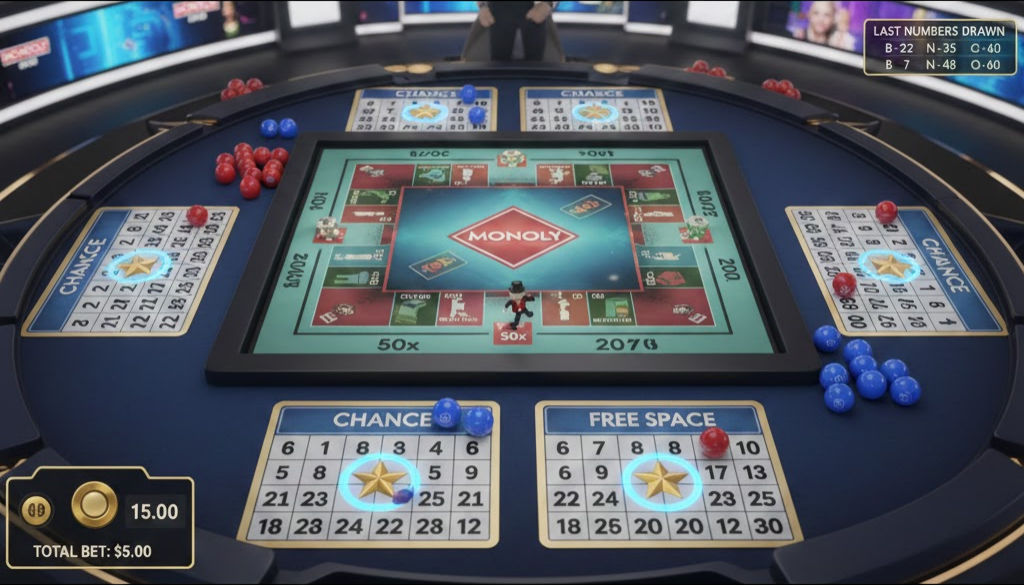
The first decision every participant faces involves the type of cards to place on the virtual table. You have the option of Chance cards or Free Space cards. On a Chance card, the center cell acts as a multiplier, which can significantly boost payouts if that specific number is called.
A Free Space card, meanwhile, starts with the center cell already marked off, making it easier to complete lines. Observations of high-level play show that choosing between these is a trade-off between frequency and magnitude.
When setting up the interface, players often look at the potential for “daubing” numbers. The speed of the ball draw means you cannot manually track every hit, so the software does it for you.
Strategic players often find a balance by mixing card types to cover different statistical Monopoly Big Baller results. Consider these factors when selecting your layout:
- The Chance card is the engine for big wins because it houses the multipliers that apply to the entire line.
- Free Space cards act as a safety net, increasing the probability of completing at least one line per round.
- Multipliers are distributed randomly before the balls start dropping, sometimes landing on numbers that are not even on your cards.
- Total card count matters, as managing four cards simultaneously provides more “coverage” of the 60 available numbers.
The Role of the Bonus Game
The real heart of Monopoly Big Baller lies in the 3-Roll and 5-Roll bonus cards. These are not bingo cards in the traditional sense. Instead, they are keys to the 3D Monopoly board. If the drawn balls match all the numbers on these specific cards, Mr. Monopoly begins his walk.
Each property he lands on has a multiplier attached to it. If he lands on “Go,” all prizes on the board double. This is where the most significant payouts occur, often eclipsing anything won during the main bingo phase.
The mechanics of the board are identical to the classic game but with a twist. Landing on “Chance” or “Community Chest” can either grant a prize or impose a tax.
Experienced users notice that the 5-Roll card is significantly harder to trigger but offers a much longer path across the board, increasing the odds of hitting the high-value dark blue properties like Boardwalk.
Because these rounds are rare, the strategy usually involves consistent, small bets on these cards to ensure you are “in the room” when the bonus finally triggers.

Managing Your Balance and Expectations
It is easy to lose track of wagers in the heat of a session. Experienced players often use a fixed unit system, limiting each round to about 5% of their total bankroll. This protects against “cold streaks” and keeps the session alive longer.
The game has a 96% Return to Player (RTP), meaning the house holds a slight long-term edge. Navigating this requires a disciplined mindset, often involving a “wait and see” approach to gauge the current multiplier rhythm. Key bankroll tactics include:
- Establishing a firm “stop-loss” limit to exit the game when needed.
- Allocating 10–20% of the bet to bonus cards, with the rest supporting the bingo cards.
- Resisting the urge to double bets after a loss (the Martingale trap).
- Viewing bingo wins primarily as funds to reach the 3D board.
The Impact of Random Multipliers
Before the twenty balls are drawn, Mr. Monopoly pulls a lever that places multipliers on random spots across your cards. There are three types: Standard (multiplies the line win), Line (pays out if that specific line is completed), and Global (multiplies the entire card’s win).
These are the “wild cards” of the game. You might have a card with four completed lines, but if the one line with a 50x multiplier stays empty, the payout remains modest.
In a live setting, you can see how these multipliers land. Sometimes they cluster on a single card, creating a “hot” zone. While you cannot control where they land, you can control how many cards you have active to catch them.
If you only play one card, your chances of catching a high multiplier are lower than if you spread your bet across four. This “wide net” approach is a staple for those who prefer steady action over high-volatility single-card play.
Tactical Observations from the Studio
The game’s high speed leaves no room for complex mid-round calculations. Simplicity is essential. Most successful participants adopt a “set it and forget it” routine, maintaining consistent layouts and bet sizes across many rounds to stay focused.
Near misses on the 5-Roll card can be frustrating, but it is important to remember that each draw is an independent mathematical event.
The game never “owes” you a bonus. Staying objective and ignoring live chat myths about “hot” or “cold” numbers ensures the experience remains entertaining. Ultimately, treating the 3D board as a rare bonus rather than a guaranteed outcome is the most sustainable way to play.
