
Wired vs Wireless Controller Preference Statistics 2026 [Latency, Market Share and Tournament Rules]

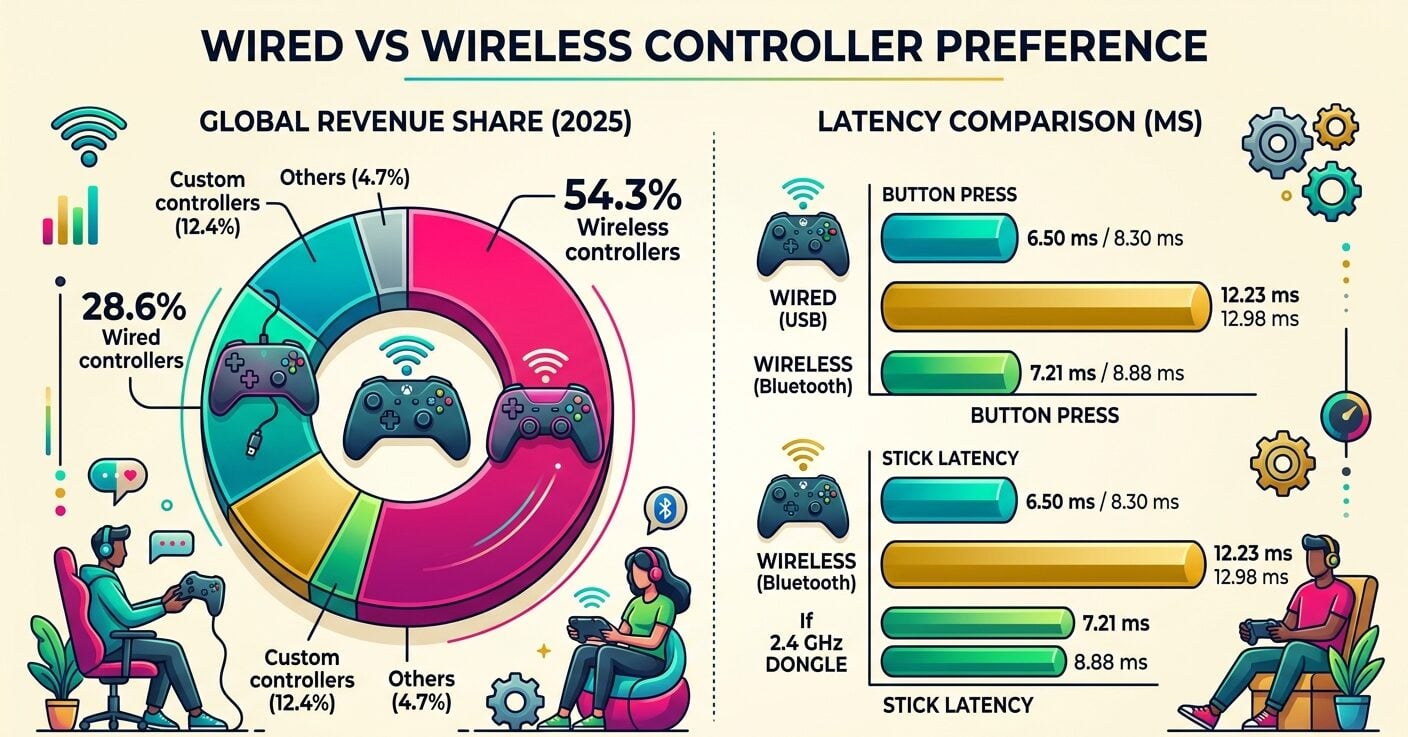
Wireless controllers took 54.3% of global gaming controller revenue in 2025, while wired models took 28.6%, according to MarketIntelo. Bench tests still favor the cable: an Xbox Series controller registered button presses in 6.50 ms over USB and 12.23 ms over Bluetooth. This page covers wired vs wireless controller preference across revenue share, latency tests, Bluetooth congestion, tournament rules, price and battery life, using the latest releases available in October 2026.
Wired vs Wireless Controller Preference Statistics
Do Gamers Prefer Wired or Wireless Controllers?
No primary survey asking players to choose between wired and wireless pads turned up in research for this page. Revenue by product type is the closest published measure of preference.
Wireless controllers accounted for 54.3% of a $6.8 billion gaming controller market in 2025, about $3.7 billion, per MarketIntelo. Wired controllers held 28.6%.
Custom controllers sit in a separate 12.4% segment. That segment includes the Xbox Elite Wireless Controller Series 2, so some wireless pads fall outside the 54.3% line.
| Product type | Share of 2025 revenue | Projected CAGR, 2026–2034 |
|---|---|---|
| Wireless controllers | 54.3% | 8.2% |
| Wired controllers | 28.6% | 5.4% |
| Custom controllers | 12.4% | 11.3% |
| Others (arcade sticks, wheels, flight sticks) | 4.7% | Not published |
Source: MarketIntelo, Gaming Controller Market Research Report, 2025 base year (updated May 2026)
Why Two MarketIntelo Reports Give Different Wireless Shares
MarketIntelo’s separate Game Controllers Market report puts wireless at 45.2% and wired at 22.8% of a $6.2 billion market in 2025.
That report lists gamepads (18.5%), joysticks (7.2%) and steering wheels (4.8%) as their own product types. The wireless share moves with the category list, so each figure needs its report name attached.
Source: MarketIntelo, Game Controllers Market Research Report, 2025 base year (updated June 2026)
Wired vs Wireless Controller Preference by Connection Type
Bluetooth led connectivity at 47.6% of 2025 revenue. USB, the wired connection, followed at 32.4%.
Wi-Fi-connected controllers held 14.8%, a segment MarketIntelo ties to cloud gaming. Streaming-hour data for one such service appears in this Xbox Cloud Gaming usage breakdown.
MarketIntelo projects 9.1% annual growth for Bluetooth and 5.2% for USB through 2034. Proprietary RF and legacy links made up the remaining 5.2% of 2025 revenue.
The report calls cross-platform compatibility a defining purchase criterion. Multi-device habits are tracked in these cross-platform gaming adoption figures.
Its text also states that leading wireless controllers deliver under 1 ms of input latency. The fastest wireless result in Gamepadla’s table below is 3.95 ms.
Source: MarketIntelo, Gaming Controller Market Research Report, connectivity segment, 2025
How Much Latency Does a Wireless Connection Add?
| Controller | Test date | USB cable, button / stick (ms) | 2.4 GHz dongle, button / stick (ms) | Bluetooth, button / stick (ms) |
|---|---|---|---|---|
| Microsoft Xbox Series Controller | 19 May 2025 | 6.50 / 8.30 | 7.21 / 8.88 | 12.23 / 12.98 |
| Sony DualSense | 16 March 2025 | 7.81 / 12.58 | Not in primary runs | 9.03 / 13.60 |
| 8BitDo Ultimate 2 Wireless Controller | 13 March 2025 | 2.81 / 7.02 | 3.95 / 8.11 | 12.02 / 15.99 |
Source: Gamepadla, Prometheus 82 hardware latency tests, average latency, March to May 2025
The USB cable posted the lowest button and stick averages on all three controllers. On the two pads tested in all three modes, Bluetooth was the slowest.
Where a 2.4 GHz dongle exists, it landed nearer the cable than Bluetooth: 7.21 ms against 6.50 ms on the Xbox pad, and 3.95 ms against 2.81 ms on the 8BitDo.
The dongle itself matters. A December 2025 Gamepadla retest of the Xbox pad through a third-party Hyperlink 2 dongle logged 12.24 ms button and 13.32 ms stick latency.
Sony’s pad showed the narrowest Bluetooth gap of the three, at 9.03 ms against 7.81 ms over USB. Retail demand for it is covered in these DualSense sales statistics.
Source: Gamepadla, Xbox Series Controller test log, retest dated 6 December 2025
Does Polling Rate Predict Latency?
| Controller | USB cable (Hz) | 2.4 GHz dongle (Hz) | Bluetooth (Hz) |
|---|---|---|---|
| Microsoft Xbox Series Controller | 125 | 124.69 | 133.16 |
| Sony DualSense | 249.92 | Not in primary runs | 542.42–674.75 |
| 8BitDo Ultimate 2 Wireless Controller | 955.69 | 940.16 | 123.9 |
Source: Gamepadla, software polling tests (median Hz), March to May 2025
Gamepadla’s Bluetooth DualSense runs logged 542.42 Hz and 674.75 Hz, against 249.92 Hz over USB. Bluetooth latency was still higher.
8BitDo advertises 1000 Hz polling on both 2.4G and wired connections. Gamepadla measures latency with its Prometheus 82 hardware and polling with software, and notes that a higher polling rate does not guarantee lower latency.
Source: 8BitDo, Ultimate 2 Wireless Controller product page; Gamepadla testing methodology
Bluetooth Congestion Pushed Steam Controller Latency to 73.8 ms
GamersNexus measured full click-to-photon system latency on Valve’s Steam Controller, which launched on 4 May 2026. These figures include the display chain, so they do not line up with Gamepadla’s controller-only numbers.
Wired USB averaged 19 ms across 499 clicks, 4 ms above a ROG Keris gaming mouse baseline of 15 ms. Valve’s 2.4 GHz Puck averaged 21.6 ms with the same 3.1 ms standard deviation.
Bluetooth alone averaged 37.3 ms with a 20.6 ms standard deviation. With seven other controllers paired over Bluetooth, the average reached 73.8 ms and the log missed 101 entries, which GamersNexus says means the true average is higher.
The Puck held at 21.8 ms under the same seven-controller interference. Install-base context for Valve’s handheld sits in these Steam Deck adoption numbers.
| Connection | Average latency (ms) | Standard deviation (ms) | Missing log entries |
|---|---|---|---|
| Wired USB | 19 | 3.1 | Not reported |
| Puck, 2.4 GHz | 21.6 | 3.1 | Not reported |
| Puck, second Steam Controller connected | 21.9 | Not reported | Not reported |
| Puck, seven other pads on Bluetooth | 21.8 | 3.4 | 2 |
| Bluetooth alone | 37.3 | 20.6 | 1 |
| Bluetooth, seven other pads connected | 73.8 | 48 | 101 |
| Xbox One controller (model 1537), USB | 22.6 | Not reported | Not reported |
Source: GamersNexus, Valve Steam Controller review, NVIDIA LDAT click-to-photon tests, published 27 April 2026
Esports Rules Behind Wired vs Wireless Controller Preference
Evo’s published rules require every controller, even for casual play, to be wired to the console. Wireless controllers are not eligible unless a game’s own rules allow them.
Two setups count as wired: a wireless pad with its batteries removed and powered only over USB, and a pad that connects only through a USB dongle.
The DualSense and DualSense Edge are legal for tournaments played on PlayStation 5. Players caught with an unapproved wireless pad face disqualification and confiscation until the event ends.
Source: Evo, tournament rules page (2024 ruleset as published at evo.gg)
Shooter rulebooks police inputs instead. PlayVS’s college rulebook for Call of Duty: Black Ops 7 requires platform-compatible controllers and bans turbo and button-macro pads, with no connection requirement.
Source: PlayVS College League, Call of Duty: Black Ops 7 Competition Rulebook
Sony’s own DualSense listing notes that haptic feedback and adaptive triggers may require a USB connection.
Source: PlayStation Direct, DualSense Wireless Controller product page
How Fast Will Wireless and Wired Controller Revenue Grow by 2034?
MarketIntelo projects the gaming controller market will reach $13.2 billion by 2034, from $6.8 billion in 2025. That is a 7.6% CAGR over 2026–2034.
Within that projection, wireless controllers grow at 8.2% a year and wired at 5.4%. Custom controllers are the fastest-growing type at 11.3%.
Historical values run from $4.1 billion in 2019 to $5.7 billion in 2023. Points after 2025 are MarketIntelo’s forecasts, not reported sales.
MarketIntelo lists cloud gaming among its growth drivers. Service-level figures for one platform appear in these Amazon Luna user statistics.
Controllers are one slice of total game spending. The wider split sits in this gaming revenue by segment breakdown.
Source: MarketIntelo, Gaming Controller Market Research Report, 2019–2025 historical and 2026–2034 forecast
The Price and Battery Gap Between Wired and Wireless Pads
PowerA lists its Enhanced Wired Controller for Xbox Series X|S at $37.99, with a detachable 10 ft USB cable.
Source: PowerA US store listing, checked October 2026
Microsoft raised the standard Xbox Wireless Controller to $64.99 on 1 May 2025, from $59.99. Console-level competition is covered in this PS5 and Xbox Series sales comparison.
Nintendo raised the Switch 2 Pro Controller from $84.99 to $89.99 in the US on 3 August 2025. Hardware totals for that console are in these Switch 2 sales figures.
Source: Microsoft US price change, May 2025, as reported by TechCrunch; Nintendo of America US price change, August 2025
Valve’s Steam Controller launched at $100. GamersNexus ran its battery for nearly 73 hours of constant input without rumble, against Valve’s claim of 35+ hours.
A full recharge took 3 hours and 26 minutes on a Steam Deck charger. A wired pad draws power from the host and has no battery to manage.
Source: GamersNexus, Valve Steam Controller review, battery and charge tests, April 2026
FAQs
Do more gamers buy wireless or wired controllers?
Wireless. MarketIntelo puts wireless controllers at 54.3% of 2025 gaming controller revenue and wired controllers at 28.6%. Those shares measure vendor revenue, not the number of players using each type.
Is a wired controller faster than a wireless one?
Yes, in Gamepadla’s tests. The Xbox Series controller averaged 6.50 ms button latency over USB, 7.21 ms through its dongle and 12.23 ms over Bluetooth in May 2025.
Are wireless controllers allowed at Evo?
Only where a game’s rules allow it. Evo requires wired controllers, counts USB-dongle pads and battery-free USB-powered pads as wired, and permits the DualSense and DualSense Edge on PS5.
Is Reddit right that Bluetooth controllers lag?
Measured data supports it. GamersNexus logged 37.3 ms click-to-photon latency for the Steam Controller on Bluetooth alone and 73.8 ms with seven other pads connected, against 19 ms wired, in April 2026.
Does a 2.4 GHz dongle match a wired connection?
Close, not equal. Gamepadla measured the 8BitDo Ultimate 2 Wireless Controller at 3.95 ms button latency on its dongle and 2.81 ms over USB in March 2025.
