
Hive Board Game Review

Hive is a two-player abstract strategy game designed by John Yianni and published by Gen42 Games in 2001. It skips the board entirely. You place and slide 22 insect tiles on any flat surface and try to surround your opponent’s Queen Bee. A game runs about 20 minutes, plays best for ages 9 and up, and packs down small enough for a coat pocket. This review breaks down the components, rules, mechanics, and the players Hive fits.
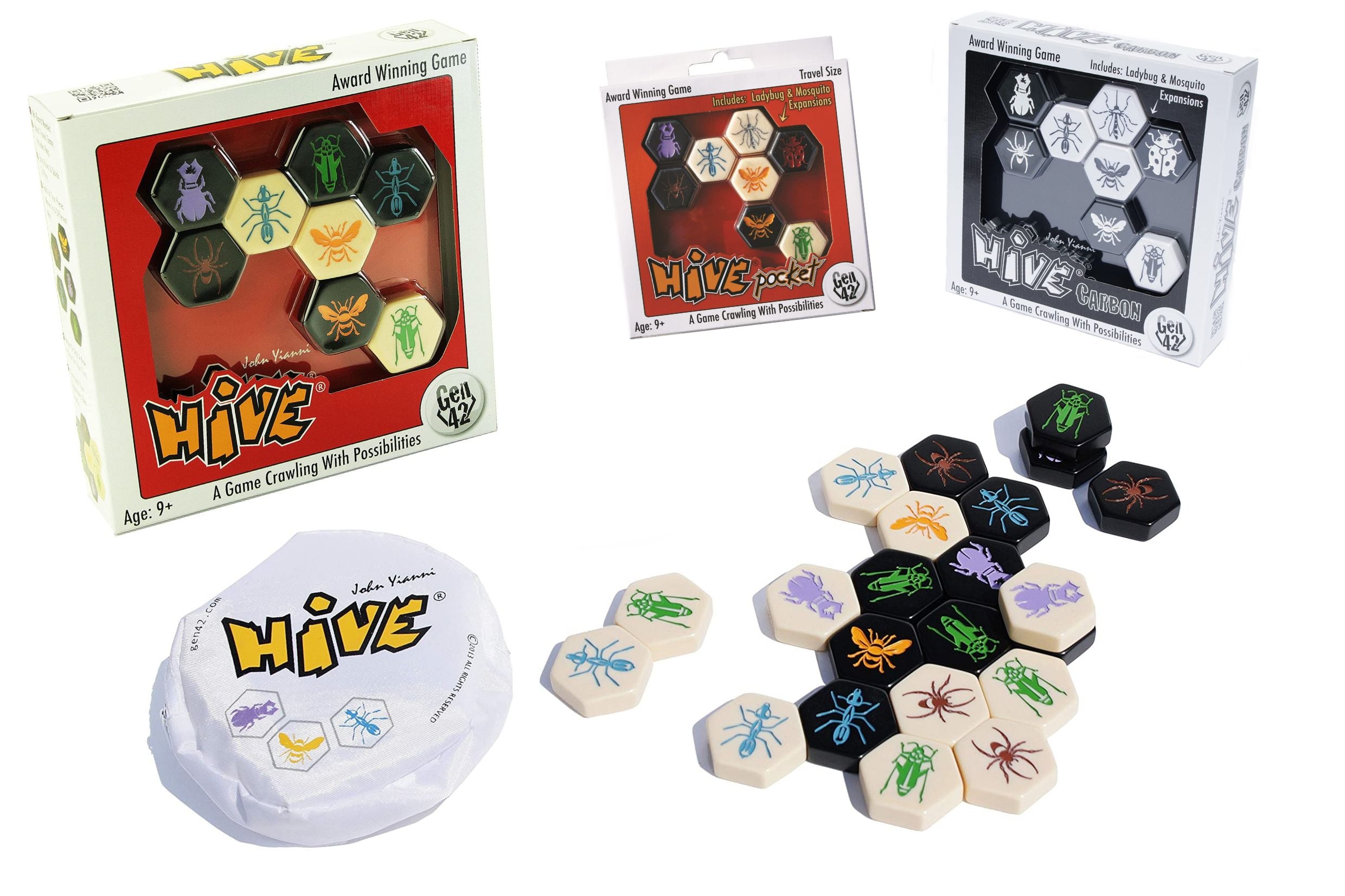
Hive Board Game Overview
Each player controls a colony of bug tiles, white against black. You take turns adding new tiles or moving ones already down, and every bug type moves a different way. Ring the enemy Queen Bee on all six sides while stopping your opponent from doing the same to yours. Tiles never leave play, and you do not have to place all of them.
| Specification | Detail |
|---|---|
| Designer | John Yianni |
| Publisher | Gen42 Games |
| Year Released | 2001 |
| Players | 2 |
| Age Range | 9 and up |
| Playing Time | About 20 minutes |
| Category | Abstract strategy |
| Complexity Rating | 2.31 / 5 (BoardGameGeek weight) |
What’s in the Hive Box
Hive keeps its parts count low. You get 22 hexagonal tiles and nothing else. No board, no dice, no cards to shuffle.
Each player owns 11 tiles in one color: one Queen Bee, two Beetles, three Grasshoppers, three Soldier Ants, and two Spiders. The insect art is engraved on the top face.
The standard edition uses thick bakelite tiles about 1.75 inches across. They feel heavy in the hand and click together well on a table. The Hive Pocket edition shrinks the same 22 tiles into a cloth drawstring bag for travel.
| Component | Quantity per player |
|---|---|
| Queen Bee | 1 |
| Beetle | 2 |
| Grasshopper | 3 |
| Soldier Ant | 3 |
| Spider | 2 |
Hive Pros and Cons
Pros
- No board means you can play on a table, a train tray, or a park bench.
- Rules fit on one page, yet the Beetle climbing on tiles adds real depth.
- The bakelite tiles hold up to years of handling.
- Setup takes zero time. Place the first tile and you have started.
- Games last about 20 minutes, so a rematch fits easily.
Cons
- Two players only, with no solo or group mode in the base game.
- The abstract look gives you no theme to latch onto beyond the insect names.
- A strong player can lock down a beginner fast, which stings early on.
- The standard tiles are bulky next to the Pocket version most players prefer.
How to Play Hive
Setup
There is no setup step. Each player takes their 11 tiles, and the first player places any tile except the Queen to start.
Turn Structure
On your turn you either place a new tile from your pile or move a tile already on the table. You cannot skip a turn if a legal move exists.
After the opening two placements, new tiles must touch your own color and cannot touch an enemy tile. You must place your Queen Bee by your fourth turn at the latest.
Two rules govern movement. The One Hive rule keeps the group connected at all times, so you cannot move a tile that would split it. The freedom to move rule means a tile has to slide into its spot without squeezing through a tight gap.
Win Condition
You win the moment an enemy Queen Bee is surrounded on all six sides. Any tiles count, yours or your opponent’s. If both Queens get surrounded on the same move, the game is a draw.
Hive Game Mechanics
The tiles are the board. As you add pieces, the shape of the hive changes, and that shape is the puzzle you both play against.
Each bug moves on its own rule. The Queen Bee shifts one space. The Beetle moves one space and can climb on top of another tile, pinning it in place. The Grasshopper jumps in a straight line over other tiles to the first empty space. The Soldier Ant slides around the whole outer edge to any open spot, which makes it the most mobile tile. The Spider moves exactly three spaces, no more and no fewer.
Tension comes from one fact: every tile you commit to attack is a tile you cannot use to defend. The choices interact like chess, which puts Hive among the skill-based abstract strategy games that reward planning a few moves ahead.
Where to Buy Hive
Prices in India sit between about ₹2,500 and ₹7,000 depending on the edition and seller.
| Platform | Edition | Price Range (INR) |
|---|---|---|
| Amazon.in | Standard | ₹5,880 – ₹7,052 |
| Amazon India | ₹4,941 – ₹5,345 | |
| BoardGamesIndia | Standard / Pocket | ₹2,500 and up |
| Local hobby shops | Varies | ₹2,500 upward |
The three expansion bugs, Mosquito, Ladybug, and Pillbug, sell separately for roughly ₹2,590 to ₹2,878 each if you want to add them later.
Who Should Play Hive
Hive suits two players who like a quick tactical duel with no luck involved. Chess and checkers fans take to it fastest, since the thinking rewards planning a few moves ahead. It also travels well for couples and commuters, since the Pocket edition rides in a bag with no fuss.
Skip it if you play mostly in groups of three or more, or if you want a theme and story with your game. Hive gives you insects and geometry, not narrative. Players who enjoy other two-player games like Onitama or Santorini will feel at home.
FAQ
Is Hive good for beginners?
Yes. The rules fit on one page and a new player learns them in five minutes. The Beetle and its climbing move adds the only real wrinkle. Expect to lose a few games to experienced players before the tile movements click into place.
How long does a game of Hive take?
A typical game runs about 20 minutes. Two beginners may take longer as they weigh each move. Skilled players who know the tile rules often finish in 10 to 15 minutes, which makes back-to-back rematches easy.
What is the best player count for Hive?
Hive is built for exactly two players. There is no solo mode or group variant in the base box. The whole design turns on one colony facing another, so two is both the minimum and the ideal count.
Is Hive worth buying?
For fans of two-player abstract games, yes. The tiles last for years, setup is instant, and the strategy holds up over many plays. If you only game in large groups or need a theme, your money may go further elsewhere.
What games are similar to Hive?
Chess is the closest match in feel, since both reward planning and have no luck. Onitama and Santorini offer the same two-player abstract tension in a small box. Players who like Hive often own several of these light strategy titles.
