
Molly House Board Game Review

Molly House comes from Jo Kelly and Cole Wehrle, published by Wehrlegig Games in 2025 with art by Rachel Ford. It puts 1 to 5 players in the queer underground of 1720s London, throwing parties while constables gather evidence.
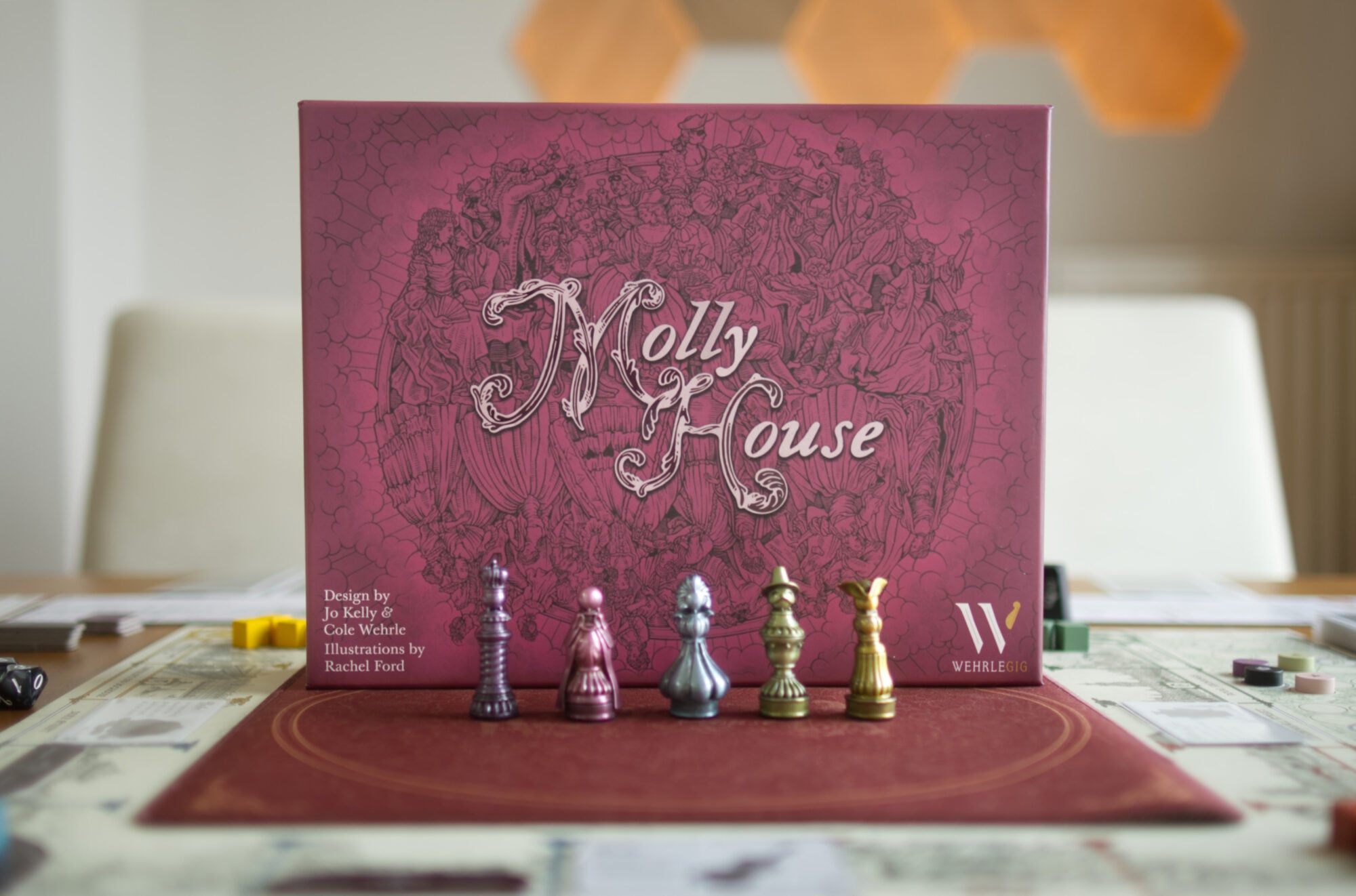
Games run 60 to 120 minutes at ages 14 and up, with a BoardGameGeek weight of 3.75 out of 5. This review covers the components, the rules, and the group it suits.
Molly House Overview
Players take the roles of mollies, the gender-defying Londoners who met in coffee houses and back rooms. You host festivities to raise the community’s joy while the Society for the Reformation of Manners hunts for evidence.
Every card you discard can become evidence, and enough raids collapse the community.
| Designer | Jo Kelly, Cole Wehrle |
|---|---|
| Publisher | Wehrlegig Games |
| Year Released | 2025 |
| Players | 1 to 5 |
| Age Range | 14+ |
| Playing Time | 60 to 120 minutes |
| Category | Thematic card game, bluffing, deduction |
| Complexity Rating | 3.75 / 5 on BoardGameGeek |
What’s in the Box: Molly House Components
| Material | Contents |
|---|---|
| Boards | One 56 x 43.5 cm board, five player boards |
| Standard cards | 52 vice cards in four suits, five aids, 25 solo |
| Small cards | 20 items, eight major and eight minor indictments |
| Wood | 64 reputation cubes, five pawns, joy markers, candelabra |
| Tokens | Raid, cruising, draw and 20 encounter tokens |
| Dice | Two movement dice, four d10, four solo d6 |
| Books | 24-page rulebook, eight-page solo rulebook |
The pawns come in five shapes rather than five colours, which helps at a crowded table. Encounter tokens hide three loyal faces and one informer face per player, so the bluffing runs on cardboard.
Molly House Pros and Cons
- The three endings tell the history without a lecture, since informers win only when the community falls.
- Festivities pull cards from every player, so quiet turns still matter.
- Rogues act as wilds and four constables form a legal set, so threats double as tools.
- The solo Rookery rules ship in the box, a rarity in solo board game rankings.
- Card and dice luck can wreck a planned festivity outright.
- The first game runs long while everyone learns the set rankings.
- Scoring has exceptions that new players forget.
- Players who dislike betrayal will bounce off the informer choice.
How to Play Molly House
Molly House Setup
Place the board, seed the four molly houses, and shuffle the vice deck. Each player takes a board, a pawn, a joy marker and encounter tokens. Setup runs about 10 minutes.
Turn Structure and Molly House Rules
Roll the two movement dice and move 0 to 4 spaces in either direction. Movement stays optional.
Your action depends on where you stop. Draw vice cards, buy an item, or host a festivity.
Hosting a Festivity
The host commits two cards, then other players add cards if they want in. More come off the community deck.
Four played cards form the final set. A straight flush ranks highest, then a queen with three of a kind, then a jack with a straight. Four constables count as a quiet gathering. Community cards in that set raise the joy track.
End of Week and Winning
Discards land in the gossip pile or the safe pile. Each week, gossip becomes reputation cubes on the houses, and a house with enough evidence is raided.
Raided players draw indictments and secretly pick a loyal or informer token. The game runs five weeks. If the community thrives, the most joy wins. If it falls, only successful informers can win. Neither outcome means everyone loses.
Where to Buy Molly House
| Platform | Notes |
|---|---|
| Wehrlegig Games | Publisher direct |
| Noble Knight Games | US retailer |
| Board Game Bliss | Canadian retailer |
| Cardhaus Games | US retailer |
| eBay, BGG GeekMarket | Secondhand copies |
| Board Game Arena | One of the digital board game adaptations |
Molly House Game Mechanics
Molly House runs on multi-use cards. A rogue is a wild number, a threat, and later evidence, so every discard costs you something.
Roll and move sets the pace. You cannot always reach the house you want.
Negotiation drives the festivities. Players argue over which set to build, because the host banks joy while helpers take scraps. That pressure sits close to the hidden goals in Nemesis, though Molly House hands out the traitor role through play rather than at setup.
Who Should Play Molly House
Groups who enjoy talking through a shared problem get the most out of it. The table bargains every festivity, so quiet players need a nudge.
Fans of Pandemic and its shared-loss structure will recognise the community threat, though the betrayal turn sits closer to Betrayal at House on the Hill.
Skip it if your group wants tight strategic control, or if betrayal sours your evening. It hits hardest at four or five, which puts it near the top of games built for five or more.
FAQ
Is Molly House good for beginners?
No. The set rankings take a full game to absorb, and the weight sits at 3.75 out of 5. Players who know poker hands adapt fastest. The solo Rookery rules make a gentler starting point.
How long does Molly House take to play?
Between 60 and 120 minutes across five weeks. First games run closer to two hours, since players keep checking the festivity ranking aid. Setup adds 10 minutes. Repeat plays land near 90 minutes.
What’s the best player count for Molly House?
Four or five. More players means more cards in each festivity and more suspicion after a raid. Three works but thins the bluffing. Solo mode uses 25 orchestration cards and its own rulebook.
Does Molly House have expansions?
No expansions exist as of 2026. BoardGameGeek lists three versions of the base game and one accessory. Wehrlegig Games sells an upgrade pack. The core box holds everything needed for solo and group play.
What games are similar to Molly House?
Arcs and Oath share Cole Wehrle’s mixed mechanisms and story-first design, and Pax Pamir uses a comparable card market. For hidden-role tension, look at cooperative deduction games.
