Ethnos Board Game Review

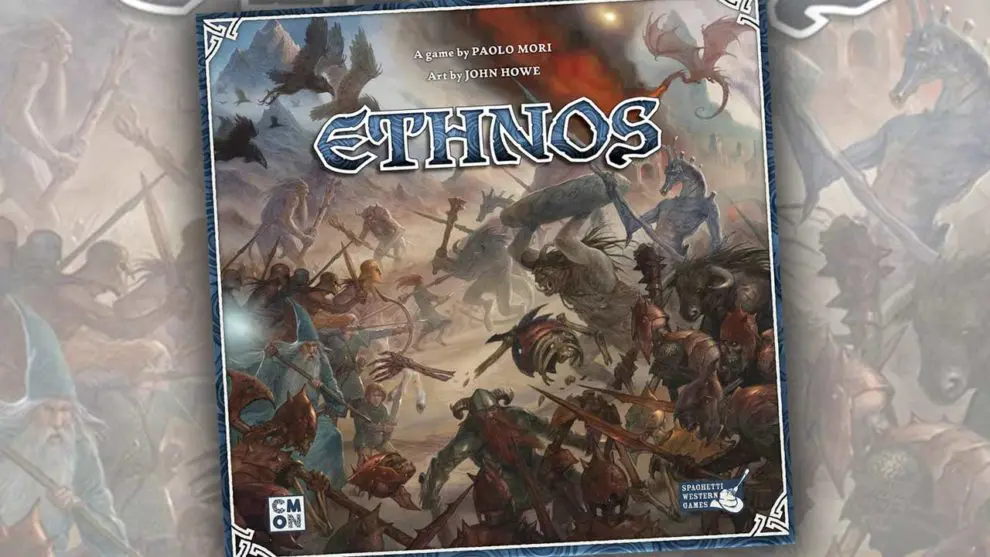
Ethnos, designed by Paolo Mori with art by John Howe and published by CMON Limited in 2017, mixes set collection, hand management, and area control in a fantasy setting. The game plays 2 to 6 players in 45 to 60 minutes, suits ages 14 and up, and sits at a 2.11 out of 5 complexity weight on BoardGameGeek. Players recruit tribes of dwarves, elves, wizards, and others to claim six fantasy regions across two or three Ages. This review covers gameplay, components, and whether Ethnos earns shelf space.
Ethnos Game Overview
Each player gathers cards from six tribes, plays them in matching sets called Bands, and places control tokens across six Kingdoms to score Glory. Whoever holds the most Glory after the final Age wins.
The game ships with twelve tribes, but you only use six per session (five for 2 to 3 players). Different tribe combinations change the feel of every game, since each tribe carries a unique power.
| Designer | Paolo Mori |
|---|---|
| Artist | John Howe |
| Publisher | CMON Limited |
| Year Released | 2017 |
| Players | 2 to 6 |
| Age Range | 14+ |
| Playing Time | 45 to 60 minutes |
| Game Type | Strategy, Fantasy |
| Complexity | 2.11 / 5 (light to medium) |
What’s in the Ethnos Box
CMON packed a generous amount into the box for the price point. Setup runs longer than most light games because of the deck building, but plays move fast once started.
- 156 Tribe cards across 12 fantasy tribes
- 3 Dragon cards that trigger end-of-Age scoring
- 12 Setup cards used to randomize tribe selection
- 156 Control markers in 6 player colors
- 18 Glory tokens worth 0, 2, 4, 6, 8, or 10 points
- 1 main game board showing the six Kingdoms
- 6 Orc Horde boards and 1 double-sided Merfolk board
- Giant tokens and 6 Troll tokens for tribe powers
Card stock holds up to repeat shuffling. John Howe’s art (the same illustrator behind Lord of the Rings concept work) gives each tribe a distinct look, though some gamers find the palette dark. The pastel control tokens clash a bit with the heavier kingdom borders, a minor visual nit.
Pros and Cons
Pros
- Six of twelve tribes per game keeps strategy fresh across many sessions
- Rules teach in 10 minutes, full first game runs about an hour
- The discard-your-hand rule after playing a Band creates tight push-your-luck decisions
- Scales from 2 to 6 players without major rule changes
- Tribe powers add variety without bloating the rule set
Cons
- Setup takes 5 to 10 minutes due to deck construction
- Art style splits opinions, some find it muddy
- Only one official promo expansion exists, limiting long-term variety
- Turn order can feel tight in 5 and 6 player games
How to Play Ethnos
Setup
Place the main board within reach of all players. Draw six setup cards to determine the tribes for this game. Pull those tribe decks, shuffle them together, then split the deck in half. Shuffle three Dragon cards into the bottom half and stack the top half on top.
Deal one card to each player. Place face-up cards equal to twice the player count below the board. Add Glory tokens (low value first) to each of the six Kingdoms.
Turn Structure
On your turn, you either recruit one card or play a Band. Recruiting means drawing from the deck or taking a face-up card. Playing a Band means laying down matching cards on the table, all the same tribe or all the same kingdom color.
After playing a Band, you discard your remaining hand face-up to the supply, which gives opponents access to your leftovers. This trade-off drives most of the game’s tension.
Placing Control Tokens
Each Band lets you place one Control token in a Kingdom matching your Band Leader’s color. The Band size must exceed the current number of Control tokens in that Kingdom, so larger Bands gain access to contested regions.
Winning
When the third Dragon appears, the Age ends. Score Glory based on Band sizes played plus Kingdom majorities. Games run two Ages for 2 to 3 players, three Ages for 4 to 6. Most Glory wins.
Where to Buy Ethnos
| Platform | Notes |
|---|---|
| Amazon | Most common source, often discounted from MSRP |
| CMON Store | Direct from the publisher when stock allows |
| Miniature Market | Carries the standard English edition |
| Cool Stuff Inc | Stocks Ethnos and the Centaurs promo |
| eBay | Used copies and out-of-print first printings |
| BoardGameGeek GeekMarket | Resale from private sellers worldwide |
Ethnos Game Mechanics
Three systems intertwine here. Set collection drives card play, area majority drives scoring across Kingdoms, and hand management forces hard timing calls.
The signature mechanism is the post-Band discard. You can never bank a Band and keep building, so every play asks whether your current set is good enough or whether you should hold out for a bigger one. Holding out costs you the cards you give to opponents when you finally play.
Tribe powers add the second layer of decision-making. Wizards let you draw extra cards. Elves return cards to your hand. Skeletons act as wild cards but disappear at end of Age. Each tribe rewards different play styles. Fans of area control board games will recognize the majority scoring, while set collection fans get a fresh twist on the basic loop.
Who Should Play Ethnos
This game fits groups that want strategic depth without a heavy rules teach. It works for couples, family game nights with teens, and gaming groups looking for a one-hour filler with real decisions.
Players who enjoyed Small World will find similar tribal variety with a different mechanical core. Sushi Go Party fans get a step up in weight. Skip Ethnos if your group dislikes randomness from the deck or if you want a single set of rules to master across plays. The variable tribe selection means each session demands fresh thinking.
Solo gamers should look elsewhere, since Ethnos has no solo mode. For two-player nights, the game works well, though some prefer dedicated two-player board games built for the count.
FAQ
Is Ethnos good for beginners?
Yes, mostly. The core rules teach in under 10 minutes, and the choice between drawing and playing a Band is intuitive. Tribe powers add complexity, but each tribe has a single ability printed on the card. New players grasp the basics in one round and play competently by the second Age.
How long does Ethnos take to play?
A 4-player game runs about 60 minutes including setup and scoring. Two and three player games finish faster, around 45 minutes, since they play only two Ages instead of three. Experienced groups can complete a full game in 40 minutes once they know the tribe powers.
What is the best player count for Ethnos?
Four to five players hits the sweet spot. The shared face-up card pool stays interesting, area majority feels contested, and turn order moves quickly. Two-player works but loses some of the area control tension. Six-player games drag slightly due to longer turn cycles.
Is Ethnos worth buying?
Yes for groups that play light-to-medium strategy games regularly. The price runs 30 to 40 dollars, and the variable tribe selection gives strong replay value. Skip it if you already own Small World or similar fantasy area control games and rarely play that style.
What games are similar to Ethnos?
Small World shares the fantasy tribe theme and area majority scoring. Inis offers heavier area control with card play. Splendor matches the light-to-medium weight with engine building instead of set collection. The reimplementation Archeos Society by the same designer streamlines several Ethnos systems for newer players.
