
Stranger Things: Upside Down Board Game Review

Stranger Things: Upside Down is a cooperative board game from designer Rob Daviau, published by CMON in 2023. It puts 2 to 4 players into the shoes of the Hawkins kids as they push back against threats leaking out of the Upside Down across the first two seasons of the Netflix show. Games run about 60 minutes and the box recommends ages 12 and up. This review covers components, gameplay flow, mechanics, and whether the game earns a spot on your shelf.
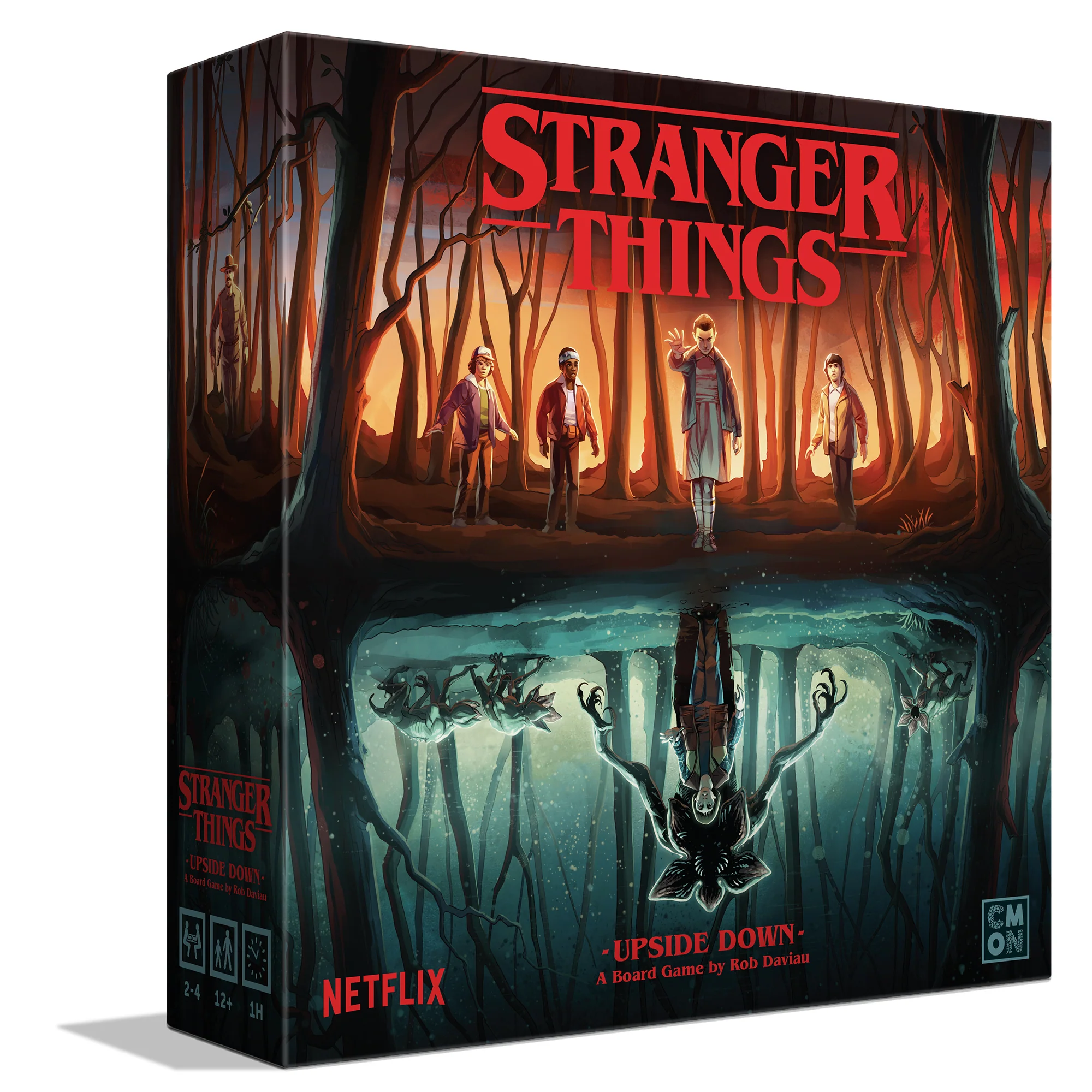
Stranger Things: Upside Down Overview
The game pits players against two parallel threats: the Demogorgon and its allies from the Upside Down, and the operatives of Hawkins National Laboratory. Each player picks a character and the group picks a season, then uses action cards to move around Hawkins, grab items, recruit allies, and clear stacks of tokens spread across the board.
Win conditions change between Season 1 and Season 2, but both ask the team to complete their objectives before scene cards run out or before the team breaks under accumulated fear. The double-sided board provides two distinct setups tied to events from the show.
| Designer | Rob Daviau |
|---|---|
| Publisher | CMON Global Limited |
| Year Released | 2023 |
| Players | 2–4 |
| Age Range | 12+ |
| Playing Time | 60 minutes |
| Game Type | Cooperative, Thematic |
| Complexity Rating | 2.18 / 5 (BGG) |
What’s in the Stranger Things: Upside Down Box
The box packs a generous component count for a one-hour cooperative game. Players get a double-sided board, six character dashboards, four fear trackers, and a full set of action and scene cards split between the two seasons.
| Component | Quantity |
|---|---|
| Double-Sided Game Board | 1 |
| Character Dashboards (Mike, Lucas, Dustin, Nancy, Joyce, Hopper) | 6 |
| Fear Trackers | 4 |
| Action Cards | 48 |
| Item Cards | 15 |
| Scene Cards (Season 1) | 25 |
| Ally Cards (Season 1) | 8 |
| Scene Cards (Season 2) | 27 |
| Ally Cards (Season 2) | 8 |
| Double-Sided Level Tokens | 77 |
| Foe Standees (Demogorgon, Demodogs, Patrol) | 7 |
| Eleven Tracker | 1 |
Character miniatures are detailed plastic figures that match the show’s cast, and the cardboard tokens are thick enough to hold up to repeated play. Art on the scene cards pulls directly from key moments in the series.
Pros and Cons
Pros
- Captures the look and feel of seasons 1 and 2 with strong artwork on the board and cards.
- Hand management around action cards creates real tension when you commit cards to a challenge before learning its difficulty.
- Two complete scenarios on a double-sided board give the box clear replay value.
- Rules are light enough to teach in 15 minutes, but the difficulty is tuned high so wins feel earned.
- Six characters with different special powers encourage swapping roles between plays.
Cons
- The core loop of beating token stacks can feel repetitive once you have played both seasons twice.
- Outcomes lean heavily on card draws, so a bad streak can sink the team regardless of decisions.
- Replay drops sharply after you have cleared both Season 1 and Season 2.
- Setup involves seeding tokens around the board and prepping multiple decks, which takes 10 to 15 minutes.
How to Play Stranger Things: Upside Down
Setup
Pick a season and flip the board to that side. Each player takes a character dashboard, places their miniature at the starting location, draws five action cards, and takes a fear tracker. Seed level tokens onto the board in stacks as the season rules direct, shuffle the scene, ally, and item decks, and put the Eleven tracker in place.
Turn Structure
On your turn you draw scene cards based on the current Act and resolve their effects, which often spawn foes or push the Upside Down forward. You then move your character along point-to-point routes between Hawkins locations.
At a location you can perform uncontested actions like drawing items or gathering info, or contested actions like fighting foes, recruiting allies, or rescuing Will. Contested actions ask you to commit action cards face down to beat the value of a token stack. Fail and your character takes fear; succeed and you clear tokens off the board.
Winning and Losing
The team wins by completing the season’s main objective, which centers on rescuing Will in Season 1 and closing the gate in Season 2. The team loses if the scene deck runs out, if a key story event fails, or if every character maxes out their fear track.
Where to Buy Stranger Things: Upside Down
| Retailer | Region | Approx. Price |
|---|---|---|
| Board Games India | India | ₹5,000 – ₹6,400 |
| Ubuy India | India | ₹5,500 – ₹6,500 |
| Amazon India | India | ₹5,000 – ₹7,000 |
| CMON Direct | Global | $59.99 USD |
| Asmodee Retailers | US / EU | $50 – $70 USD |
Stranger Things: Upside Down Game Mechanics
At the core sits a hand management puzzle. Your hand of action cards is your only currency for movement, items, and combat, so every card you spend on getting somewhere is a card you cannot spend on a fight.
Contested checks add a push-your-luck layer. You commit cards before you know how hard the challenge will be, then flip the top of the stack to learn the target number. Adding more cards raises your chances but drains the team’s shared deck faster, which speeds up bad events.
Each character has variable player powers tied to their role in the show. Mike triggers extra actions in certain spots, Eleven supports the team through her tracker, and Hopper has stronger combat options. Point-to-point movement between Hawkins locations forces tough choices about who covers the Upside Down side of the board, since travel there generates fear.
Who Should Play Stranger Things: Upside Down
The game lands best with fans of the show who want a thematic cooperative game for game night with friends or family. Couples and groups of three hit the sweet spot, where decisions feel weighty but turns stay short. At four players downtime grows and the team conversation can stall.
If you enjoyed Pandemic or Horrified, the cooperative tension here will feel familiar, though Upside Down leans harder on hand management and lighter on action economy. Players who want a deep strategic puzzle or long campaign should look elsewhere. Skip it if you only know the show casually, since much of the appeal sits in the IP.
FAQ
Is Stranger Things: Upside Down good for beginners?
Yes, with one caveat. The rules teach in 15 minutes and the actions are easy to grasp, making it a fine pick for people new to cooperative games. The difficulty is tuned high, so beginners may lose their first one or two plays before the team learns to manage fear and card spending well.
How long does Stranger Things: Upside Down take to play?
A full game runs about 60 minutes once players know the rules. First plays take closer to 90 minutes because of the rules teach and the 10 to 15 minute setup. Season 2 plays slightly longer than Season 1 due to its larger scene deck and tunnel system layout.
What’s the best player count for Stranger Things: Upside Down?
Three players hits the sweet spot. Two works well and keeps turns fast, but the team has to spread thin across the board. Four players covers more ground but adds downtime between turns and slows team discussions during contested checks. Solo play is not officially supported in the base rules.
Is Stranger Things: Upside Down worth buying?
If you love the show and want a cooperative game tied to its first two seasons, yes. The theme is strong and the box gives you two full scenarios. Players who do not care about the IP may find the token-clearing loop repetitive after a few plays, so the show connection drives most of the value here.
What games are similar to Stranger Things: Upside Down?
Horrified by Ravensburger uses similar cooperative monster-hunting structures with point-to-point movement. Pandemic offers the same shared-fate tension with a different theme. Fans of Rob Daviau’s design work should also try Pandemic Legacy, which he co-designed and which delivers a much deeper campaign experience.
