
Puerto Rico Board Game Review

Puerto Rico, designed by Andreas Seyfarth and published by alea and Ravensburger in 2002, casts 3 to 5 players as colonial governors competing for victory points. A game runs 90 to 150 minutes and suits ages 12 and up. It mixes role selection with crop production and construction, and it held the number one spot on BoardGameGeek for several years. This review walks through how it plays, what comes in the box, where it shines, where it stumbles, and who it suits.
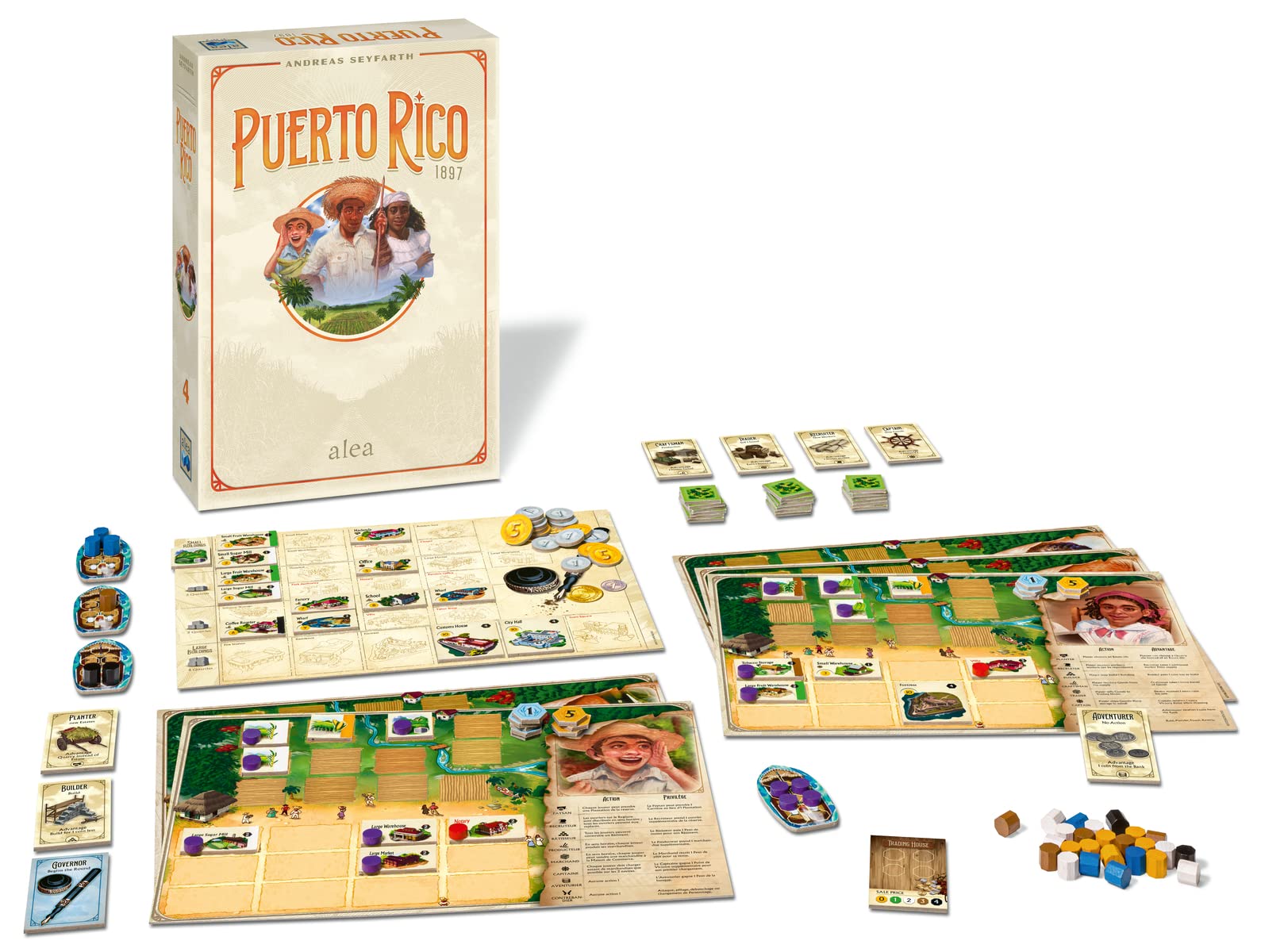
Puerto Rico Overview
Each player manages a private island board holding plantations, city buildings, and stored goods. You grow corn, indigo, sugar, tobacco, and coffee, then ship them to Europe for points or sell them for doubloons.
Doubloons pay for buildings that raise production or grant new abilities. Points come from buildings you own, goods you ship, and large buildings staffed with colonists. The player with the most points at the end wins.
| Designer | Andreas Seyfarth |
|---|---|
| Publisher | alea, Ravensburger |
| Year Released | 2002 |
| Players | 3–5 (some editions add 2-player rules) |
| Age Range | 12+ |
| Playing Time | 90–150 minutes |
| Game Type | Strategy, City Building, Economic |
| Complexity Rating | 3.27 / 5 |
What’s in the Box: Puerto Rico Components
The box holds wooden pieces and individual player boards. The bits hold up to heavy play.
- One island board per player with plantation and building spaces
- Seven role cards: Settler, Mayor, Builder, Craftsman, Trader, Captain, and Prospector
- Building tiles for small and large city buildings
- Plantation tiles and quarry tiles
- Round colonist discs and a colonist ship
- Wooden goods barrels in five colors for the five crops
- Cardboard doubloon coins
- Victory point chips in values of one and five, kept face down
- Three cardboard cargo ships, a trading house, and a governor token
The goods barrels and colonist discs are wood, while the doubloons, tiles, and point chips are thick cardboard. Franz Vohwinkel’s art stays plain and readable rather than decorative.
Pros and Cons
- Role selection keeps everyone active. When one player picks Craftsman, every player produces, so downtime stays low.
- Picking a role that helps you more than your rivals creates a sharp decision every single turn.
- Setup takes about ten minutes once you know the building layout.
- The mix of buildings and crop paths gives high replay value, since no two games push the same strategy.
- A teach runs 15 to 20 minutes despite the depth underneath.
- Turn order matters a lot. The player sitting after a strong role pick often copies the action cheaply.
- The colonial theme is dry and, for many players, uncomfortable in how it frames the setting.
- New players lose heavily against veterans, with no catch-up mechanism to soften it.
- The optimal opening is fairly fixed, which can make early turns feel scripted.
How to Play Puerto Rico
Setup
Give each player a board and starting doubloons, with later players receiving slightly more. Deal each player one starting plantation. Sort the buildings into supply, load the colonist ship, and set out the three cargo ships and trading house by player count. The start player takes the governor token.
Round Structure and Turns
The governor chooses a role card first, then choice passes clockwise. The chosen role triggers an action for all players, while the person who picked it gains a bonus.
- Settler: take a plantation tile; the picker may take a quarry.
- Mayor: draw colonists from the ship and assign them; the picker takes one extra.
- Builder: buy a building; the picker pays one doubloon less.
- Craftsman: produce goods from staffed plantations; the picker makes one extra good.
- Trader: sell one good to the trading house; the picker earns a doubloon more.
- Captain: ship goods for points; the picker scores an extra point.
- Prospector: the picker alone takes a doubloon, used at higher player counts.
Each role left unchosen gains a doubloon at the round’s end, so a neglected role becomes more tempting over time.
Winning Puerto Rico
The game ends when a player fills every building space, when the colonist supply empties during a Mayor action, or when the point chips run out during shipping. Add up points from shipped goods, owned buildings, and staffed large buildings. The highest total wins.
Where to Buy Puerto Rico
| Retailer | Edition | Approx. Price |
|---|---|---|
| Amazon India | Puerto Rico 1897 | ₹10,000–₹12,000 |
| Board Games India | Puerto Rico 1897 | ₹10,000–₹12,000 |
| Toycra | Original | ₹4,000–₹6,000 |
| Boardway India | Original | ₹4,000–₹6,000 |
| BoardGameGeek Market | Various | $45–$60 |
Puerto Rico Game Mechanics
The engine is action drafting through role cards. Because choosing a role triggers it for the whole table, every pick is a read on what helps you and how much it gifts your rivals. Taking Captain when your hold is full and an opponent’s is empty is the core skill.
On top of that sits tableau building. You arrange plantations and buildings on your own board to form a production chain, and each new building can change what your earlier ones are worth. This is engine building, where corn-to-ship and tobacco-to-trade paths reward different setups.
Two quieter rules shape the late game. Point chips are face down, so opponents can estimate but not confirm your score, and the doubloons piling on unused roles steadily raise the value of actions nobody wants. Together they keep tension running to the final turn.
Who Should Play Puerto Rico
This one rewards players who enjoy tight efficiency puzzles and indirect competition rather than direct attacks. If you like reading the table and squeezing value from each role, it pays off across many plays.
It plays sharpest at four or five players, where role picks pinch harder and the shared ships fill faster, while the three-player game is calmer and more solitaire. Fans of watching a production engine grow often move on to heavier tableau builders like Terraforming Mars or Earth after this one. For a lighter, card-based take on the same role system, its reimplementation San Juan trims the board down to a hand of cards. Skip Puerto Rico if you want conflict, negotiation, or a strong narrative, since it offers none of those.
FAQ
Is Puerto Rico good for beginners?
The rules teach in under 20 minutes, so a first game is manageable. The trouble is the gap in skill. New players who sit down against experienced ones tend to lose by a wide margin, since strong openings and shipping timing are not obvious at first.
How long does Puerto Rico take to play?
A full game runs 90 to 150 minutes. Three players move faster and land near the lower end, while a five-player table with newer players can stretch past two hours. Setup adds about ten minutes once everyone knows the buildings.
What is the best player count for Puerto Rico?
Four or five players gives the sharpest game. Role choices restrict opponents more and the ships clog up, forcing harder shipping calls. Three players still works but feels calmer and closer to a solo optimization puzzle with less pressure on each pick.
Is Puerto Rico worth buying?
If you enjoy economic strategy with low luck and constant decisions, it earns its place and holds up after many plays. The dated colonial theme and steep learning curve are the main reasons some players pass on it despite the strong design.
What games are similar to Puerto Rico?
San Juan reworks the same role system into a card game. Race for the Galaxy shares the action-selection feel at a faster pace. For a lighter, quicker engine to build, Project L is an easier entry point, while Le Havre and Caverna expand the production side over a longer game.
