
The White Castle Board Game Review

The White Castle is a 2023 Euro-style board game from Spanish design duo Llama Dice (Israel Cendrero and Sheila Santos), published by Devir. Players control rival clans seeking favor with the daimyo of Japan’s Himeji Castle across just three quick rounds. The game plays 1 to 4 players, ages 12 and up, in about 60 to 80 minutes. This review walks through the gameplay, components, mechanics, and who will get the most out of it.
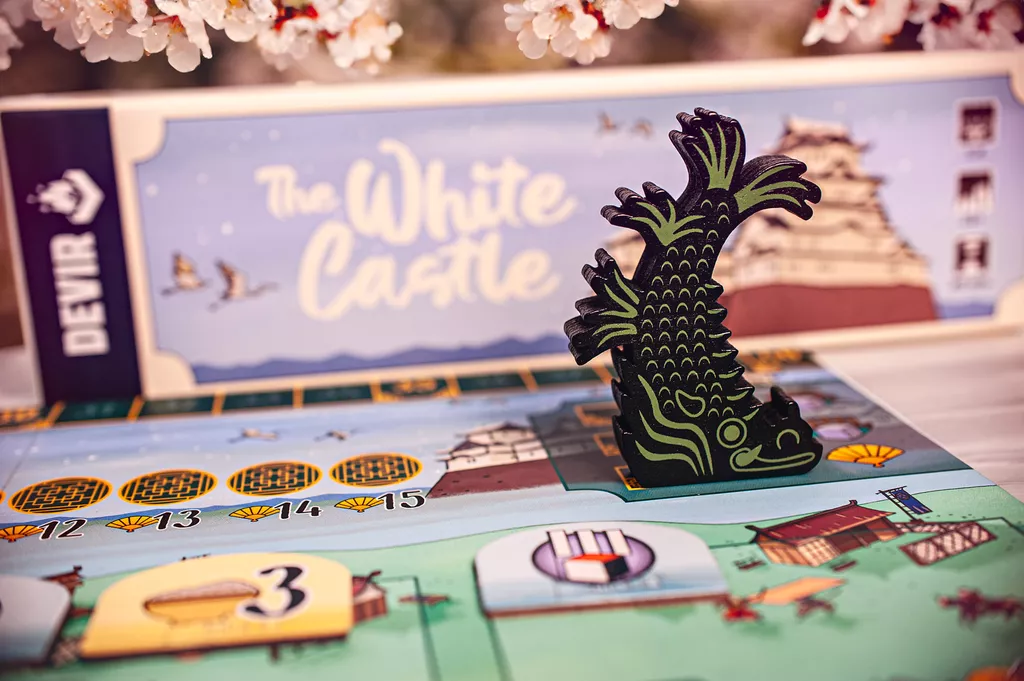
The White Castle Game Overview
The setting is Himeji Castle in feudal Japan. You send warriors to the walls, courtiers up through the castle floors, and gardeners to tend the koi ponds. Every action eventually pays out points at the end of three rounds.
The game shares its DNA with Llama Dice’s earlier hit, The Red Cathedral. Both are tight medium-weight games packed into small boxes. The White Castle leans harder on dice placement and tableau building.
| Designer | Israel Cendrero, Sheila Santos |
|---|---|
| Publisher | Devir |
| Year Released | 2023 |
| Players | 1 to 4 |
| Age Range | 12+ |
| Playing Time | 60 to 80 minutes |
| Game Type | Strategy / Euro |
| Complexity Rating | 3.06 / 5 (Medium) |
What’s in the Box of The White Castle
Devir crammed a lot into a compact box. The cardboard is thick, the wooden pieces are well-shaped, and the art by Joan Guardiet ties everything together.
| Component | Quantity |
|---|---|
| Main Board | 1 |
| Player Boards | 4 |
| Six-sided dice (black, white, coral) | 15 |
| Wooden Warriors, Courtiers, Gardeners | 60 |
| Resource cubes, tokens, markers | 25 |
| Cards (Castle, Garden, Starting, Solo) | 77 |
| Tiles, coins, Daimyo seals, bridges | 82 |
The three cardboard dice bridges are a small but charming touch. They store dice between rounds and are easy to set up. Players who like good Euro-style board games will appreciate the production value here.
The White Castle Pros and Cons
Pros
- Dice placement creates a tight puzzle every turn. The pip value of your die versus the action space changes whether you gain coins or pay them.
- Short play time without losing depth. Two-player games can wrap in 35 minutes, four-player games in about 75.
- Action combos feel satisfying. A Gardener action can trigger a Warrior action, which can trigger another action.
- Variable setup. The cards in each castle level shift between games, so the third-tier Daimyo bonuses look different almost every play.
- Easy teach. Most players pick up the rules in 10 to 15 minutes.
- Solo mode is included, with nine dedicated cards driving the AI opponent.
Cons
- Only nine total turns per player. Some players will feel the game ends just as their engine clicks into place.
- The dark second-floor castle rooms can be confusing about which dice colors activate them.
- Meeples shift around the player board during play, which gets fiddly when calculating resource gains.
- Four-player counts can suffer from downtime if even one player thinks slowly.
- A handful of rules questions are not clearly answered in the manual.
How to Play The White Castle
Setup
Place the main board between players. Each player takes a player board with starting meeples (warriors, courtiers, gardeners), starting resources, and a few starting cards. Shuffle the castle cards into their three rooms. Roll the dice pool and place dice on the three bridges.
Turn Structure
On your turn, pick one die from either end of a bridge. Place it on an action space matching the die’s color. If your die has more pips than the space requires, you gain coins. Fewer pips means you pay coins to act.
The main actions involve moving meeples onto the board. Send warriors to the walls, send courtiers into the castle and up its three levels, or activate gardeners in your garden tableau. Picking a die from the left side of a bridge also triggers a Lantern Reward, paying out bonuses based on the cards in your tableau.
Win Conditions
After three rounds (nine turns total per player), score points from courtiers in the castle, warriors on the wall (only if you have courtiers inside), gardeners, leftover resources, and your final position on the Influence track. Highest score wins.
Where to Buy The White Castle
| Retailer | Region |
|---|---|
| Amazon | US / UK / EU |
| Miniature Market | US |
| Cardhaus Games | US |
| BoardGameBliss | Canada |
| Zatu Games | UK |
| Devir (official) | EU / International |
| eBay / GeekMarket | Secondary market |
The White Castle Game Mechanics
The core engine combines dice placement and worker placement. Dice come in three colors and three locations on the bridges, so your choice has two layers: which die to pick, and where to send it.
The pip-versus-space math drives most decisions. A high pip die on a low-cost space pays you to act. A low pip die on a high-cost space costs money. This creates real tension when your favorite color is all low rolls.
The Courtier action drives the scoring engine. Mother-of-pearl moves courtiers up the castle, where higher floors score more points (1 / 3 / 6 / 10 points by tier) and add cards to your tableau. Those tableau cards boost future Lantern Rewards. Engine building is light but present, and the loop rewards forward planning.
Player interaction is indirect. You compete for dice and for spots in the castle. There is no direct conflict, which fits the Euro tradition.
Who Should Play The White Castle
This game suits players who like dice-driven decision puzzles in a short package. If you enjoy Lost Ruins of Arnak, Tiletum, or Llama Dice’s own Red Cathedral, you will likely click with The White Castle.
It works best at two or three players. Two players is fast and brain-burning. Four players adds variety but introduces downtime risk. Solo play is solid, with a card-driven opponent that keeps the puzzle interesting.
Skip it if you want long sessions of deep engine building or heavy player conflict. Players who prefer cooperative experiences will find this too competitive and abstract. New gamers may also struggle with the dice math at first, though the rules teach quickly.
For groups that enjoy short, sharp two-player games with dice and decisions, The White Castle earns a spot on the shelf.
FAQ
Is The White Castle good for beginners?
Not for total newcomers, but accessible for anyone with a few Euro games under their belt. The rules teach in 10 to 15 minutes. The dice pip math takes a turn or two to click. After one full play, most players understand the flow and can focus on strategy.
How long does The White Castle take to play?
The box says 80 minutes, but actual times run shorter once players know the rules. Two-player games often finish in 35 to 45 minutes. Three-player games run 50 to 65 minutes. Four-player games can stretch to 75 minutes if any player takes long turns.
What’s the best player count for The White Castle?
Two or three players hits the sweet spot. Two players is quick and tactical, with both players having strong control over the dice pool. Three players adds competition for dice without much downtime. Four players works but risks slower turns and reduced dice availability.
Is The White Castle worth buying?
For Euro fans, yes. At around $35 MSRP, the production quality, replay value, and short play time make it a solid purchase. The variable card setup keeps games fresh. The solo mode adds value for players who game alone. The Matcha expansion adds further variety if you want more.
What games are similar to The White Castle?
The closest match is The Red Cathedral, also from Llama Dice, which uses dice rolling to drive worker placement. Tiletum offers a heavier take on dice and resource conversion. Lost Ruins of Arnak shares the medium-weight Euro feel. Troyes is another dice-driven Euro worth checking out.
