
Sea Salt and Paper Board Game Review

Sea Salt and Paper, designed by Bruno Cathala and Théo Rivière and published by Bombyx in 2022, is a set collection card game for 2–4 players aged 8 and up. Games run about 30–45 minutes across several scoring rounds. The hook here is the end-of-round gamble: when you think you’re ahead, do you lock in your points immediately or give opponents one more turn and risk it for a bigger payout? That push-your-luck twist, layered on top of a Rummy-style card game, is what separates Sea Salt and Paper from dozens of similar small-box card games.
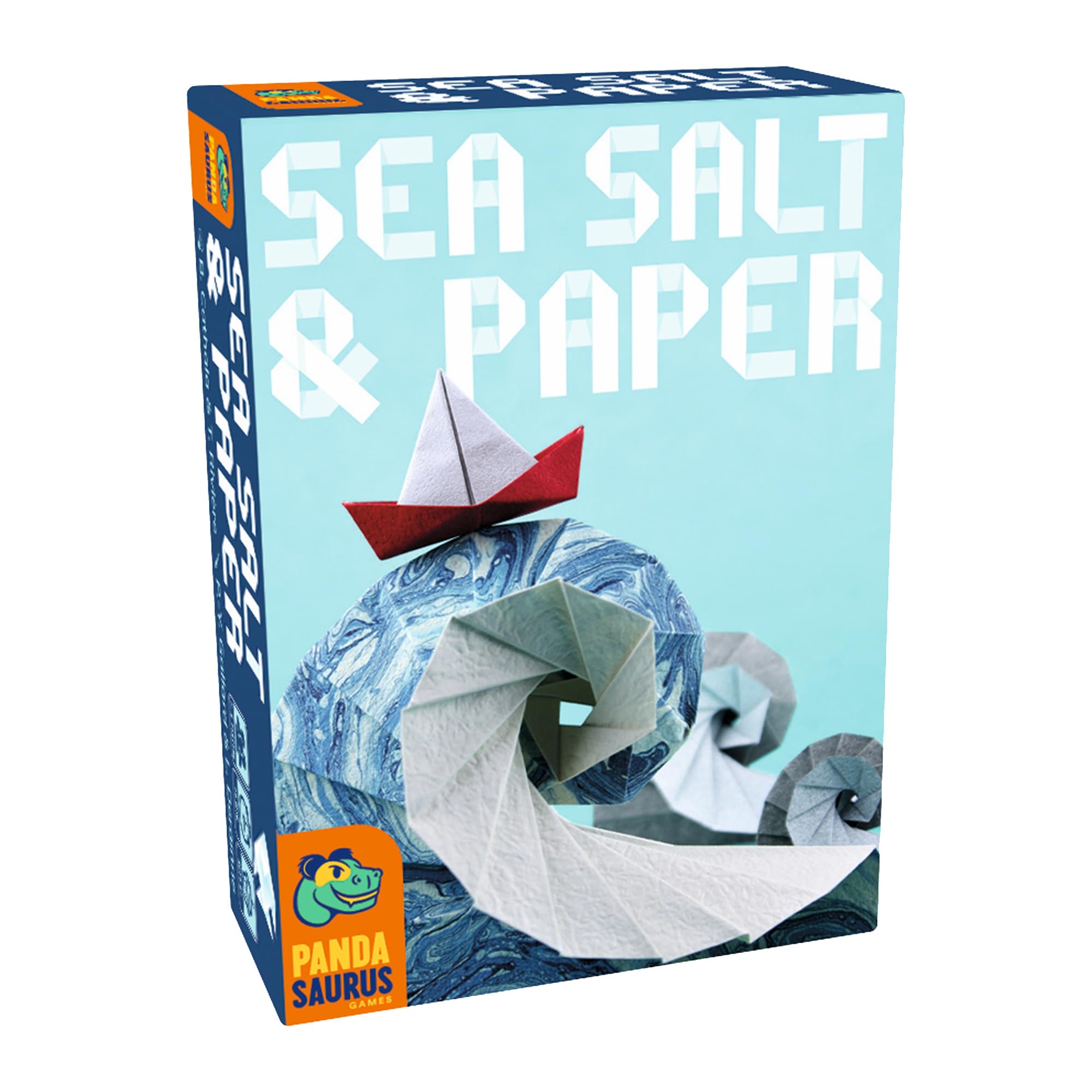
Sea Salt and Paper Overview
The game puts players in a loosely nautical setting, though “theme” is generous here. You’re collecting cards depicting origami-style sea creatures: fish, crabs, octopi, penguins, sharks, boats, and mermaids. The origami art by Lucien Derainne and Pierre-Yves Gallard is the real star. Each card looks like a paper-folded animal, and the effect is distinct from anything else on most game shelves.
Your goal is to collect sets and matching pairs of cards to score points across multiple rounds, racing to a target score that depends on player count: 40 points for 2 players, 35 for 3, and 30 for 4.
| Detail | Info |
|---|---|
| Designer | Bruno Cathala, Théo Rivière |
| Publisher | Bombyx (Pandasaurus Games in the US) |
| Year Released | 2022 |
| Players | 2–4 |
| Age Range | 8+ |
| Playing Time | 30–45 minutes |
| Game Type | Set Collection, Card Game, Family |
| Complexity Rating | 1.48 / 5 (BGG) |
What’s in the Sea Salt and Paper Box?
Sea Salt and Paper comes in a compact blue box small enough to fit in a jacket pocket. This is a travel-friendly game by design, and the footprint on a table is minimal.
| Component | Details |
|---|---|
| Cards | 58 cards (base game) featuring origami maritime illustrations in 11 different colors |
| Card Types | Duo pairs (Crab, Boat, Fish, Swimmer + Shark), set collection cards (Shell, Octopus, Penguin, Sailor), Mermaids, multiplier cards |
| Rulebook | Short pamphlet with clear diagrams |
| ColorADD Cards | Reference cards for colorblind accessibility |
Card stock quality has varied between print runs. Earlier Bombyx editions received some criticism, but more recent printings have improved. The artwork carries the production — each card has a distinct origami creature that looks handmade rather than digitally rendered.
Pros and Cons of Sea Salt and Paper
- The STOP vs. LAST CHANCE decision at end of round creates genuine tension every time
- Duo card combos give you meaningful choices beyond basic set collection
- Tiny box makes it one of the most portable card games available
- Accessible enough for an 8-year-old but with enough depth for adults
- Rounds are short, so a bad round doesn’t sting for long
- The origami art style is unlike any other card game on the market
- Nine different card types with four duo powers can confuse new players during the first round
- First-time games feel somewhat random before players learn the card distribution
- Two-player games can feel less dynamic since there’s less competition for discard piles
- No score pad included — you’ll need pen and paper or a phone app
How to Play Sea Salt and Paper
Setup
Shuffle the entire deck and place it face down in the center of the table. Draw two cards from the top and place them face up beside the deck. These two cards form the starting discard piles. No one starts with cards in hand.
Taking Your Turn
Each turn has two steps. First, you must add a card to your hand. You either draw two cards from the deck (keep one, discard the other to one of the two face-up piles) or take the top card from one of the discard piles. Second, you may play matching pairs from your hand — called “duos” — face up in front of you for a bonus effect.
Each duo type gives a different bonus. Crab pairs let you secretly take any card from a discard pile. Boat pairs give you an extra turn. Fish pairs let you draw the top card from the deck. Swimmer + Shark pairs let you steal a random card from another player’s hand.
Ending the Round
If your visible and held cards total 7 or more points, you can choose to end the round. You announce either STOP or LAST CHANCE. If you call STOP, the round ends immediately and everyone scores. If you call LAST CHANCE, each other player gets one more turn, then everyone scores — but you only collect bonus points if you still have the highest total. This is the heart of the game and where push-your-luck tension lives.
Scoring and Winning
All cards in your hand and in front of you count for scoring. Set collection cards (Shells, Octopi, Penguins, Sailors) score based on how many you’ve collected — more cards in a set means a higher payout. Mermaid cards score points equal to the number of cards in your most common color. Multiplier cards double the value of specific sets. The round’s scores get added to a running total, and the first player to reach the target (30, 35, or 40 depending on player count) triggers the final scoring. If someone manages to collect all four Mermaids during a single round, they win the game outright.
Where to Buy Sea Salt and Paper
| Store | Link |
|---|---|
| Amazon | Amazon – Sea Salt and Paper |
| Target | Target – Sea Salt and Paper |
| Pandasaurus Games | Pandasaurus – Sea Salt and Paper |
| Miniature Market | Miniature Market – Sea Salt and Paper |
| Board Game Arena (Online) | Play on Board Game Arena |
Sea Salt and Paper Game Mechanics
The game blends hand management, open drafting, set collection, and push-your-luck into a surprisingly compact package. The draw-two-keep-one mechanic from the deck mirrors classic card games like Lost Cities and Gin Rummy. Each draw forces a small decision: which card helps your collection, and which card are you feeding to the discard pile where an opponent might grab it?
Duo combos add a second layer. Playing a pair of matching cards isn’t just about scoring — it triggers an immediate bonus action. Steal from opponents with Swimmer + Shark. Take an extra turn with Boats. Fish through the deck or dig through discard piles with Crabs. These combos let you chain actions together in a single turn, which is where experienced players start pulling ahead of newcomers.
The STOP vs. LAST CHANCE choice is the mechanical centerpiece. Calling LAST CHANCE is greedy — you’re betting you have the highest score and that nobody can overtake you in one turn. If you’re wrong, you get nothing extra and may have given an opponent the chance to score more. Calling STOP is safe but limits your bonus. This single decision elevates the game beyond standard set collection territory.
Who Should Play Sea Salt and Paper?
Families with kids aged 8 and up will get the most out of this. The rules click after one teaching round, and the origami art appeals to a wide range of ages. Cathala’s track record with family-weight games like Kingdomino shows here — the design is clean and approachable without feeling shallow.
Gamers who enjoy Sushi Go! or Splendor but want something with a bit more tension should try this. The push-your-luck element gives it an edge that pure card drafting games often lack. It also works as a travel game — the box fits in a bag and you can play it at a restaurant table or on a park bench.
Skip this if you need deep strategy in your games. Sea Salt and Paper is light. The complexity rating sits at 1.48 out of 5 on BoardGameGeek, and experienced gamers may find the card draws too luck-dependent for their taste. It’s also less interesting with just two players, where the discard piles see less competition.
FAQ
Is Sea Salt and Paper good for beginners?
Yes. The rules take about five minutes to teach, and most new players pick up the flow within a single practice round. The card types and duo effects need a quick reference at first, but the core action of draw-a-card and collect-sets is familiar to anyone who has played Rummy or similar games.
How long does Sea Salt and Paper take to play?
A full game lasts about 30–45 minutes across several rounds. Individual rounds take roughly five minutes each. The total number of rounds varies depending on how aggressively players end rounds and how quickly someone hits the point threshold for their player count.
What’s the best player count for Sea Salt and Paper?
Three players hits the sweet spot. There’s enough competition for the discard piles and enough uncertainty about who will end the round. Four players works well too. Two players is still fun but feels more like a head-to-head card duel with less discard pile interaction.
Is Sea Salt and Paper worth buying?
At around $12–15, it’s one of the better values in the card game space. The compact size, short playtime, and broad age range mean it gets to the table often. The STOP vs. LAST CHANCE mechanic alone makes it more interesting than most games at this price point and complexity level.
What games are similar to Sea Salt and Paper?
The closest comparisons are Sushi Go Party! for the set collection and light feel, and Lost Cities for the hand management and push-your-luck scoring tension. Arboretum shares the card selection dilemma of helping yourself vs. feeding your opponent through the discard pile.
