Concordia Board Game Review

Concordia, designed by Mac Gerdts and published by PD-Verlag in 2013, is a strategy game set during the height of the Roman Empire. Players take on the role of Roman merchant families expanding trade networks across the Mediterranean. It supports 2–5 players aged 13 and up with a typical session running about 100 minutes. With an 8.1 rating on BoardGameGeek and over 46,000 ratings, it has earned a lasting reputation among euro game fans. This review breaks down what makes Concordia work and whether it belongs on your shelf.
Concordia Overview
The game puts you in charge of a Roman dynasty during an era of economic growth. Your goal is to send colonists across the map, build houses in cities that produce goods, and acquire personality cards that both grant you actions and score you points at the end of the game. There are no dice and no random card draws during play. Every decision sits squarely on your shoulders.
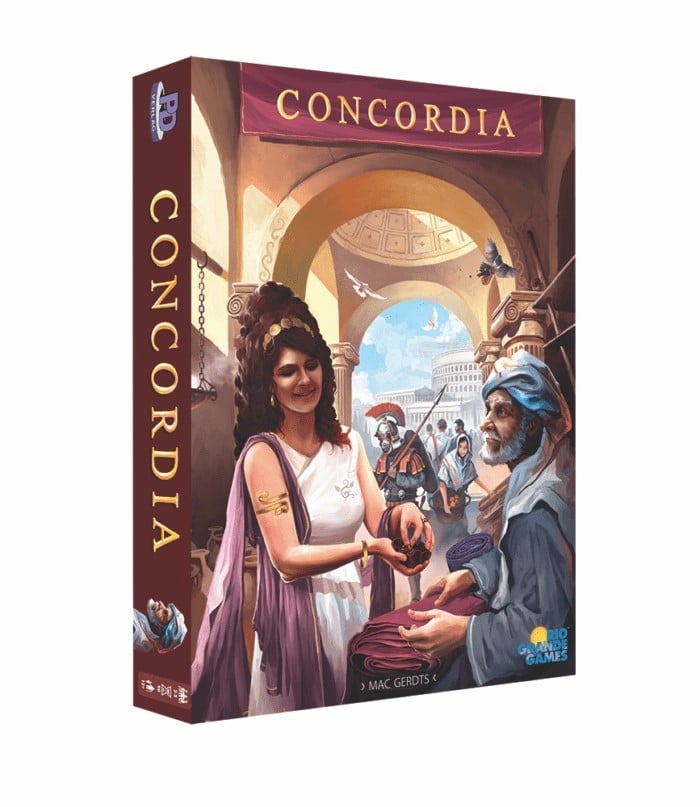
The theme of Roman trade may not grab attention off the shelf, and the box art has been a running joke in the hobby for years. But once it hits the table, Concordia earns respect through clean design and deep decision-making.
| Detail | Information |
|---|---|
| Designer | Mac Gerdts |
| Publisher | PD-Verlag (also Rio Grande Games and others) |
| Year Released | 2013 |
| Players | 2–5 |
| Age Range | 13+ |
| Playing Time | 100 minutes |
| Game Type | Strategy, Economic, Hand Management |
| Complexity Rating | 2.99 / 5 (BGG) |
What’s in the Concordia Box?
The component count is modest compared to many modern euro games, but the quality is solid. Wooden resource tokens are shaped and colored to represent their type — wine, food, tools, bricks, and cloth. They feel good to handle and look distinct on the table.
| Component | Details |
|---|---|
| Game Board | Double-sided (Imperium for 3–5 players, Italia for 2–4 players) |
| Personality Cards | Starting hand of 7 per player, plus market cards |
| Wooden Pieces | 110 total (colonists, houses, ships in player colors) |
| Resource Tokens | Shaped wooden pieces for 5 resource types |
| City Tokens | 30 double-sided tokens (letter/resource) |
| Bonus Markers | 24 markers |
| Coins | Denominations of 1, 2, 5, and 10 |
| Other | Concordia card, Praefectus Magnus card, player aids, quick intro sheet, rulebook, historical booklet |
The board itself is large, colorful, and clearly designed. City spaces, sea routes, and land paths are all easy to read. The rulebook is just four pages, which is remarkably concise for a game with this much strategic depth. A quick intro card also helps speed up setup for new players.
Concordia Pros and Cons
- Extremely elegant rules — four-page rulebook that covers everything
- No randomness during play; outcomes depend entirely on player choices
- Double-sided board adapts to different player counts
- Cards serve dual purpose (actions during play and scoring at game end), creating constant tension
- Expansion maps change the game feel without adding new rules
- Plays well across all player counts, with three and four being the sweet spot
- Box art is widely considered unappealing and may discourage potential buyers
- Scoring is hidden until the end, making it hard for newer players to gauge their position
- The theme feels dry to players who prefer strong narrative or visual flair
- Two-player games lose some of the tension from competition over board space
- First few plays can feel aimless until you understand how scoring works
How to Play Concordia
Setup
Choose a side of the board based on your player count — Imperium for 3–5, Italia for 2–4. Shuffle and place city tokens randomly on the map, then flip them to reveal their resource type. Remove some market cards based on the number of players. Each player starts with an identical hand of 7 personality cards, a storehouse board, starting resources, coins, and colonists placed in Rome.
Turn Structure
On your turn, you play one card from your hand and carry out its action. The played card goes face-up into your personal discard pile. That’s it — one card, one action, then the next player goes. The simplicity of each turn hides the depth underneath. You might move colonists and build a house (Architect), produce goods in cities where you have houses (Prefect), buy new personality cards from the market (Senator), or copy the last action played by another player (Diplomat).
Playing your Tribune card lets you pick up all discarded cards back into your hand. If you recover more than three cards, you earn a coin for each extra card. The Tribune also lets you recruit a new colonist from your storehouse. Timing your Tribune play is one of the game’s most interesting decisions — do you pick up early with a thin hand, or push further and risk running out of options?
Concordia Win Conditions
The game ends when either the last personality card is purchased from the market or a player builds their 15th house. That player receives the Concordia card (worth 7 bonus points), and everyone else gets one final turn. Scoring happens only at the end. Each personality card in your hand corresponds to a Roman god — Jupiter, Saturnus, Mercurius, Minerva, Vesta — and each god scores differently based on your houses, goods, colonists, or cards. The player with the highest total wins.
Where to Buy Concordia
| Platform | Notes |
|---|---|
| Amazon | Rio Grande Games edition, widely available |
| BoardGameGeek Store | Accessories and upgrade components available |
| Board Game Bliss | Ships from Canada, multiple editions stocked |
| Board Game Oracle | Price comparison across US retailers |
| Noble Knight Games | New and used copies |
| Steam / Nintendo Switch | Concordia: Digital Edition for solo or online play |
| Your local game store | Check for availability — supports local businesses |
Concordia Game Mechanics
Concordia uses hand management as its core mechanism. Every player begins with the same 7 cards, so the opening moves are symmetrical. As the game progresses, players buy different cards from the market, and their options diverge. The cards you buy shape both your available actions and your end-game scoring, so every purchase is a commitment to a particular strategy.
The action retrieval system is what sets Concordia apart from other card-driven games. You don’t draw cards from a deck — you play them out, and then use the Tribune to sweep them all back. This creates a natural rhythm. Early in the game, you cycle quickly through a small hand. Later, with 10 or 12 cards, you’re deciding which to play first and which to hold back, knowing you’ll need the Tribune eventually.
There’s also a light deck-building element. New personality cards expand what you can do on a turn. The Consul lets you buy cards at a discount. The Senator lets you purchase from the market. Some cards grant entirely new action types. But because every card also scores at the end, buying a card that helps you act better might score worse than one that sits quietly in your hand, multiplying your points. That tension between utility and scoring makes Concordia’s card system feel tight throughout.
Movement and area control round out the system. Your colonists — one land settler and one ship to start — move across the map to reach cities. Building a house in a city locks in production for that resource type whenever anyone plays a Prefect card in that province. Having houses in multiple provinces spreads your production. Having multiple houses in one province concentrates it. Both paths have merit depending on which gods you’re aiming to score.
Who Should Play Concordia?
Concordia is best suited for players who enjoy strategy games where planning ahead matters more than reacting to chaos. If your group likes Splendor but wants something meatier, or if you’ve played Ticket to Ride until the routes feel memorized, Concordia is a strong next step. It shares some DNA with heavier games like Terraforming Mars in terms of engine-building satisfaction, but it’s considerably easier to teach.
Groups of three or four will get the most out of it. At those counts, there’s real competition for cities and trade routes without excessive downtime between turns. Two-player games work fine but lack some of the board tension. Five players can drag a bit, though the Imperium map accommodates it well.
If you need a game with a strong narrative or visual spectacle, Concordia probably won’t excite you. The theme is functional rather than immersive. But if you value clean game mechanics and replayability, few designs at this weight class compete with it. Expansion maps like Salsa, Britannia, and Gallia & Corsica change the game feel significantly without adding new rules, which extends the shelf life even further.
Concordia Venus, a standalone reimplementation, adds team play for up to 6 players. It’s worth considering if your group regularly has five or six at the table.
FAQ
Is Concordia good for beginners?
Concordia is approachable for players with some board game experience. The rules fit on four pages and each turn is simple — play one card, do one action. New players may struggle with scoring in their first game since points are hidden until the end, but by the second play, most people have a clear grasp of how the system works.
How long does Concordia take to play?
Expect about 100 minutes with a full group. Three-player games often wrap up in 60–75 minutes once everyone knows the rules. Setup adds roughly 10 minutes. The pace moves quickly because each turn involves just one card play, so downtime between turns is short.
What’s the best player count for Concordia?
Three and four players hit the sweet spot. There’s enough competition for cities and resources to keep things tense without dragging between turns. Two works but feels looser. Five is playable on the Imperium side of the board, though sessions run longer.
Is Concordia worth buying?
If you enjoy euro-style strategy games without heavy randomness, Concordia delivers exceptional value. The double-sided board and multiple expansion maps keep it fresh for dozens of plays. It also has a digital version on Steam and Nintendo Switch if you want to try before buying the physical copy.
What games are similar to Concordia?
Splendor shares the engine-building feel but with simpler decisions. Ark Nova offers comparable strategic depth with a different theme. Power Grid focuses on economic strategy with more direct competition. If you like Concordia’s hand management, you might also enjoy games in the Dune: Imperium family.
