
Luthier Board Game Review

Luthier, from designers Dave Beck and Abe Burson at Paverson Games (2025), puts players in the role of 18th-century instrument makers crafting violins, harpsichords, and other instruments for noble patrons of the Bach, Mozart, and Beethoven era. The game supports 1 to 4 players, runs 90 to 150 minutes, and carries an age rating of 14+. With artwork by Vincent Dutrait and a complexity rating of 3.78 out of 5, it sits firmly in heavy euro territory. This review covers the mechanics, components, and player experience to help you decide if it belongs on your shelf.
Luthier Game Overview
Luthier blends hidden bidding and worker placement against a classical music backdrop. Players run workshops in 18th-century Western Europe, balancing instrument production, patron contracts, apprentice training, and concert performances.
The combination of bidding dice in secret for action priority, then placing workers to actually execute those actions, drives the central tension. Players choose their own path: build reputation through performances, focus on instrument quality, train apprentices, or court specific historical patrons.
| Designer | Dave Beck, Abe Burson |
|---|---|
| Publisher | Paverson Games |
| Year Released | 2025 |
| Players | 1 to 4 |
| Age Range | 14+ |
| Playing Time | 90 to 150 minutes |
| Game Type | Strategy / Heavy Euro |
| Complexity | 3.78 / 5 |
What’s in the Luthier Box
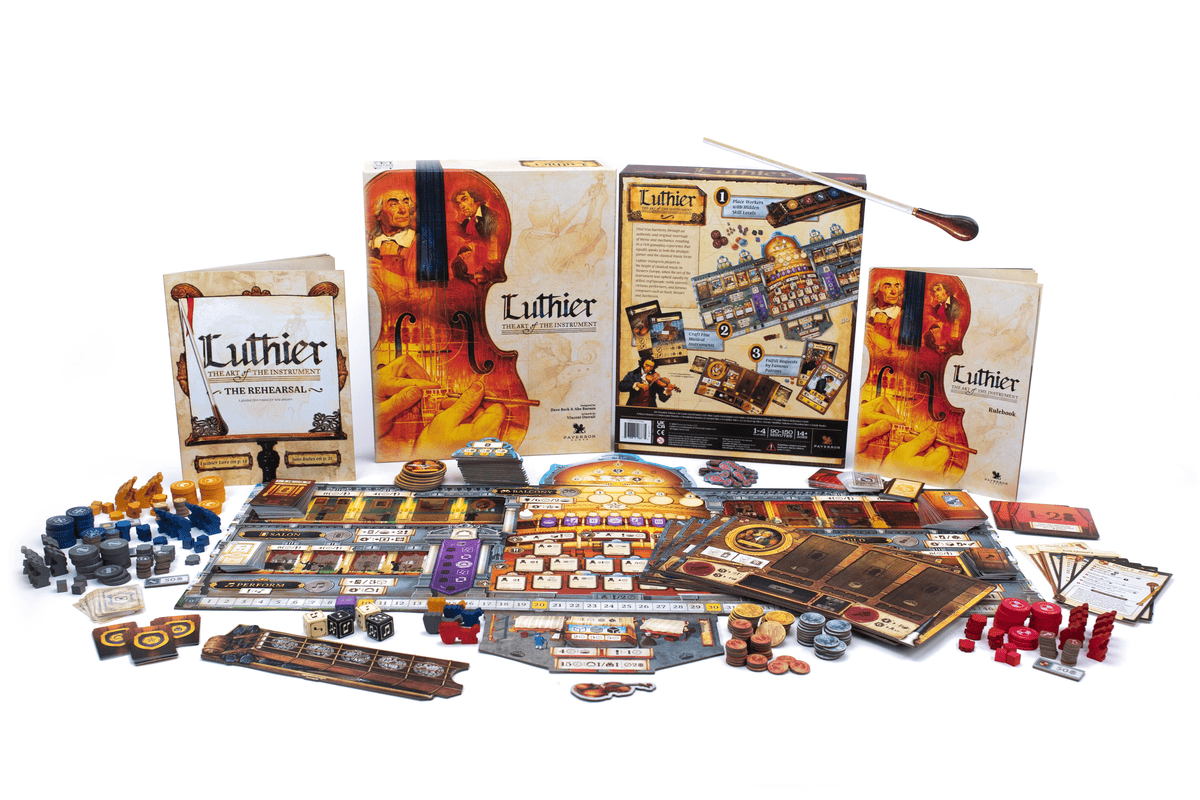
The box contains a central game board, four player workshop boards, wooden worker meeples in player colors, and bidding dice for the hidden auction system. Resource tokens represent wood, varnish, strings, and other crafting materials.
Patron cards, instrument tiles, apprentice pieces, and skill track markers fill out the component count. Vincent Dutrait’s artwork covers the cards and board with period illustrations of workshops and historical figures. Paverson also provides access to an official classical music soundtrack to play during sessions.
Pros and Cons of Luthier
- Hidden bidding adds genuine tension to turn order selection
- Multiple scoring paths through performance, building, training, and reputation
- Theme integrates with mechanics rather than feeling pasted on
- Vincent Dutrait artwork looks excellent on the table
- Solo mode supports single-player sessions
- Official soundtrack adds atmosphere during play
On the downside:
- Playtime stretches past two hours at four players
- The 3.78 complexity rating means a long rules teach
- Setup takes 10 to 15 minutes once you know what you’re doing
- Players who dislike auction mechanics should look elsewhere
How to Play Luthier
Setup
Each player takes a workshop board, starting workers, and initial resources. Lay out the main board with patron cards, action spaces, and the bidding track. Place the round marker on the first space and shuffle the instrument and apprentice decks.
Turn Structure
Each round opens with hidden bidding. Players secretly commit dice to determine turn order and access to premium action spaces. Higher bids pick first but cost more resources to commit.
After bidding resolves, players take turns placing workers on action spaces. Options include gathering wood, crafting instruments, recruiting apprentices, courting patrons, or performing concerts. Skill tracks advance as you take related actions, unlocking better worker abilities and end-game bonuses.
Win Conditions
The game runs across several rounds. Players score points from completed instruments, satisfied patrons, performance reputation, skill track positions, and end-game bonuses. Highest total wins.
Where to Buy Luthier
| Retailer | Region |
|---|---|
| Paverson Games (direct) | Global |
| Amazon | US, UK, EU |
| Miniature Market | US |
| Board Game Bliss | Canada |
| Philibert | EU |
Luthier Game Mechanics
Hidden bidding drives most decisions. Players commit dice blind, guessing what others might bid for the same actions. Overbid and you waste resources; underbid and you miss the action you needed.
Worker placement follows bid resolution. Workers gain new abilities as you climb skill tracks, a familiar pattern from worker placement games like Viticulture, but Luthier adds auction overhead on top of placement.
Area majority comes in through patron influence, where players compete for favor with specific historical figures who score at game end. Open drafting handles instrument blueprints and apprentice selection. Dice rolling appears only in the bidding phase, which keeps action outcomes predictable once turn order locks in.
Who Should Play Luthier
Luthier suits players who already enjoy heavy euros like Brass: Birmingham, Praga Caput Regni, or Agricola. The complexity puts it beyond casual game nights, and the playtime needs committed sessions.
Classical music fans get extra value from the theme and soundtrack integration. Solo players have a built-in mode worth trying alongside other solo board games. Skip Luthier if your group prefers quicker games under 90 minutes or dislikes hidden auction mechanics.
FAQ
Is Luthier good for beginners?
No. With a complexity rating of 3.78 out of 5, Luthier sits in heavy euro territory. New players will struggle with the hidden bidding system layered on top of worker placement, skill tracks, and patron management. Start with lighter games like Stone Age or Lords of Waterdeep before attempting Luthier.
How long does Luthier take to play?
Expect 90 minutes at two players and up to 150 minutes at four. Add 10 to 15 minutes for setup and another 30 minutes for first-time rules teaching. Experienced groups land closer to the lower end of the range once everyone understands the bidding system and turn flow.
What’s the best player count for Luthier?
Three players hits the sweet spot. Two players reduces bidding tension since opponent predictions become easier. Four players extends playtime past two hours and creates more downtime between turns. Three balances strategic depth with reasonable pace and meaningful auction pressure.
Is Luthier worth buying?
For heavy euro fans who enjoy auction mechanics and unusual themes, yes. The hidden bidding feels different from standard worker placement, and the classical music angle stands out. Casual players or those who avoid long games should pick something else. The 2.8K BGG ratings averaging 8.2 reflect strong reception among the target audience.
What games are similar to Luthier?
Praga Caput Regni shares the multiple-path scoring and medium-heavy complexity. Viticulture has comparable worker placement with theme integration. Dune: Imperium pairs worker placement with deck-building if you want a similar weight game with different mechanical layers. Ra and Modern Art offer auction-focused experiences without the production side.
