
European Roulette vs. American Roulette: How One Extra Zero Doubles the Casino Advantage

If you can read a roulette table layout, you can spot the difference between the two main versions in under a second. The European wheel has one green zero pocket. The American wheel has two — a 0 and a 00. That’s the entire visible difference.
The wheel size, chip layout, payouts, and dealer protocol are essentially identical. What that single extra pocket does to the math, however, is dramatic.
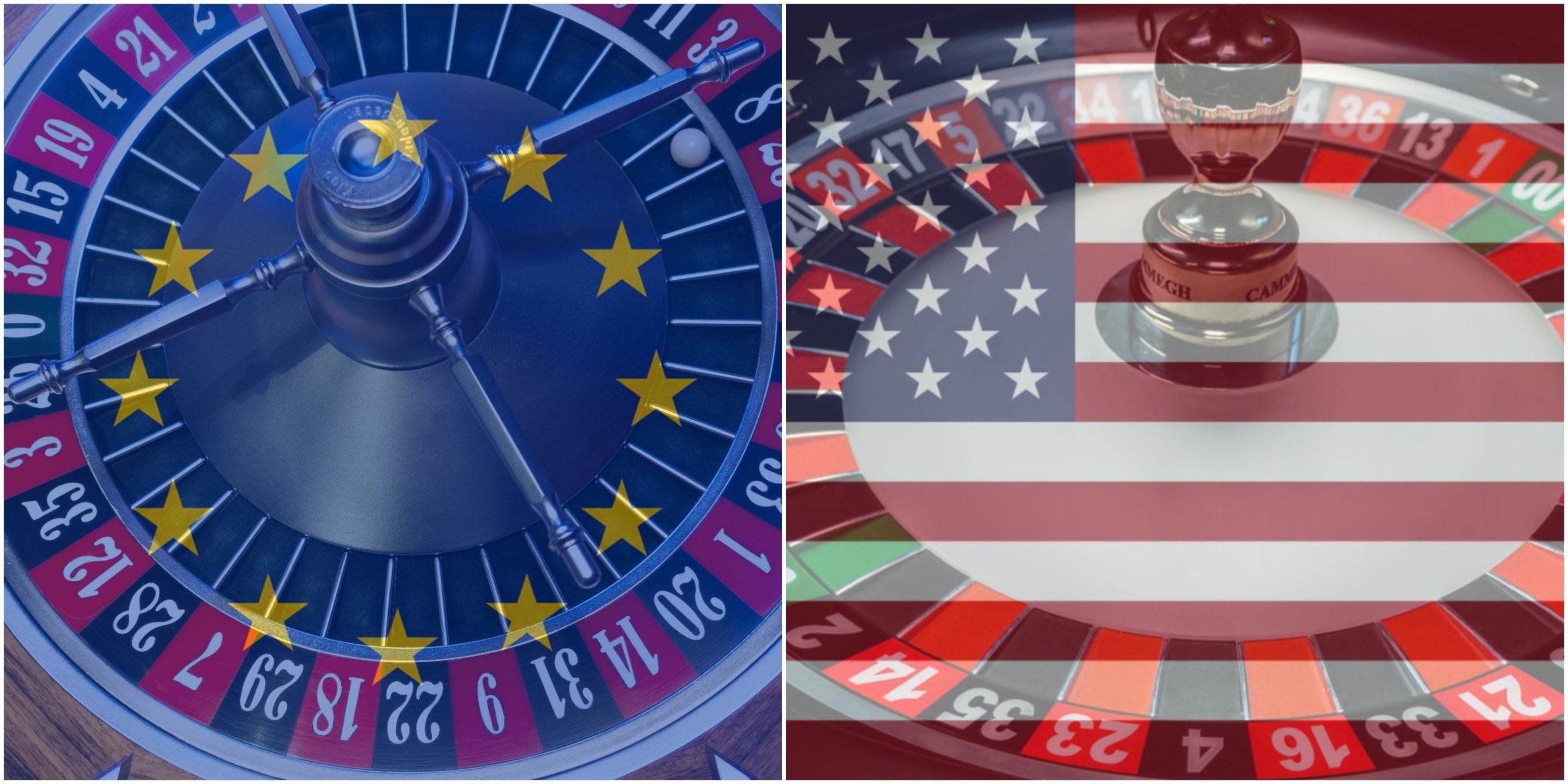
The house edge on a European wheel is 2.70%. On an American wheel, it climbs to 5.26%. Same payouts, same chips, nearly twice the long-run cost to the player.
The history of why the United States kept the double zero while the rest of the world abandoned it is a clean illustration of how small structural choices in casino design quietly compound into very different outcomes for the people sitting at the table.
The Math Hidden in Plain Sight
The reason the extra zero matters so much is that it doesn’t change any of the payouts. Roulette is calibrated as if the wheel had 36 equally-weighted pockets — a winning straight-up bet pays 35:1, a corner bet pays 8:1, a column bet pays 2:1, and so on.
Those payouts make sense on a 36-pocket wheel: bet $1 on each of the 36 numbers, win one, get back $36, break even. The trouble starts when the actual wheel has 37 pockets (European) or 38 (American).
The extra slot or two never appears in the payout calculation, but it absolutely appears in the probability calculation, and the gap is where the casino’s profit lives.
On a European wheel, that gap is one extra slot out of 37, working out to a 2.70% expected loss per dollar wagered. On an American wheel, the gap is two slots out of 38, which gives 5.26% — almost exactly double. Some operators offer triple-zero wheels in Las Vegas, pushing the edge to 7.69%; those should be avoided unconditionally.
Where That Extra Zero Came From?
The wheel itself was formalized in 18th-century France with both a 0 and a 00, but European casinos eventually consolidated around the single-zero version because operators in Monte Carlo figured out that a slightly more player-friendly game produced more long-term volume.
The double-zero crossed the Atlantic via 19th-century Mississippi riverboats, where operators kept it specifically because the higher house edge produced better margins on the same bet flow.
When Nevada legalized casino gambling in the 1930s, American operators inherited the riverboat layout and never moved off it.
Modern Las Vegas and Atlantic City floors are still dominated by 38-pocket wheels because the players who walk in expect that layout.
Online, the geography largely reverses. Licensed European operators default to the 37-pocket single-zero table; lobbies on platforms like https://fieryplay.com/en typically host European roulette as the standard tier with American roulette as an optional extra rather than the headline product, partly because European players overwhelmingly choose it when given the option.
The Real Cost Over a Real Session
The 2.7% versus 5.26% gap sounds abstract until you translate it into actual session math. The difference compounds with volume in ways most casual players underestimate.
| Scenario | European (2.70%) | American (5.26%) |
| 100 spins at $1 even-money | $2.70 expected loss | $5.26 expected loss |
| 500 spins at $1 even-money | $13.50 | $26.30 |
| 1,000 spins at $1 even-money | $27.00 | $52.60 |
| 100 spins at $10 straight-up | $27.00 | $52.60 |
| Two-hour session, $5 bets at standard pace | ~$15 | ~$29 |
Two hours of casual play is roughly 60–80 spins on a live table; faster on an online RNG version. The numbers above assume a realistic pace and standard betting; the gap is even larger if you use the American five-number bet, which has the worst house edge on the entire layout.
The Bets That Make Each Game Worse
Most bets at a roulette table carry exactly the same house edge as every other bet on the same wheel. A few exceptions worth knowing:
- The five-number bet on American roulette (0, 00, 1, 2, 3) carries a 7.89% house edge — the only bet on the layout with a worse edge than the underlying wheel.
- Triple-zero roulette wheels carry a 7.69% house edge across all bets and have appeared at some Las Vegas casinos, marketed with branded themes that obscure the math.
- “Bonus” live-dealer products like Lightning Roulette and Quantum Roulette layer multiplier mechanics on top of a standard European wheel; the underlying edge stays at 2.70%, but per-spin cost rises to fund the multipliers.
- Betting systems like Martingale and D’Alembert don’t reduce the structural house edge; they just rearrange variance, often catastrophically.
- French roulette tables with La Partage or En Prison reduce the edge on even-money bets to 1.35% — the lowest legal edge available in any standard roulette game.
The pattern is consistent: anything marketed as exciting on a roulette table tends to carry a higher edge, while the boring single-zero European wheel with French rules is mathematically the best version of the game ever offered.
The Practical Verdict
If you have any choice at all — and online, you essentially always do — the single-zero European wheel is the obvious answer.
American roulette costs nearly twice as much per dollar wagered for an experience that is otherwise identical. The only legitimate reason to play the American version is access: a brick-and-mortar casino that doesn’t offer European tables, or a live-dealer streaming product that happens to be the only option available. For everyone playing online, the single-zero default is the right one, and a French table with La Partage rules is even better.
The math is settled. The casino has every incentive to keep you on the higher-edge wheel; the player’s only real job is to recognize the difference and choose accordingly.
