
Trial by Trolley Board Game Review

Trial by Trolley is a party game designed by Scott Houser, published by Skybound Tabletop and Explosm Games in 2020. It takes the classic trolley problem thought experiment and turns it into a loud, chaotic game of arguing, sabotage, and moral justification. The game supports 3 to 13 players, is rated for ages 14 and up, and runs anywhere from 30 to 90 minutes depending on player count.
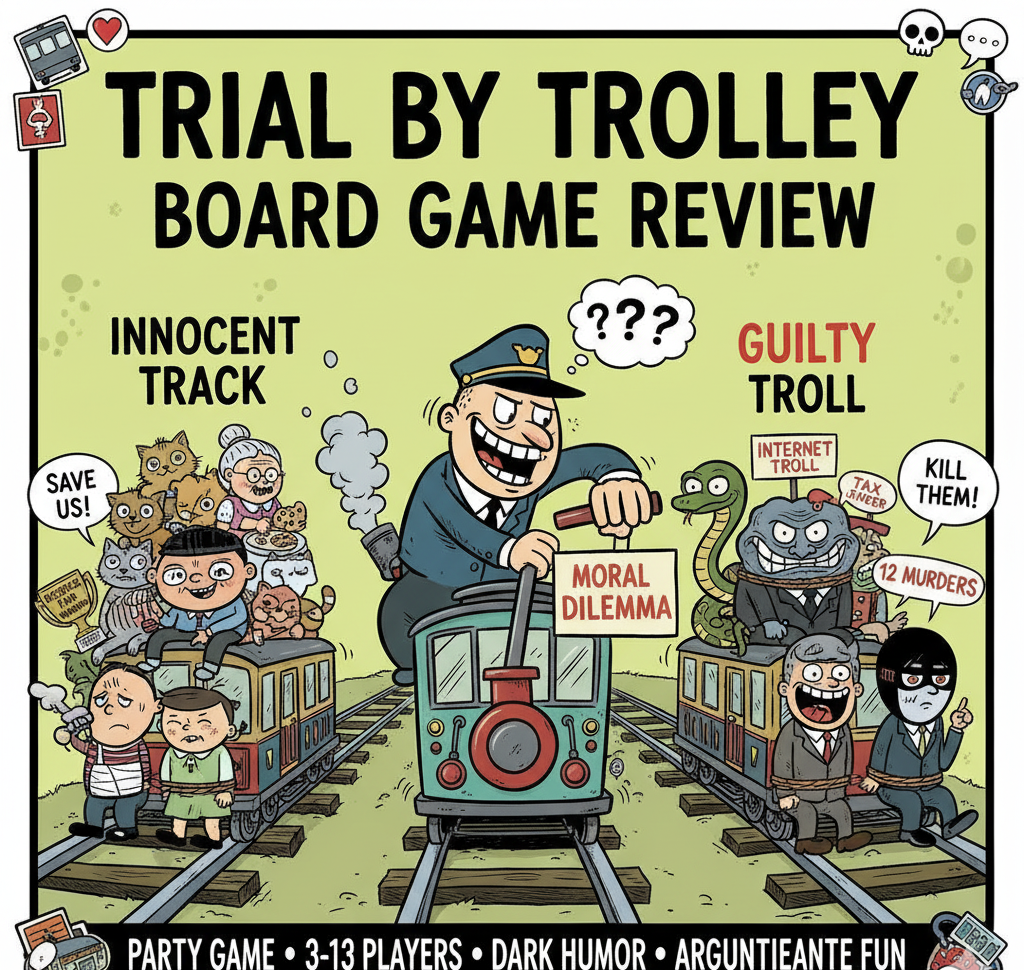
Trial by Trolley Overview
The premise is simple: one player controls a runaway trolley and must choose which of two tracks to send it down. Everyone else plays cards to their track and tries to convince the trolley operator to spare their lives and condemn the other team. It’s a game about persuasion, absurdity, and occasionally indefensible arguments.
The theme borrows directly from the trolley problem, a classic ethics thought experiment, and pairs it with the irreverent humor of the Cyanide & Happiness webcomic. The result is something that plays more like an improv comedy game than a strategy game.
| Attribute | Detail |
|---|---|
| Designer | Scott Houser |
| Publisher | Skybound Tabletop / Explosm Games |
| Year Released | 2020 |
| Players | 3–13 |
| Age Range | 14+ |
| Playing Time | 30–90 minutes |
| Game Type | Party / Social Deduction |
| Complexity Rating | 1.02 / 5 |
What’s in the Trial by Trolley Box
The component count is generous for a card-based party game. The cards are the core of the experience, and there are enough of them to keep rounds feeling fresh across multiple play sessions.
- 200 Innocent Cards
- 125 Guilty Cards
- 175 Modifier Cards
- 26 Death Tokens
- 1 Track Mat (double-sided)
- Instructions
The cards feature the signature Cyanide & Happiness art style — crude, expressive, and deliberately absurd. Innocent cards depict characters you might feel guilty about killing (a 1st grade science fair, a litter of puppies, Robin Hood). Guilty cards feature people and things you’d have an easier time condemning. Modifier cards add context to any card on the table, such as making a character immortal unless hit by a trolley, or revealing that someone got away with twelve murders on a technicality.
The track mat is sturdy enough for regular use, and the death tokens are simple cardboard discs that do the job. Nothing about the production is extravagant, but the components hold up well and the card quality is adequate for the amount of handling they get during a session.
Trial by Trolley Pros and Cons
Pros
- Works at almost any player count from 3 to 13
- Minimal setup — playable within minutes
- Huge card variety keeps rounds unpredictable
- The arguing and negotiating generates genuine laughter
- Very low rules overhead, easy to teach mid-party
- Modifier cards create genuinely absurd combinations
Cons
- Winning depends almost entirely on the Conductor’s mood
- Cards are language-dependent, limiting international play
- Dark humor won’t land with all audiences
- Loses energy with fewer than 5 players
How to Play Trial by Trolley
Each round, one player takes the role of the Conductor. The rest of the players split into two teams as evenly as possible. Teams alternate each round so players switch sides throughout the game.
Round Setup
Players on each team draw cards based on their role for the round. One player on each team draws three Innocent cards, another draws three Guilty cards, and a third draws three Modifier cards. With smaller teams, players share these roles. With larger teams, extra players each draw Modifier cards.
Playing Cards to the Tracks
- Each team randomly places one Innocent card face-up on their track, then chooses a second Innocent card from their hand to add next to it. The goal is to put your most sympathetic characters on display.
- After Innocent cards are placed, each team’s Guilty card holder chooses one card to play — but they add it to the opposing team’s track. This is your chance to make the other team harder to spare.
- Finally, each Modifier card holder chooses one card to play. Modifiers can go on any card already on the table — your own track to strengthen your case, or your opponent’s track to make their situation worse.
Arguing and Deciding
Once all cards are down, both teams plead their case to the Conductor. There are no formal rules here — players argue, negotiate, bribe, and reason however they like. The Conductor listens, then chooses one track. Every player on the chosen track takes a death token.
Winning the Game
Play continues until every player has been the Conductor once. With three or four players, each player serves as Conductor twice. At the end of the game, the player with the fewest death tokens wins. The rulebook doesn’t include a tiebreaker, so ties are resolved however the group sees fit.
Variant Rules
Two official variants change the balance of the game. Trolley Tom gives the player with the most death tokens extra Modifier cards each round, giving struggling players a chance to recover. Accomplices to Murder gives every non-Conductor player three Modifier cards, dramatically increasing the chaos on the tracks.
Trial by Trolley Game Mechanics
Trial by Trolley uses a player judge structure, where one player makes a final decision that can’t be appealed or overruled. This mechanic appears in games like Apples to Apples and Cards Against Humanity, and it means that winning is never fully in your hands — you can only influence the outcome through argument and card play.
The card drafting layer adds a layer of actual decision-making that similar games often skip. Players choose which Innocent card to present, which Guilty card to burden the other team with, and where to place Modifiers. These choices matter because the right combination of cards can create genuinely compelling (or genuinely damning) cases.
Modifier cards are where most of the comedy comes from. A card that makes a character “immortal unless hit by a runaway trolley” or establishes that someone “got away with twelve murders due to a technicality” takes straightforward tracks and turns them into arguments that no reasonable person should be able to win. The unpredictability of which Modifiers appear on which cards drives most of the table conversation.
The simultaneous team structure means both sides are working at the same time, which keeps the game moving quickly and prevents the downtime common to games where players take strict turns.
Who Should Play Trial by Trolley
Trial by Trolley works best with groups who enjoy party games built around conversation and argumentation rather than mechanical depth. It lands well with groups who are comfortable with dark humor and won’t be put off by content involving fictional death, moral relativism, and occasional vulgarity.
The 14+ age rating is appropriate. The standard edition is relatively tame by party game standards, but the R-Rated Modifier Expansion pushes the content into territory that’s strictly adults-only.
Groups that enjoy Wavelength, Dixit, or Jackbox games will likely enjoy the social energy here. Groups looking for something with more strategic substance should look elsewhere — this is not a game you win through clever planning.
It plays best with 6 to 10 players, where teams are large enough for real debate and the Conductor role rotates at a reasonable pace. At 3 to 4 players it still works, but the energy drops noticeably. At the upper end of 11 to 13 players, managing team roles takes more coordination.
Where to Buy Trial by Trolley
| Retailer | Format |
|---|---|
| Amazon | New and used, various editions |
| Cardhaus Games | New |
| Noble Knight Games | New and used |
| eBay | Used listings, multiple editions |
| Skybound | Direct from publisher |
FAQ
Is Trial by Trolley good for beginners?
Yes. The rules take under five minutes to explain and the game is playable immediately. There’s no complex strategy to learn — players just need to argue their case. It’s one of the easier party games to introduce to people who rarely play board games.
How long does Trial by Trolley take to play?
Most sessions run between 45 and 75 minutes depending on player count and how much time the Conductor takes with each decision. At maximum player count, rounds take longer due to more players presenting arguments. The game ends once every player has been Conductor once.
What’s the best player count for Trial by Trolley?
Between 6 and 10 players is the sweet spot. Teams are large enough for real back-and-forth debate, rounds move at a good pace, and there’s enough variety in the Conductor role to keep things interesting. Below 5 players, the energy drops off noticeably.
Is there an expansion for Trial by Trolley?
Yes. The R-Rated Modifier Expansion adds more adult-oriented Modifier cards for groups that want raunchier content. The base game is already mature in its humor, so the expansion is for groups who specifically want to push the content further.
What games are similar to Trial by Trolley?
Apples to Apples and Cards Against Humanity share the player judge mechanic. Wavelength and Codenames offer similar social energy with more structure. If you like the argumentation aspect specifically, Balderdash and Quiplash are worth considering for groups who enjoy defending absurd positions.
