War Of The Ring Board Game Review

War of the Ring: Second Edition, designed by Roberto Di Meglio, Marco Maggi, and Francesco Nepitello and published by Ares Games in 2011, puts one to four players inside the full sweep of Tolkien’s Lord of the Rings — from the Shire to the fires of Mount Doom. Rated for ages 13 and up with a playing time of two to four hours, it is one of the most thematically realized strategy games ever made, and one of the most demanding. This review covers what you get in the box, how the game plays, and whether it belongs in your collection.
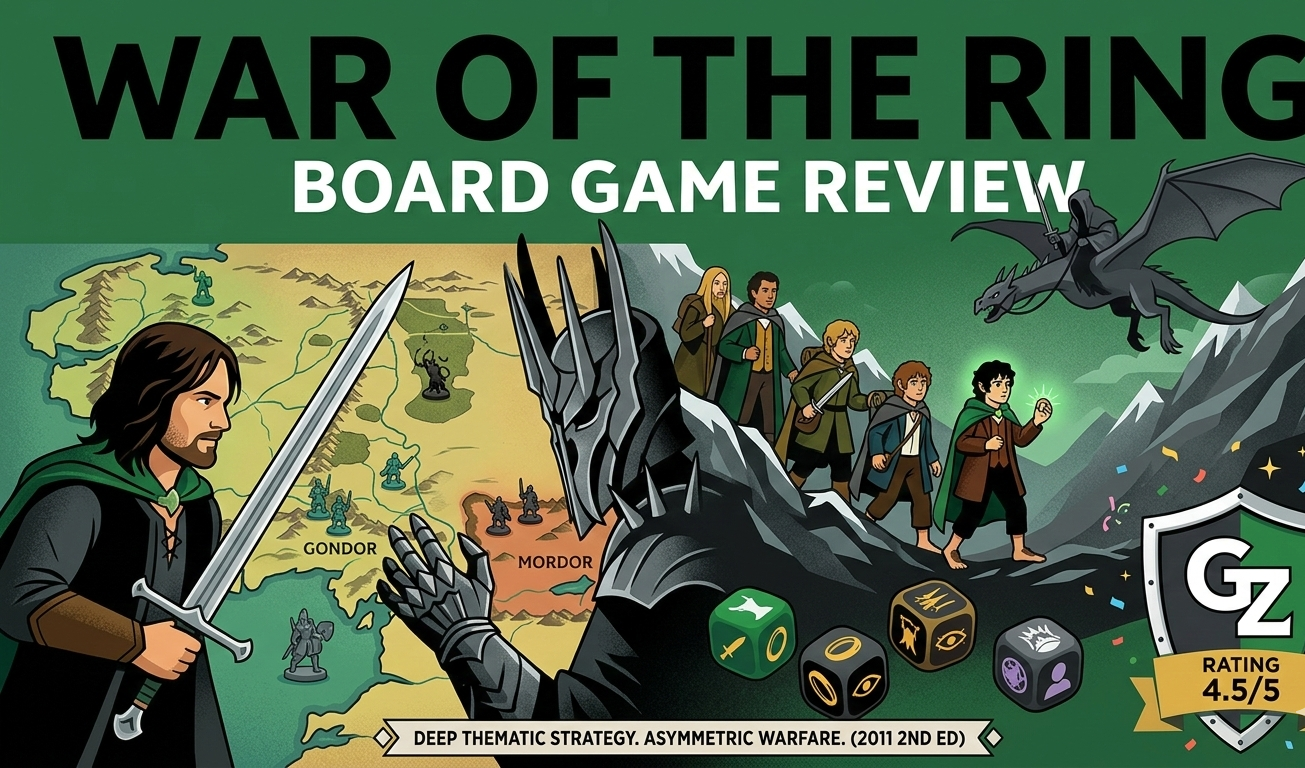
War of the Ring Overview
One side controls the Shadow — Sauron’s vast armies of orcs, trolls, and Nazgûl — and attempts to crush the Free Peoples through military conquest or corrupt Frodo before he reaches Mount Doom. The other side leads the Free Peoples: Gondor, Rohan, the Elves, the Dwarves, and the fellowship itself. Both sides have entirely different tools, strengths, and win conditions. This asymmetry is the engine that makes every game feel distinct.
| Detail | Info |
|---|---|
| Designers | Roberto Di Meglio, Marco Maggi, Francesco Nepitello |
| Publisher | Ares Games |
| Year Released | 2011 (2nd Edition) |
| Players | 2–4 |
| Age Range | 13+ |
| Playing Time | 150–180 minutes |
| Game Type | Area Control, Asymmetric Strategy |
| Complexity (BGG) | 4.02 / 5 — Heavy |
What’s in the War of the Ring Box
The contents are substantial. Setup alone takes fifteen to twenty minutes the first few times, and the sheer volume of pieces means you will want a tray or sorting system before your second play.
| Component | Quantity / Detail |
|---|---|
| Plastic miniatures | 204 figures across 30+ sculpt types |
| Game board | 70×100 cm double-panel, depicting northwestern Middle-earth |
| Event and Character cards | 110 cards with original Tolkien-themed art |
| Action Dice | 16 custom dice (split between Free Peoples and Shadow) |
| Combat Dice | 5 standard combat dice |
| Hunt tiles and tokens | Thick cardboard hunt pool tiles, corruption markers, nation tokens |
| Rulebook | Full rulebook plus quick-reference cards |
The miniatures are plastic and functional rather than premium — some of the smaller unit figures are a little indistinct. The cardboard tokens are clear enough but take some time to learn by sight. The board itself is large, detailed, and handsome. You will need a dedicated table.
War of the Ring Pros and Cons
Pros
- Exceptional thematic integration — almost every rule connects to a story beat from the books
- Asymmetrical design gives both sides a genuinely different feel
- The Fellowship movement system is clever and tense
- Event cards create memorable, swinging moments without feeling arbitrary
- Replay value is high — no two games unfold the same way
- Satisfying at two players; the core experience it was built for
Cons
- Setup and teardown add 30+ minutes to every session
- Rulebook is dense; expect a rough first game
- Miniature quality is below what the price suggests
- Some tokens are hard to read at a glance
- Significant output randomness in combat and hunt draws — not ideal for players who dislike dice swings
How to Play War of the Ring
Each round follows six phases. First, players recover their action dice and draw two event cards. Then the Free Peoples player has the option to declare the Fellowship’s location, which can activate nations, heal corruption, or swap the Fellowship’s guide.
Hunt Allocation and the Action Roll
Before rolling, the Shadow player commits some dice to the Hunt Box — these become the dice used to pursue the Fellowship later. Then both players roll their full sets of action dice. Any “Eye” result rolled by the Shadow is also added to the Hunt Box.
Action Resolution
Players alternate spending dice to take actions. Each die face allows specific moves: Army actions let you move forces or attack; Muster actions recruit troops or advance nations on the Political Track; Character actions move leaders, companions, or the Fellowship itself; Event actions let you play cards from your hand.
The Hunt for the Ring
Each time the Free Peoples player moves the Fellowship, the Shadow rolls the dice in the Hunt Box. A successful hunt draws a tile from the Hunt Pool, which deals corruption or wounds to Fellowship members. Frodo reaching 12 corruption points is an instant Shadow victory. Managing this risk — moving quickly vs. moving safely — is the heart of the Free Peoples’ game.
Victory Conditions
The Shadow wins militarily by controlling enough Free Peoples settlements to reach 10 victory points, or by corrupting Frodo. The Free Peoples win militarily at 4 points (their nations are worth more individually), or by moving Frodo to the Crack of Doom with fewer than 12 corruption. After the Action Resolution phase, players check whether either military victory condition is met. If not, the round resets.
Where to Buy War of the Ring
| Retailer | Price (approx.) | Availability |
|---|---|---|
| boardgamesindia.com | ₹9,500 | Out of Stock |
| ubuy.co.in | ₹10,883 | In Stock |
| desertcart.in | ₹18,877 | In Stock |
| amazon.in | ₹21,875 | In Stock |
War of the Ring Game Mechanics
The action dice system drives everything. Each die face is tied to a specific category of action, so the roll you get at the start of a round determines your options for that round — but rarely completely limits you, since cards can substitute for missing die faces and the Free Peoples have a wild die that mimics any face.
The Political Track handles the reluctance of nations to commit to war. Gondor and Rohan begin the game unwilling to mobilize fully. They have to be nudged toward war through Muster actions, Fellowship declarations, or being attacked directly. It is a mechanic that mirrors the books without needing a single line of text to explain why Rohan isn’t immediately charging into battle.
Combat uses a pool of dice scaled to army size, with leaders granting rerolls. Event cards can be played during battles to add bonuses, redirect attacks, or trigger special abilities. The interaction between combat dice and timely card play is where many of the game’s memorable moments happen. A small defending force can hold a stronghold longer than the numbers suggest — which is exactly the point.
The tension between military management and Fellowship movement is what makes War of the Ring work at a design level. Neither player can ignore either track. The Shadow must split attention between crushing armies and hunting Frodo. The Free Peoples must push the Fellowship toward Mount Doom while keeping enough military presence to avoid being wiped off the board before Frodo arrives.
Who Should Play War of the Ring
This game is for players who want a long, deep, story-driven strategy experience and are willing to invest time in learning it. It rewards repeated plays — the first session is largely about learning the system; the second is where genuine strategy starts to emerge.
Tolkien fans will get more out of it, but it is not required. The mechanics hold up on their own. Players who enjoy games like Star Wars: Rebellion or Twilight Imperium will find familiar pleasures here: asymmetric factions, a long arc of escalation, and moments that feel like they came out of the source material.
It is less suited to casual groups, players with limited table time, or anyone who dislikes meaningful dice variance. This is a game for two serious players with a cleared afternoon, not a party game or a quick filler. At two players it is at its best. The four-player variant exists but adds coordination overhead without a proportional improvement in experience.
FAQ
Is War of the Ring good for beginners?
Not as a first strategy game. The rulebook is long and dense, and the first game will feel like a tutorial regardless of preparation. Players comfortable with medium-weight games who are ready to step up will find the learning curve worthwhile, but it takes two or three sessions before everything clicks.
How long does War of the Ring take to play?
Budget three to four hours for a full game, plus setup and teardown of around thirty minutes combined. Experienced players can finish in closer to two and a half hours. It is a genuine time commitment and works best when you schedule it as a dedicated session rather than squeezing it in.
What is the best player count for War of the Ring?
Two players. The game was designed for head-to-head play and the decision-making is sharpest with one person per side. The four-player variant works but requires team coordination that can slow the game and diffuse the strategic tension that makes the two-player version so compelling.
Are there expansions for War of the Ring?
Yes. The main expansions are Lords of Middle-earth, which adds new character figures and cards, and Kings of Middle-earth, which expands the political and military options further. Warriors of Middle-earth adds faction-specific forces. Each adds complexity, so get comfortable with the base game first.
What games are similar to War of the Ring?
Star Wars: Rebellion is the closest comparison — same asymmetric structure, hidden movement, and franchise-in-a-box feel. Twilight Imperium scratches a similar epic-scale itch but plays very differently. For something lighter with Tolkien theming, the War of the Ring card game covers similar ground in a fraction of the time.
