
The Unique Subculture of the “Useless Web.” Explained!

The Internet was meant to be a huge, transparent, and knowledge-rich library. Well, this grand project failed miserably — we now have a digital void. In all this miscellanea, there’s weird content — of ALL kinds — in the so-called “Useless Web.” Here’s an explanation of what it is!
Actual History of the Internet, If You Care
There was no stretch in the introduction; in its early days, the vision for the Internet literally was much more like a global, interconnected laboratory than the commercial marketplace or social media hub it is today.
Before the World Wide Web, there was ARPANET (created in the late 1960s). It was funded by the U.S. Department of Defense, but its primary users were university researchers.
- The Goal: To share expensive computing resources and data between universities.
- The Vibe: It was a closed community. To get an email address back then, you generally had to be a student, a professor, or a government contractor.
Then, those who governed it lost control in the early 90s due to two major shifts:
- The Removal of Commercial Restrictions: In 1991, the National Science Foundation lifted the ban on commercial traffic on the Internet.
- The Mosaic Browser: This was the first browser to display images inline with text. Suddenly, the Internet was for looking at photos and, eventually, shopping.
Useless Web: Term and Examples
The “Useless Web” is a subculture of the Internet dedicated to websites that have no practical utility, commercial purpose, or informative value.
Such sites exist purely for absurdity, humor, or experimental art, instead of trying to sell you something or teach you a fact. For a website to be considered “useless,” it usually meets several of these criteria:
- Single-Tasking: The site does exactly one thing.
- Experimental Design: Many are “interaction experiments.”
- Zero Utility: It doesn’t help you with a task, provide news… It just doesn’t help.
Games, the Tip of the Iceberg
Casino games, casual games, puzzles, co-ops, etc. — you can try anything. One of the best examples is the series of Chicken Road free play games, where you walk a puffy, silly chicken across dangerous roads. Well, that game has some sense, a goal, and even rewards.

In contrast to it, most games in this part of the Internet are much simpler and weirder, like…
- Find the Invisible Cow: A digital version of “Hot or Cold.” You move your mouse around a blank screen; as you get closer to the “cow,” a voice yells “COW!” louder and faster. When you find it, you click, it moos, and… you start over.
- One Square Minesweeper: A parody of the classic game. It is a Minesweeper board with exactly one square. You click it and win/lose instantly.
- Checkbox Race: A “speedrun” game where you must check a long list of browser checkboxes as fast as possible. It is surprisingly stressful for something so mundane.
Another unique genre of such entertainment are motion games. These rely on satisfying (or frustrating) browser physics. For instance:
- Staggering Beauty: You control a tall, wiggly worm with your mouse. If you shake your mouse vigorously, the screen enters a psychedelic, strobe-light “frenzy” mode. (Warning: Not for those sensitive to flashing lights!)
- Elastic Man: You are presented with a hyper-realistic, stretchy face (often looking like Morty from Rick and Morty). You can pull, pinch, and snap the skin in any direction.
Interactive Art & Visual Experiments
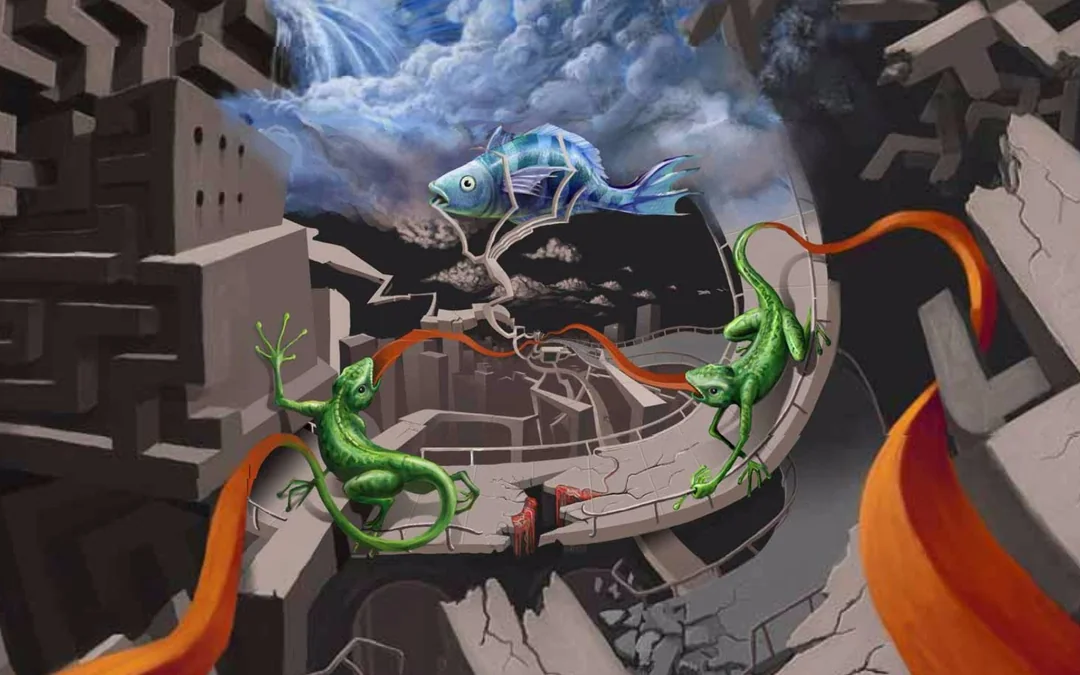
These “useless” sites use code to create mesmerizing, often hypnotic visual experiences that respond to you. For instance, ZoomQuilt: An “infinite zoom” painting.
As you look at it, the image zooms deeper and deeper into a landscape that never ends, seamlessly transitioning between different artists’ styles.
The Niche Archives & Odd Information
Some useless sites are just collections of things that are too specific to have a “purpose” but are fascinating to browse. Cool examples:
- The Museum of Endangered Sounds: A library of dead technology sounds. You can listen to the whir of a 1990s floppy disk drive, a dial-up modem, or the “start-up” sound of an old Windows PC.
- Radiooooo: A musical time machine. You pick a country on a map and a decade (e.g., 1940s Brazil), and it plays the radio hits from that specific time and place.
Troll Sites & Digital Jokes
These sites are designed to confuse, prank, or mildly annoy you. An epic example here would be Hacker Typer: a screen that looks like a high-level government terminal. No matter what keys you hit, it types out perfect, complex “hacker” code.
It’s designed to let you look like a movie hacker in a coffee shop. Parallel to that example, you’ve got the Is It Christmas? website: it says “NO” every day (except one).
Therapeutic & Emotional Outlets

Surprisingly, some useless sites serve an emotional purpose without having a traditional “function.”
- Scream into the Void: A text box where you type out your frustrations or secrets. When you hit “scream,” the text flies away into a dark, animated black hole and disappears.
- The Nicest Place on the Internet: A simple loop of videos of people from all over the world looking into their cameras and giving you a warm, silent hug or a thumbs-up.
If you expected at least something to be serious… Well, this isn’t happening.
The Actual Meaning of the Seemingly Useless Sites
Hot news: Useless Websites are a DIGITAL REBELLION. The whole project is part of a larger modern movement called the “Smol Web.” The Philosophy: it’s a pushback against “The Big Five” (Google, Amazon, Meta, Apple, and Microsoft).
So, in a modern Internet filled with data tracking, advertisements, and “productivity hacks,” these sites are a reminder of a time when the web was just a place for people to make stuff because they could. Now you know more!
