
From Dice to Algorithms: How Game Randomness Has Evolved

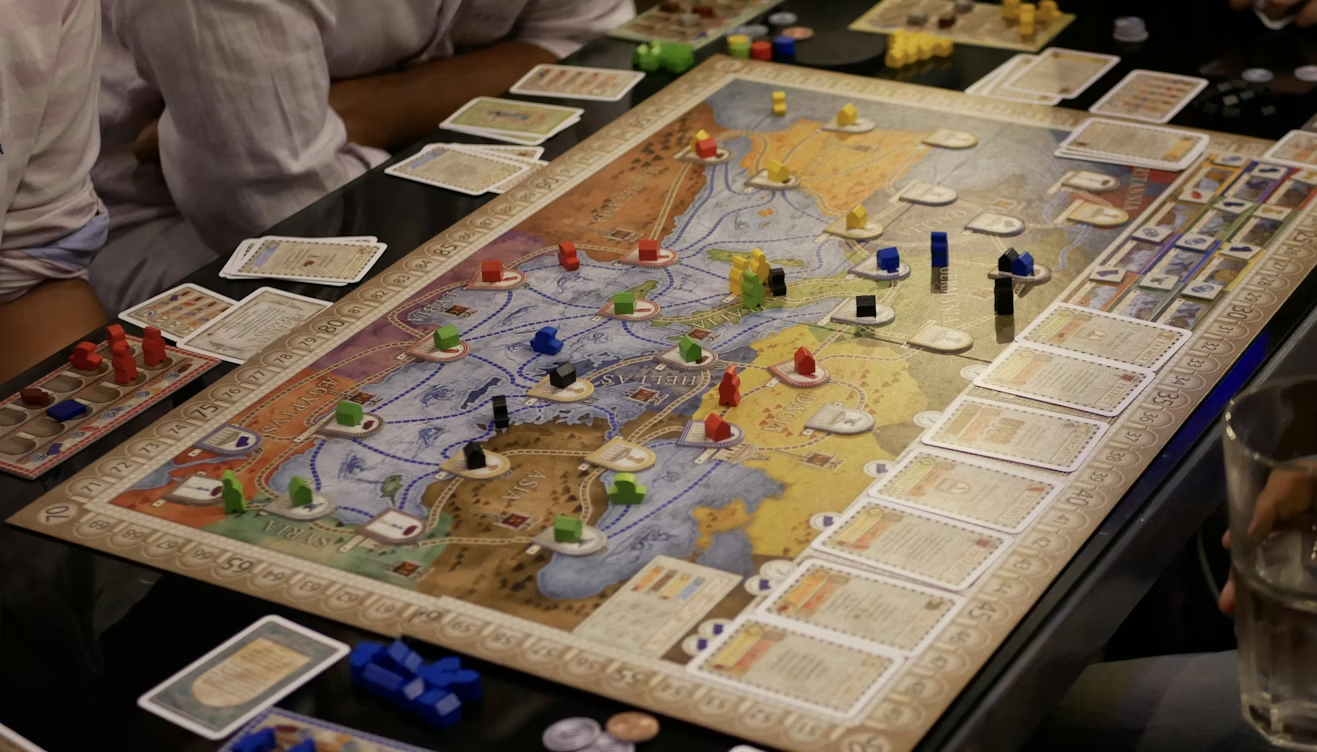
Randomness has always been at the heart of games. It introduces uncertainty, creates tension, and ensures that no two sessions unfold in exactly the same way.
While the methods used to generate randomness have changed significantly over time, the goal has remained consistent: to make games engaging while maintaining a sense of fairness.
Physical randomness in early games
Traditional games relied on physical objects to create chance. Dice rolls, card shuffles, spinners, and tile draws were all simple ways to introduce unpredictability.
These systems were easy to understand and, most importantly, visible. Players could watch a die tumble across the table or see cards being shuffled, which helped build trust in the outcome.
Physical randomness was never perfect. Dice could be weighted, cards could be worn, and human shuffling was rarely truly random. Yet these imperfections rarely mattered
Designers learned to account for them, balancing luck with strategy so that chance enhanced the experience rather than dominating it.
The transition to hybrid systems
As games grew more complex, designers began combining physical components with digital support. Companion apps started handling setup, random events, and hidden information. This allowed for richer experiences without adding rules or components that slowed the game down.
Hybrid systems also gave designers more control. Instead of relying entirely on repeated physical actions, software could introduce variation while avoiding extreme streaks or repetitive outcomes. Randomness became something that could be shaped rather than left entirely to chance.
How algorithmic randomness works?
In digital environments, randomness is usually generated through algorithms known as pseudo-random number generators.
These systems follow mathematical rules to produce sequences that appear unpredictable. While they are not truly random in a physical sense, they are effective enough for gameplay when properly implemented.
What matters most to players is not the technical nature of randomness, but how it feels. Designers use algorithms to manage distribution, ensure balance, and prevent outcomes that feel unfair or broken. Randomness becomes a design tool—used deliberately to support pacing, difficulty, and replayability.
Randomness as a design choice
Modern game design treats randomness with care. Too much unpredictability can make players feel powerless, while too little can make a game feel scripted. Successful games strike a balance, allowing chance to influence outcomes without removing meaningful decision-making.
In cooperative games, randomness often creates shared challenges that require players to adapt together. In strategy games, it introduces risk, forcing players to plan around uncertainty. In both cases, randomness adds depth rather than chaos when used thoughtfully.
Digital examples of structured randomness
In fully digital games, randomness is handled entirely by software. Outcomes are generated instantly, often thousands of times per second, without any physical interaction. These systems are designed to mirror the unpredictability of traditional games while remaining consistent and controlled.
Such mechanics are common in modern chance-based digital games, where structured randomness is used to create variation and replay value, as seen in this example. In these environments, randomness is carefully managed to ensure that outcomes remain unpredictable while still operating within defined parameters.
Trust and player perception
When randomness moves behind the screen, trust becomes less intuitive. Players can no longer see how outcomes are generated, so consistency and transparency become essential. Games that behave in expected ways, even when outcomes are unfavorable, are more likely to be perceived as fair.
Clear rules, predictable distributions, and stable behavior help reinforce that trust. When players understand what randomness can and cannot do within a system, they are more willing to accept uncertainty as part of the experience.
Looking ahead
The future of randomness in games is increasingly adaptive. Advanced systems can adjust variability based on player behavior, creating experiences that remain challenging without becoming frustrating. Procedural generation and AI-assisted balancing continue to push the boundaries of how randomness can be used.
From rolling dice to running algorithms, randomness has evolved alongside game design itself. While the tools have changed, the challenge remains the same: using chance in a way that enhances play, rewards engagement, and keeps games feeling fresh over time.
