
Secret Hitler Board Game Review

Secret Hitler is a 2016 social deduction board game designed by Mike Boxleiter, Tommy Maranges, and Max Temkin, published by Goat Wolf & Cabbage. Set in 1930s Germany, the game divides 5-10 players into Liberals and Fascists who work secretly to enact policies and win the game. Players ages 13 and up navigate 45 minutes of deception, voting, and strategic thinking to determine if they can identify Hitler before it’s too late.
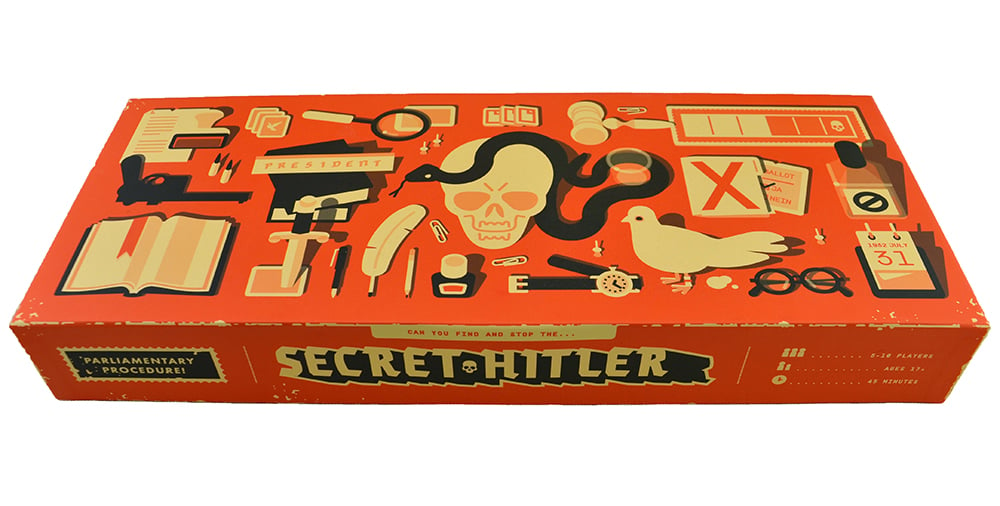
Secret Hitler Overview
Players receive secret roles as Liberals, Fascists, or Hitler. Fascists know each other’s identities and work together to pass fascist policies while protecting Hitler. Liberals remain in the dark about everyone’s loyalties and must enact five liberal policies or eliminate Hitler to win.
The game revolves around electing a President and Chancellor each round who together decide which policy gets enacted. Players vote on government proposals, debate suspicions, and use executive powers to investigate other players.
| Designer | Mike Boxleiter, Tommy Maranges, Max Temkin |
|---|---|
| Publisher | Goat Wolf & Cabbage |
| Year Released | 2016 |
| Players | 5-10 |
| Age Range | 13+ |
| Playing Time | 45 minutes |
| Game Type | Party, Social Deduction, Bluffing, Team-based |
| Complexity Rating | 1.74 / 5 |
What’s in the Secret Hitler Box
Secret Hitler includes two game boards (Liberal and Fascist), secret role cards, party membership cards, and Ja/Nein voting cards for each player. The policy deck contains 6 Liberal and 11 Fascist tiles that players draw throughout the game.
An election tracker token moves along the board when governments fail to form. The instruction booklet explains setup and special powers clearly.
The components use thick cardboard that withstands repeated handling. Boards feature distinct iconography that makes tracking policies and available executive actions easy. The cards are readable and the voting cards flip quickly during dramatic reveal moments.
Secret Hitler Pros and Cons
Pros:
- Players stay engaged through constant voting and discussion between rounds
- Setup takes under 10 minutes once players understand the role distribution
- Each game plays differently based on who receives which roles
- Visual design clearly communicates game state without confusion
- Conversation and accusations drive the entire experience
Cons:
- The 1930s Germany theme makes some players uncomfortable
- Younger players may struggle with the deception and political concepts
- Quiet players can get overshadowed by dominant personalities
- First-time players need extra guidance to understand role distribution
- Games with five players lack the tension of larger groups
How to Play Secret Hitler
Setup
Choose the correct board based on player count. Shuffle the 17 policy tiles and place them face down as a draw pile. Each player receives an envelope containing their secret role card, party membership card, and one Ja card plus one Nein card.
Players close their eyes while Fascists (excluding Hitler in some player counts) open their eyes to identify each other. Hitler keeps their identity hidden from everyone except the Fascists.
Gameplay
Each round begins with nominating a President and Chancellor. The current President nominates a Chancellor, then all players vote simultaneously using their Ja or Nein cards. If the majority votes Ja, the government forms and moves to the legislative session.
The President draws three policy tiles from the deck, discards one face down, and passes the remaining two to the Chancellor. The Chancellor discards one and enacts the other by placing it on the appropriate board track.
Executive Actions
Enacting fascist policies unlocks executive powers for the President. These include investigating a player’s party membership, calling a special election to choose the next President, peeking at the top three policy tiles, or executing a player to remove them from the game.
Players must decide when to trust claimed investigations and whether executed players were truly suspicious. Similar to Werewolf, information from eliminated players becomes critical for deduction.
Win Conditions
Liberals win by enacting five liberal policies or by executing Hitler. Fascists win by enacting six fascist policies or by electing Hitler as Chancellor after three fascist policies have been passed.
Where to Buy Secret Hitler
| Platform | Price |
|---|---|
| Amazon | $50 |
| Philibert | $50 |
| Zatu Games | $50 |
| eBay | Varies |
Secret Hitler Game Mechanics
Secret Hitler uses hidden role assignment as its foundation. Fascists gain information advantage while Liberals rely on voting patterns and behavior analysis to identify opponents.
The policy deck creates tension through its 11 fascist to 6 liberal ratio. Presidents and Chancellors can claim they received only fascist policies, creating plausible deniability for actual Fascists while making Liberals look suspicious.
Voting mechanics force players to take public stances on government proposals. Voting patterns reveal information about loyalties over multiple rounds. The election tracker advances when three governments fail consecutively, automatically enacting the top policy as chaos spreads.
Executive actions shift power dynamics mid-game. Investigation lets Presidents learn one player’s party membership privately. Special elections allow trusted players to bypass the normal turn order. Execution permanently removes players but risks eliminating Liberals.
Who Should Play Secret Hitler
Secret Hitler works best for players who enjoy reading other people and building arguments based on incomplete information. Groups of 6-8 players create the ideal balance between information and chaos.
The game suits fans of One Night Ultimate Werewolf and Coup who want longer deduction experiences. Unlike those faster games, Secret Hitler develops arguments over multiple rounds as players track voting histories.
Players uncomfortable with the World War II theme should skip this game regardless of mechanical quality. Groups with very quiet players may find louder personalities dominate discussion and voting.
The game shines at parties where players know each other well enough to read behavior changes. Strangers can still play effectively but miss the tells that come from familiarity.
FAQ
Is Secret Hitler good for beginners?
Secret Hitler works for beginners with guidance on the rules and bluffing concepts. Start with 5-6 players to simplify deduction, then add players as the group gains experience. The first game usually involves teaching moments about policy distribution and executive action timing.
How long does Secret Hitler take to play?
Most games finish in 45 minutes including discussion time. Setup requires about 10 minutes for experienced groups. First-time players should expect 60-75 minutes total as they learn role distribution and ask rules questions during play.
What’s the best player count for Secret Hitler?
Seven or eight players creates the most balanced experience. Six players works well for learning the game. Five players makes deduction too easy while nine or ten players creates too much chaos for meaningful voting pattern analysis.
Is Secret Hitler worth buying?
Groups that enjoy social deduction and strategic bluffing will replay Secret Hitler frequently. The hidden roles and policy distribution vary enough to prevent solved strategies. Skip this if your group prefers cooperative experiences or dislikes confrontational gameplay like The Resistance: Avalon.
What games are similar to Secret Hitler?
The Resistance: Avalon and One Night Ultimate Werewolf share hidden role mechanics and deduction elements. Secret Hitler adds policy drafting and executive powers that those games lack. Coup offers similar bluffing but focuses on individual survival rather than team coordination.
