Why Cooperative Card Games Gave Up on Booster Packs?

Cooperative card games ask something unusual of a group. Everyone needs to understand roughly the same pool of cards, because the plan only works if the person to your left can predict what you are able to do.
That is a straightforward expectation around a kitchen table where one person owns the box. It becomes a great deal harder when the cards arrive in sealed randomised packets and every player owns a different subset of the game.
The tabletop hobby has effectively run both experiments over the past two decades, and the co-op side has landed firmly on one answer.
Why Boosters and Co-op Pull in Opposite Directions
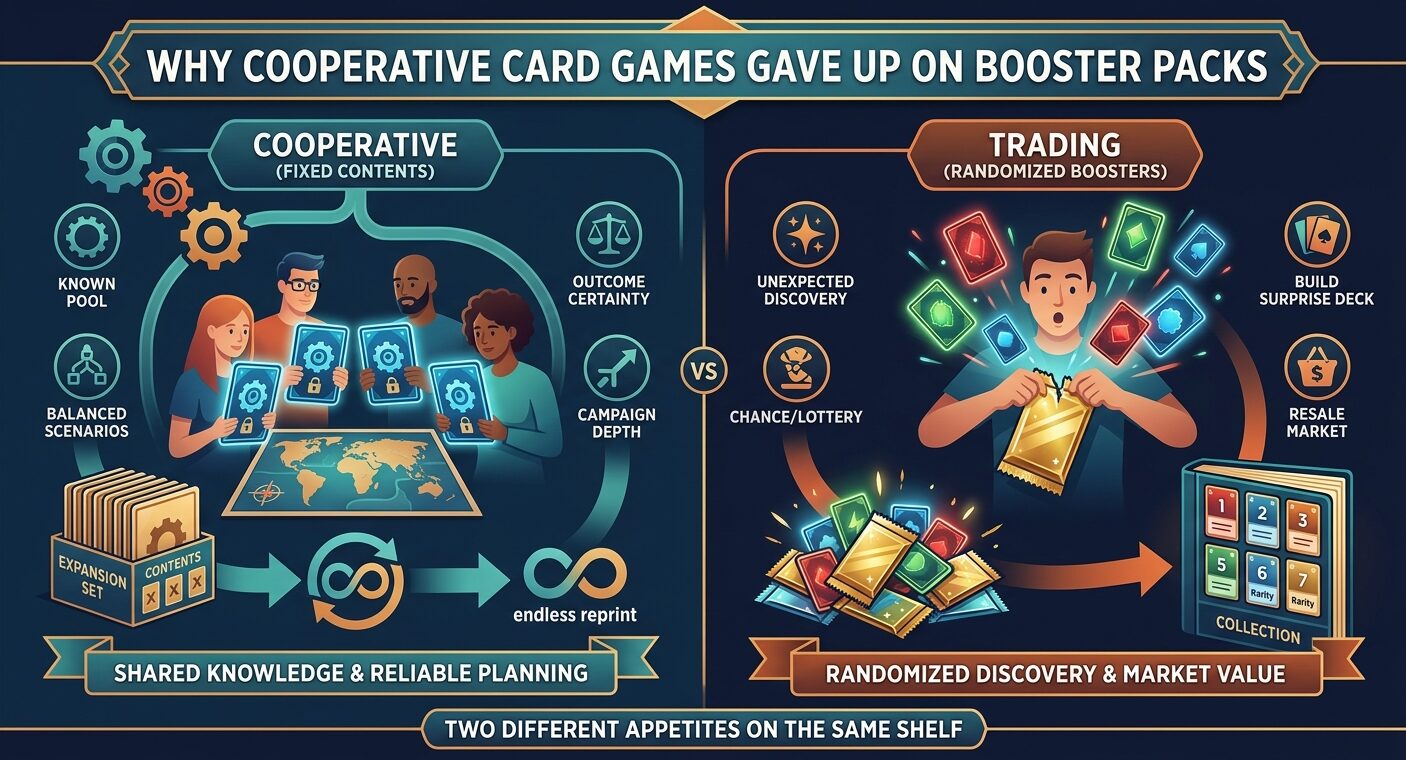
A trading card game is designed around asymmetry. You build something your opponent has not seen, and the surprise is a large part of the appeal.
Cooperative play inverts that completely. Hidden capability is a liability when four people are trying to sequence actions against a scenario that punishes hesitation, so the design wants a known, shared pool.
There is also the practical problem of the missing card. If the group’s plan needs a specific effect and nobody opened it, the randomised model has quietly decided your evening for you.
What the Randomised Model Actually Costs?
None of that makes the booster model bad, and it is worth being precise about what it involves rather than waving at it. Working that out means having sales data, which is why price databases have become such a fixture of collecting.
CardTrack is one of the larger independent examples, cataloguing 103,401 cards across five games, with 20,704 Pokemon cards, 30,181 Magic cards, 46,546 Yu-Gi-Oh cards, 3,188 Lorcana cards and 2,782 One Piece cards. Valuations are built from more than 1.6 million cert verified sales, drawn from completed listings and auction results rather than asking prices.
Each price carries a confidence level, and the site will say outright when there is insufficient data instead of inventing a number, which is a more honest posture than the category usually manages. Around that sit the tools collectors actually use, including a set completion cost calculator, a grading return estimator, a centering checker, a trade evaluator and a fee calculator for working out what a sale nets after the platform takes its share.
It is an independent project rather than anything run by a publisher. For anyone weighing the two distribution models against each other, that kind of record is the only way to answer the cost question with something better than a guess.
The Fixed Distribution Answer
The cooperative side went in the opposite direction, and the vocabulary followed. Fantasy Flight built its cooperative card game line around fixed contents, where an expansion contains exactly what the box says and everyone who buys it owns the same cards.
The design benefits are obvious once you have played a campaign. Scenarios can be balanced against a known pool, difficulty can escalate across a campaign with confidence, and the group can plan between sessions without anyone auditing their collection first.
The trade is that discovery disappears. You do not get the moment of opening something unexpected, which is a genuine loss for a certain kind of player.
There is also a distribution advantage that rarely gets mentioned. A fixed expansion can be reprinted indefinitely, so a campaign released years ago remains buyable at something close to its original price.
Two Different Hobbies on the Same Shelf
Plenty of households own both, which is the part that gets overlooked. A shelf of campaign boxes and a binder of graded singles sit next to each other quite happily, because they are answering different appetites.
The campaign boxes are bought for the evening they produce. The binder is bought for the object itself, and its value is set by a market rather than by a designer.
Confusing the two is where people run into trouble. A cooperative expansion is a fixed price for a known experience, while a booster is a lottery ticket with a resale value attached, and the second only makes sense if you actually enjoy that second thing.
Picking Something for the Table
If the goal is simply a good night with three other people, the fixed model wins on almost every practical measure. The cooperative rankings here are dominated by games where everything you need arrives in the box, and that is not a coincidence.
Deck builders sit in an interesting middle position, since the cards are fixed, but the deck you assemble during play is not. You get some of the surprise without any of the collecting.
The Short Version
Cooperative card games abandoned randomised distribution because it worked against everything the format is trying to do. Shared knowledge is the point, and boosters make shared knowledge expensive.
The trading card model is not worse, it is simply aimed elsewhere, and the tools that have grown up around it exist because the costs are real and worth measuring. Knowing which hobby you are buying into is most of the decision.
