
Deck Building vs Bag Building: Why the Same Draw Math Feels Completely Different

Pick up a hand in Dominion and you can almost feel the shape of your next few turns. Reach into your bag in Orléans, and even when you know exactly what’s inside, the outcome still lands like a small surprise.
Both mechanisms ask you to improve a personal pool and then draw from it at random. Yet the experience of uncertainty is noticeably different. That gap is the interesting question, and understanding it says a lot about how tabletop design shapes perception.
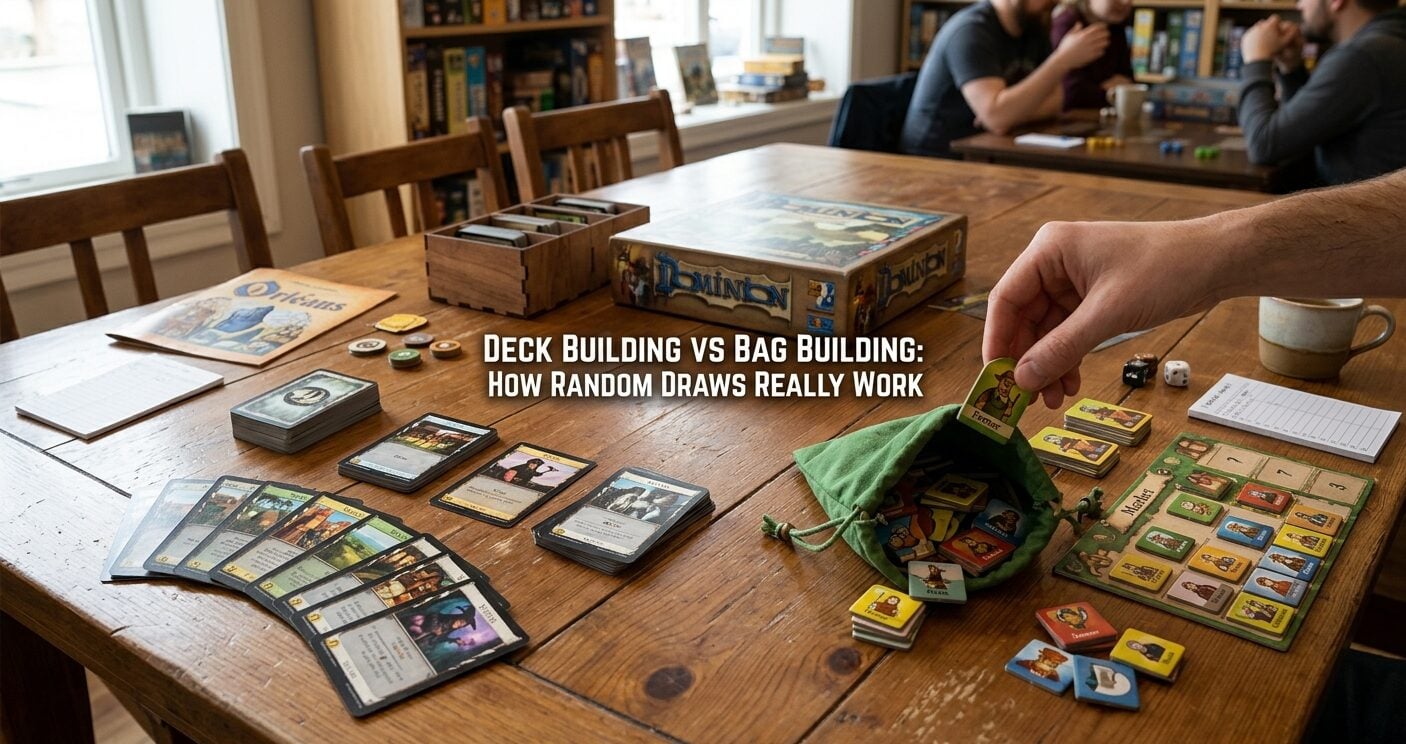
The Same Basic Idea, Two Very Different Experiences
At the mechanical level, deck and bag builders are cousins. BoardGameGeek groups them together under the broader Deck, Bag, and Pool Building mechanism precisely because each system lets players reshape the pool that will generate their future options.
The shared logic looks like this:
- Start with a modest pool of components.
- Add, remove, or upgrade pieces over the course of the game.
- Draw a subset of that pool when it’s time to act.
- Repeat, with a pool that keeps changing based on your choices.
Whether those components are cards on a table or wooden tokens in a fabric sack, the underlying question stays the same: what belongs in the pool, and what should be pulled out of it?
Every Draw Changes the Next One
The mathematical spine of both mechanisms is sampling without replacement. When you draw a component and set it aside, the composition of what’s left shifts, and so do the probabilities for the next draw.
A quick example. Suppose your bag holds 10 tokens, and 2 of them are red:
- First draw: 2-in-10 chance of red.
- If red comes out: the next draw sits at 1-in-9.
- If red does not come out: the next draw becomes 2-in-9.
Every single draw nudges the odds around.
This kind of shifting distribution is not unique to tabletop games. Probability information is used to describe chance-based digital games too: sites like casinocanada.com publish RTP and probability figures for online games, while at the table you can usually inspect the pool yourself and recalculate on the fly. The mathematical family is similar. The transparency is not.
In academic terms, this is exactly the setup covered by the hypergeometric distribution, which Penn State’s STAT 414 material introduces specifically for random selection without replacement. That is a lot of vocabulary for a small idea: what you already drew changes what is likely to come next.
Why Decks Feel Easier to Read?
Cards give you information almost by accident. As a hand plays out, your discard pile grows, the draw pile shrinks, and a reshuffle is always somewhere on the horizon.
None of that removes randomness. What it does is provide information about a random system.
Experienced Dominion players often keep a loose mental accounting of:
- what has been played this shuffle,
- what still sits in the deck,
- how many cards remain before a reshuffle,
- what the next hand is likely to contain.
Dominion makes the cycle unusually visible: players begin with small decks and construct them during play by acquiring cards that will appear in later hands. You watch your engine assemble itself one draw at a time.
The randomness never disappears in a deck builder. It becomes something you can plan around.
Why Bags Feel Less Predictable?
A bag can hold perfectly knowable contents and still feel opaque. That is the strange trick of the mechanism, and it is where a lot of the emotional difference lives.
There is a distinction worth keeping in mind:
- Unknown composition means you do not know what is in the pool.
- Unknown next draw means you know the pool but not the order.
Bag builders usually give you the second, not the first. You may know your bag holds exactly four blue tokens, three red, and two yellow. What you do not get is any tactile cue about which one your fingers will find.
The official Orléans rules describe the process directly: players draw character tiles from their Followers Bag onto their Market during their turn.
The changing contents of that bag are part of your strategic state, but the order of the draws stays hidden until your hand comes out.
Dominion vs Orléans: A Simple Mechanical Comparison
The two games share a family resemblance but implement pool building in very different physical languages:
| Feature | Dominion | Orléans |
| Random object | Cards | Character tiles |
| Player modifies pool | Yes | Yes |
| Drawn components visible | Yes | Yes |
| Undrawn order visible | No | No |
| Cycle structure | Draw, discard, reshuffle | Bag draw, place, return per rules |
| Main strategic question | What should enter or leave the deck? | What should enter the bag to shape future draws? |
Neither system is objectively richer than the other. What differs is where the information lives. Dominion externalizes the cycle in visible piles that a careful player can read. Orléans keeps the sequence inside the bag, so planning happens at the level of ratios and composition rather than order.
When Adding Something Good Makes Your Draws Worse?
Here is the counterintuitive part of pool building. A stronger pool and a more consistent pool are not the same thing.
Imagine your pool has eight components, two of which are critical to your strategy. Add a generally useful ninth, and yes, your overall capability goes up. But the probability of hitting one of those two critical components on any given draw just went down. You have diluted the good stuff.
Seasoned builders often think about the pool in three dimensions rather than one:
- Acquisition. Which new components strengthen the mix?
- Removal. Which weak components are dragging the average down?
- Concentration. How many copies of a key piece are worth holding?
This is why trashing cards in Dominion or refusing to bloat your Orléans bag with unnecessary tokens can be as valuable as the flashy acquisitions. Quality of the pool is not just the sum of its parts. It is a ratio.
Why Fair Randomness Can Still Feel Unfair?
Probability does not owe anyone a satisfying story arc. Small samples produce streaks, and streaks stick in memory far longer than the runs where nothing surprising happened.
A few things are usually going on when a mechanically fair game feels rigged:
- The sample size of any single turn is tiny.
- Bad draws are memorable; average draws are forgettable.
- Knowing an outcome was possible does not make it feel acceptable.
- Players tend to compare their draws to the pool’s average, not to its variance.
Good tabletop design accounts for this. Redraws, mitigation actions, wild components, larger hands, and ways to remove weak pieces all soften the sharp edges of variance without pretending randomness isn’t there.
The math stays the same. The experience becomes more tolerable.
Which System Gives Players More Control?
Neither mechanism is inherently more strategic. They just reward different kinds of attention.
| Type of system | What it rewards |
| Deck building | Cycle management: timing, sequencing, hand composition, knowing when to thin the deck. |
| Bag building | Composition management: ratios, adding and removing at the right moment, playing well with combinations that arrive out of order. |
Both still belong to the same broader family of pool-building mechanics, so the difference is one of implementation rather than of design philosophy. What changes is which lever the player has the clearest grip on.
Randomness Is Something Players Build
The deeper point of both mechanisms is that players are not waiting for luck. They are editing the population from which future random results will be drawn.
Every acquisition and every removal is a small edit to the probability distribution of your next turn. Decks make that editing visible through recognizable cycles. Bags hide the order but ask you to think in ratios.
The math is close cousins. The felt experience diverges because tabletop design is about information as much as it is about probability.
That is why the same underlying draw system can produce two very different games at your table, and why the choice between a deck and a bag is really a choice about what you would like the player to see.
